
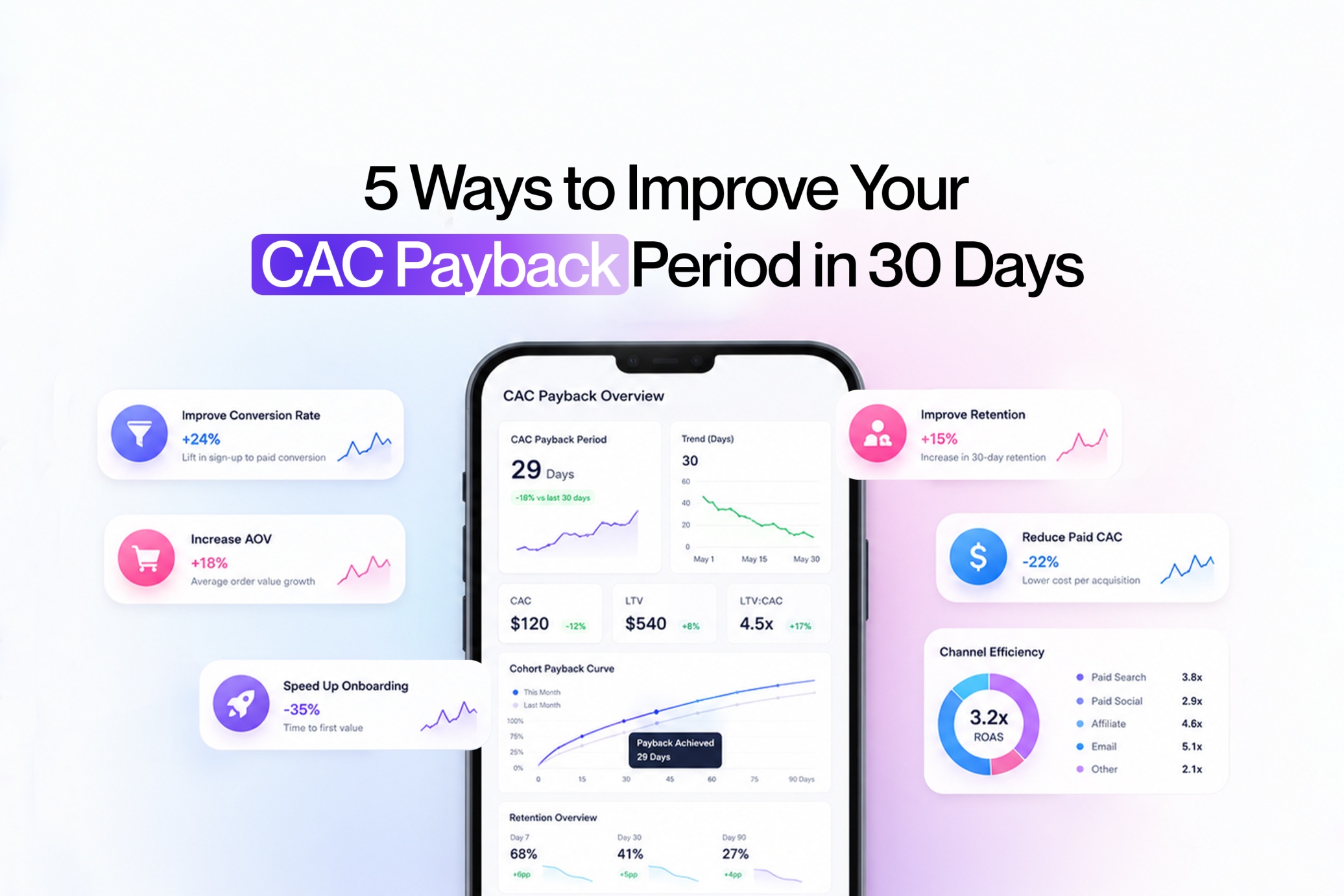
Customer Acquisition Cost is one of the first numbers most eCommerce teams look at when they review growth performance. It tells you how much you are spending to acquire a customer, and on the surface, that sounds like enough.
But CAC alone does not tell the full story.
The more important question is this: how quickly are you getting that acquisition cost back?
That is where your CAC payback period becomes a much more useful metric. It helps you understand whether your growth is actually becoming profitable or simply creating revenue that takes too long to recover.
Let’s say your brand is spending heavily on Meta Ads or Google Ads. Your campaigns may be bringing in orders. Your Shopify dashboard may show revenue growth. Your ROAS may also look decent. But if your margins are weak, discounts are high, or customers are not coming back for repeat purchases, your business may still be waiting too long to recover the money spent on acquiring those customers.
This is why the CAC payback period matters for eCommerce brands. It connects marketing spend, conversion rate, product margin, customer behaviour, retention, and profitability in one practical view.
And the good part is that improving CAC payback does not always mean cutting ad spend or making drastic changes. In many cases, you can start improving the inputs that affect your payback period within 30 days. You can improve conversion, increase revenue per customer, reduce wasted spend, strengthen retention, and get better visibility into what is really affecting profitability.
Let’s break it down in a simple and practical way.
CAC payback period tells you how long it takes to recover the money you spent to acquire a customer
In simple terms, it answers one important business question:
How long does it take before a new customer starts becoming profitable?
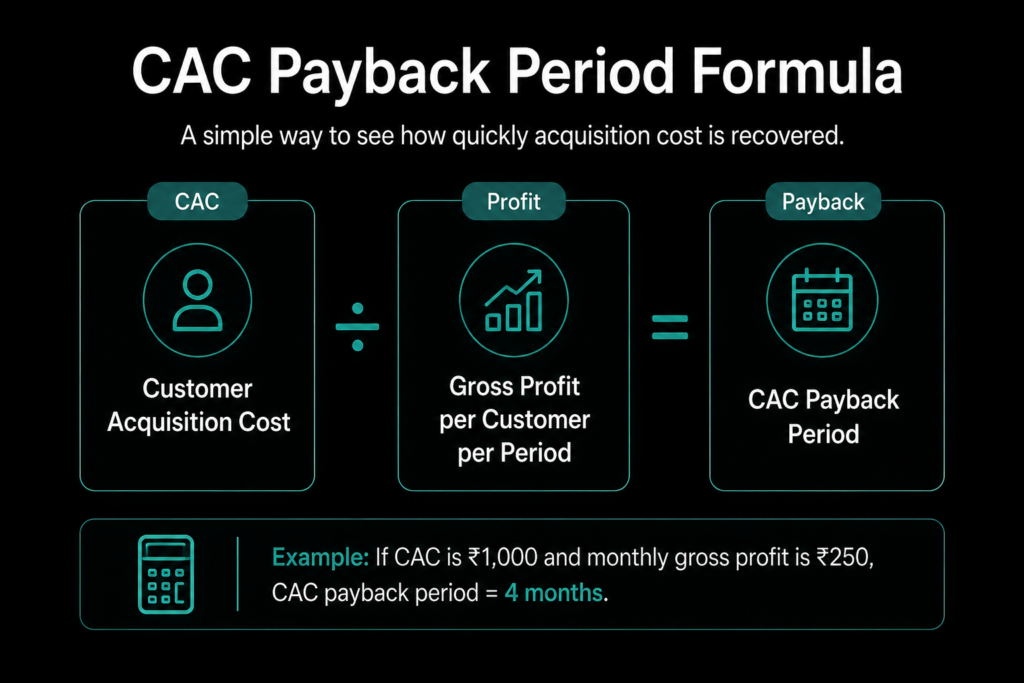
The basic payback period calculation is:
CAC Payback Period = Customer Acquisition Cost ÷ Gross Profit per Customer per Period
For example, if your Customer Acquisition Cost is ₹1,000 and the customer generates ₹250 in gross profit per month, your CAC payback period is 4 months.
This means your business needs around 4 months to recover the cost of acquiring that customer.
For eCommerce brands, the calculation may vary depending on how profit is measured. Some brands calculate CAC payback based on first-order gross profit. Some use contribution margin after discounts, shipping, returns, payment charges, and fulfilment costs. Others include repeat purchase revenue because they know the customer may become profitable only after the second or third order.
There is no problem with using a method that fits your business. The important thing is to stay consistent. Once you choose how you calculate CAC payback period, track it regularly and compare it across campaigns, products, channels, and customer segments.
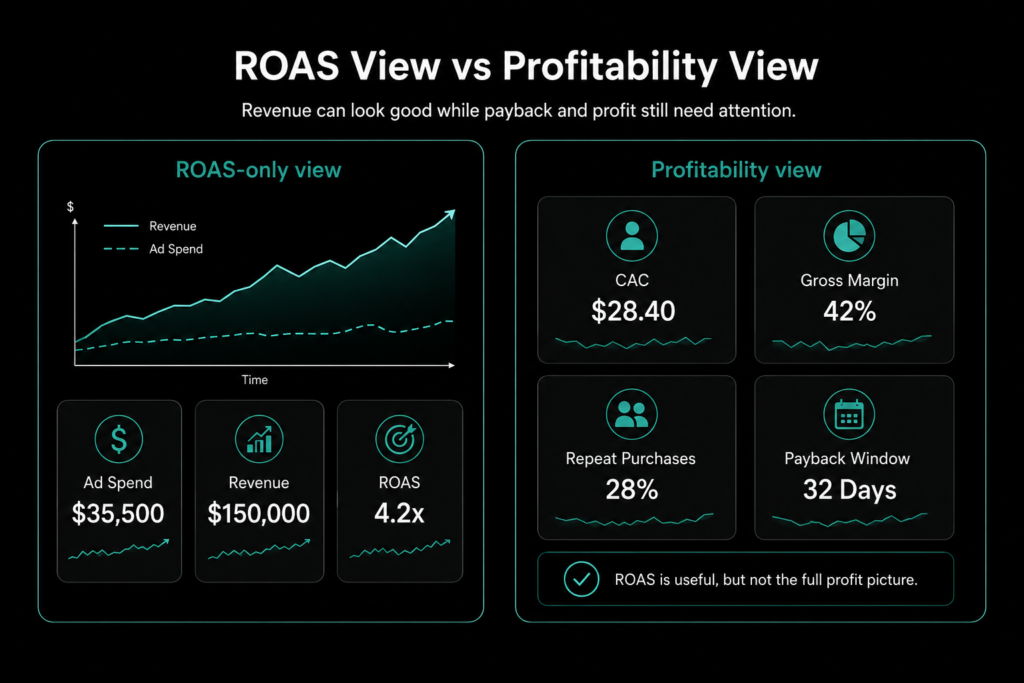
Many eCommerce teams still depend heavily on ROAS to understand marketing performance. ROAS is useful, but it can also be misleading if you look at it alone.
A campaign can show good ROAS and still create poor profitability.
For example, imagine a product campaign generating 4x ROAS. At first glance, that looks strong. But once you include product cost, shipping, discounts, returns, payment fees, and marketing spend, the actual profit may be much lower than expected. If customers do not come back for a second purchase, the brand may take longer to recover its acquisition cost.
This is why the CAC payback period gives a clearer picture. It helps you understand whether your acquisition strategy is supporting profitable growth or only increasing revenue.
CAC payback period also brings different parts of the business together. It is not only a marketing metric. It is connected to your pricing, product margin, average order value, repeat purchase rate, revenue per customer, and LTV:CAC ratio.
If your CAC is high but your customers repeat quickly, your payback period may still be manageable. If your CAC is moderate but your margins are weak and customers rarely return, your payback period may become a problem.
This is also why it is important to understand the difference between revenue and profit. You can explore this further in this blog on profitable revenue vs ROAS.
Want to see what is really affecting your CAC, revenue, and profitability?
A lot of founders search for a CAC payback period benchmark because they want to know whether their number is good, bad, or average.
That is understandable. Benchmarks are helpful because they give you a reference point. But with CAC payback, there is no single number that works for every eCommerce brand.
SaaS benchmark discussions from companies and investors such as Bessemer and a16z are often useful for understanding how CAC, LTV, payback, and growth efficiency work together. They are especially relevant when people talk about how to improve the payback period SaaS businesses track. But an eCommerce brand should not copy SaaS benchmarks directly.
eCommerce has different buying behaviour, margins, return cycles, discounting patterns, inventory movement, and repeat purchase timelines.
For example, a skincare or wellness brand may accept a longer CAC payback period because customers may reorder every 30, 45, or 60 days. A saree, jewellery, or fashion brand may need a different view because repeat purchases may happen less frequently or around specific seasons. A low-margin product category may require a tighter payback window than a high-margin category.
So instead of asking, “What is the perfect CAC payback period benchmark?”, a better question is:
What is a healthy CAC payback period for our product category, margin, AOV, repeat purchase cycle, and retention behaviour?
Your benchmark should be built from your own business data. Compare payback across paid CAC and blended CAC. Look at which products recover acquisition costs faster. Check whether first-time buyers from Meta Ads behave differently from customers acquired through Google Ads, email, WhatsApp, referrals, or organic search.
You can also read this blog on CAC vs LTV for D2C brand profitability to better understand how Customer Acquisition Cost and lifetime value work together.
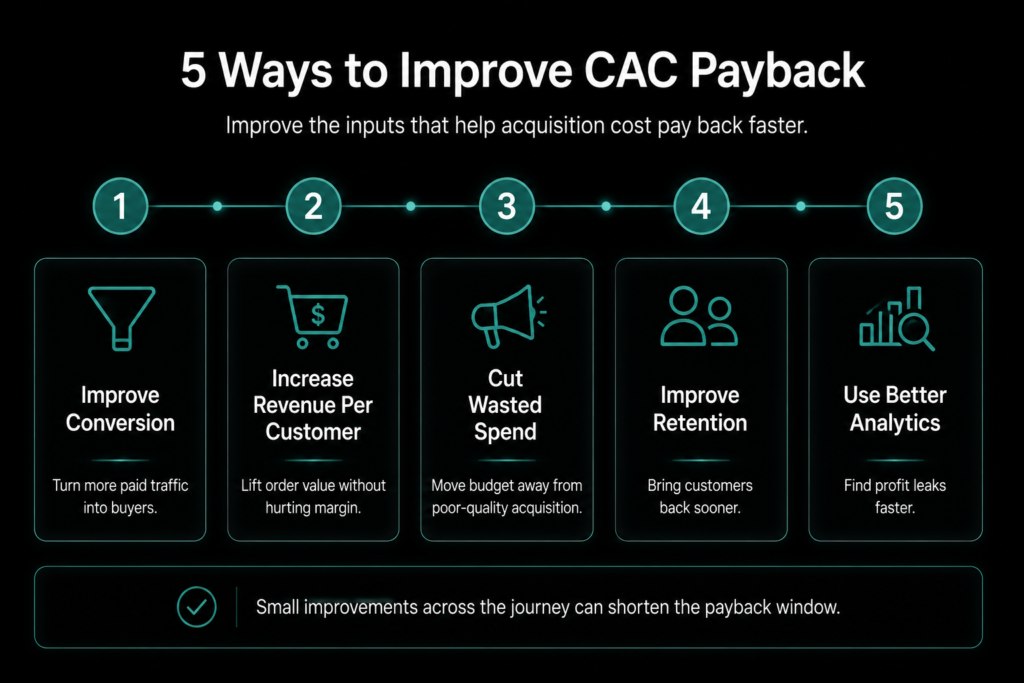
Improving your CAC payback period in 30 days does not mean every issue will be solved immediately. But it does mean you can start improving the key areas that influence payback.
Instead of only asking how to reduce customer acquisition cost, look at the full journey. Ask where money is being lost after the click, after the first order, and after the first customer interaction.
Here are five practical ways to start.
If you are already paying for traffic, then your product pages and landing pages have to convert better.
This is one of the quickest ways to optimize CAC because you do not increase your ad spend; you simply make your traffic more effective.
For example, if your Meta Ads campaign is driving 10,000 visits to your product page, and only some of them convert, your CAC remains high. However, when you improve the product page and manage to convert more visitors, the CAC becomes more efficient from the same budget.
That is why conversion rate optimization has a lot to do with CAC payback period.
Firstly, examine the pages that have the most traffic. Do they describe the product? Do they convey its value and uniqueness? Is their imagery effective? Is their price evident? Is the delivery information available? Are the reviews visible? Is the call-to-action clear? Is it mobile-friendly?
Often enough, the CAC seems to be high because the campaign is being blamed early. The real reason might be the page itself, the offer, the checkout process, or the lack of trust factors.
For instance, a visitor clicks an ad for a premium product, but on the page he/she
One practical way for reducing the payback period of CAC is increasing the revenue per customer.
Assuming that CAC remains unchanged, the revenue per customer should increase so that the payback period becomes shorter. This does not imply that the company should push any random product or make the customer spend money unnecessarily. Rather, the aim here is to make customers purchase more relevant products during the same journey. For instance, when a customer purchases a face cleanser, a skincare brand should recommend a moisturiser or a sunscreen to complete his routine. In case the customer purchases a saree, the brand should recommend a blouse piece, jewellery or a styling accessory. If the customer is buying a gadget, the brand should recommend a warranty, a cable, a case, or a bundle.
That is all very simple. By giving the customer something valuable, the company will increase revenue per customer.
All of this can be done via bundling, upselling, cross-selling, free shipping minimums, post-purchase offers, and relevant product recommendations. However, what is essential here is margin. An increase in the average order value will positively affect CAC payback period only if the additional revenue makes a substantial part of profits.
When brands ask how to reduce customer acquisition cost, the first thought is usually to reduce ad spend.
But cutting spending blindly can hurt growth.
A better approach is customer acquisition cost optimization. This means understanding which campaigns, channels, products, and customer segments are helping the business recover CAC faster and which ones are slowing payback down.
For example, one campaign may have a higher CAC but bring repeat buyers who return within 30 days. Another campaign may show lower CAC but bring discount-driven customers who never purchase again. If you only look at first-order CAC, the second campaign may look better. But if you look at the CAC payback period, the first campaign may actually be healthier.
This is why you need to compare campaign quality, not just campaign cost.
Look at campaigns that bring traffic but weak conversion. Look at campaigns that sell low-margin products. Look at campaigns that depend heavily on discounts. Look at campaigns that bring new customers but poor repeat purchase behaviour. These are the places where your ad spend may be creating revenue, but not fast payback.
It is also useful to compare paid CAC and blended CAC.
Paid CAC shows what it costs to acquire customers through paid marketing channels. Blended CAC shows total acquisition cost across all customers and channels. Paid CAC helps you judge campaign efficiency. Blended CAC helps you understand overall acquisition health.
For eCommerce brands using Meta Ads, Google Ads, email, WhatsApp, organic content, influencer campaigns, and referrals, both numbers matter.
The goal is not always to spend less. The goal is to move spend toward campaigns that bring better customers, better margins, and faster payback.
CAC payback does not end when the first order is placed.
In many eCommerce businesses, the first order may not fully recover the acquisition cost. The brand becomes profitable only when the customer buys again.
This is why retention has a direct impact on CAC payback period.
If customers return quickly, your acquisition cost gets recovered faster. If they do not return, your marketing team has to keep spending more to bring in new customers every month.
Think about a wellness, skincare, food, or personal care brand. If customers reorder within 30 to 60 days, the brand may recover CAC faster even if first-order profit is not very high. But if the post-purchase journey is weak and customers forget about the brand, the payback period becomes longer.
This is where email marketing, WhatsApp marketing, product education, replenishment reminders, win-back campaigns, and onboarding optimization become important.
After a customer places the first order, the brand should not go silent. The customer should receive useful communication that helps them understand the product, use it better, discover related products, and come back at the right time.
For example:
If a customer buys a skincare product, the brand can educate them on how to use it, when to expect results, what product pairs well with it, and when to restock. If a customer buys fashion or jewellery, the brand can share styling ideas, care tips, new arrivals, or occasion-based recommendations.
Retention is not only about sending offers. It is about building a better customer journey after the first purchase.
When repeat purchase journeys improve, CAC payback period can improve too because each customer contributes more revenue over time.
You can read more about customer drop-off and repeat purchase behaviour in this blog on eCommerce churn rate benchmarks.
Most eCommerce teams already have data. The problem is that the data is scattered.
Meta Ads shows one part of the story. Google Ads shows another. Shopify shows revenue and orders. Email and WhatsApp tools show retention performance. Inventory tools show stock movement. Finance data shows margin and cost later.
The real issue is not the lack of dashboards. It is the lack of connected decision-making.
When data is scattered, teams spend more time checking reports than taking action. By the time they understand why CAC increased or why payback slowed down, the problem may have already affected revenue and profit.
To improve CAC payback period, you need to answer deeper questions quickly.
Which product is bringing revenue but a weak margin?
Which campaign is increasing CAC?
Which customer cohort is paying back faster?
Which channel brings better repeat buyers?
Which products are getting ad spend but going out of stock?
Which offers improve conversion but reduce profitability?
Which weeks show a drop in marketing efficiency ratio?
These questions cannot be answered properly by looking at ad dashboards alone.
CAC payback is affected by marketing, product, margin, customer behaviour, inventory, and retention. That is why eCommerce teams need a connected analytics layer that brings these signals together.
This is where eCommerce decision intelligence becomes useful. It helps teams move from simply viewing reports to making better decisions.
If your team spends too much time switching between dashboards, you may also find this blog on decision fatigue caused by bad analytics useful.
For founders who want a simpler weekly view, this guide on weekly eCommerce metrics can also help.
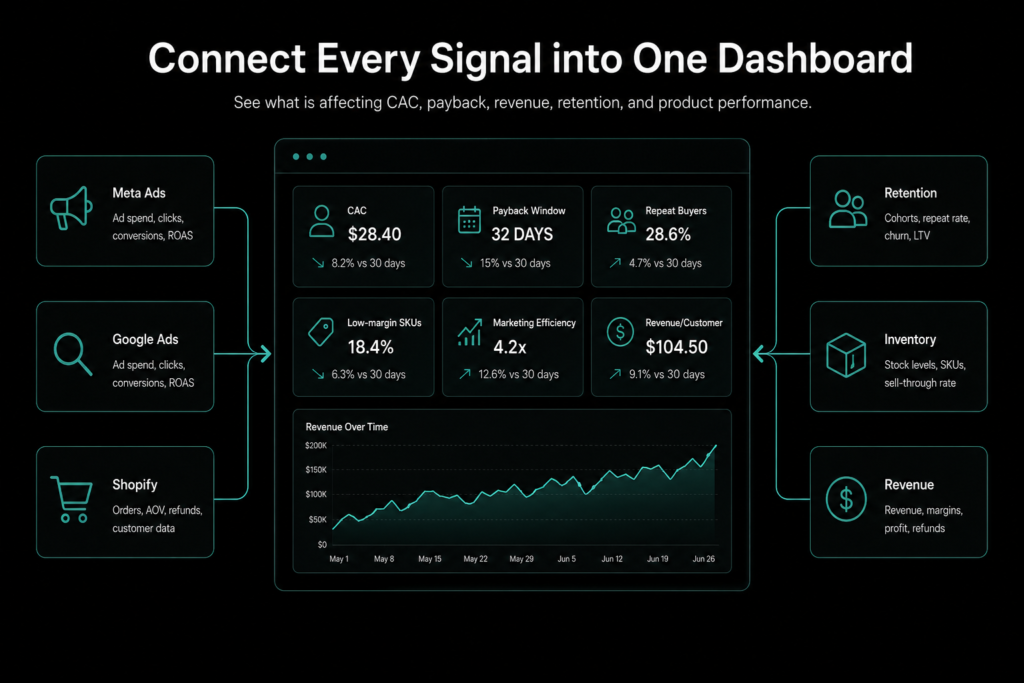
Find what is delaying your CAC payback period and connect your key eCommerce signals in one place.
Netsights.ai helps eCommerce teams understand what is really affecting CAC, revenue, retention, product performance, and profitability.
Instead of checking marketing data in one place, Shopify data in another, customer behaviour somewhere else, and retention performance separately, teams can bring important signals into one decision-ready view.
This matters because CAC payback problems rarely come from only one place.
Sometimes CAC is rising because paid campaigns are becoming expensive. Sometimes the issue is weak product page conversion. Sometimes a campaign is pushing a low-margin product. Sometimes customers are buying once and not coming back. Sometimes ad spend increases just when a key product goes out of stock. Sometimes ROAS looks fine, but contribution margin is weak.
Without connected visibility, these issues are easy to miss.
iSight eCommerce analytics helps teams view Shopify insights, store performance, product performance, customer behaviour, and revenue trends in one place.
Netification KPI alerts help teams get notified when important metrics change. If CAC rises, revenue drops, repeat purchases slow down, or product performance shifts, the team can respond faster instead of waiting for the next manual report.
Netty AI eCommerce assistant helps teams ask questions about CAC, ROAS, repeat buyers, churn, revenue, and profitability without manually checking multiple dashboards.
This is useful for founders, marketing teams, and growth teams because improving CAC payback is not only about tracking one metric. It is about understanding what is causing the metric to move.
Netsights.ai helps teams find those signals faster, so they can make clearer growth decisions.
Improving your CAC payback period in 30 days does not mean every acquisition problem will be solved immediately.
But it does mean your team can start making better decisions within 30 days.
You can improve high-traffic pages so more paid visitors turn into buyers. You can increase revenue per customer in a way that protects margin. You can move the budget away from low-quality campaigns and toward customers who pay back faster. You can improve repeat purchase journeys so customers return sooner. You can use better analytics to find where profit is leaking before the problem becomes bigger.
Most importantly, you can stop treating CAC as an isolated marketing metric.
CAC payback period is a business health metric. It shows whether your growth engine is creating profitable customers or simply bringing in revenue that takes too long to recover.
When your team can clearly see what is increasing Customer Acquisition Cost, what is delaying profitability, and which products, campaigns, and customer segments are worth scaling, growth becomes easier to manage.
If you want to understand what is really affecting your CAC payback period, start your free trial and explore how Netsights.ai helps eCommerce teams make clearer, faster, and more profitable decisions.
Stop guessing what is increasing CAC. Start making clearer, faster, and more profitable growth decisions.
A: CAC payback period is the time it takes to recover the cost of acquiring a customer from the profit that customer generates.
A: Use this formula: Customer Acquisition Cost ÷ Gross Profit per Customer per Period.
A: There is no single benchmark. It depends on your margin, AOV, category, retention rate, and repeat purchase cycle.
A: Brands can reduce CAC by improving conversion rates, reducing wasted ad spend, improving targeting, and increasing repeat purchases
A: Paid CAC measures acquisition cost from paid marketing channels. Blended CAC measures total acquisition cost across all customers and channels.
A: Retention improves CAC payback because repeat purchases help recover acquisition cost faster.
We write about growth, retention, and the numbers that actually predict what happens next for D2C brands. Have a topic you'd like us to cover? Get in touch .
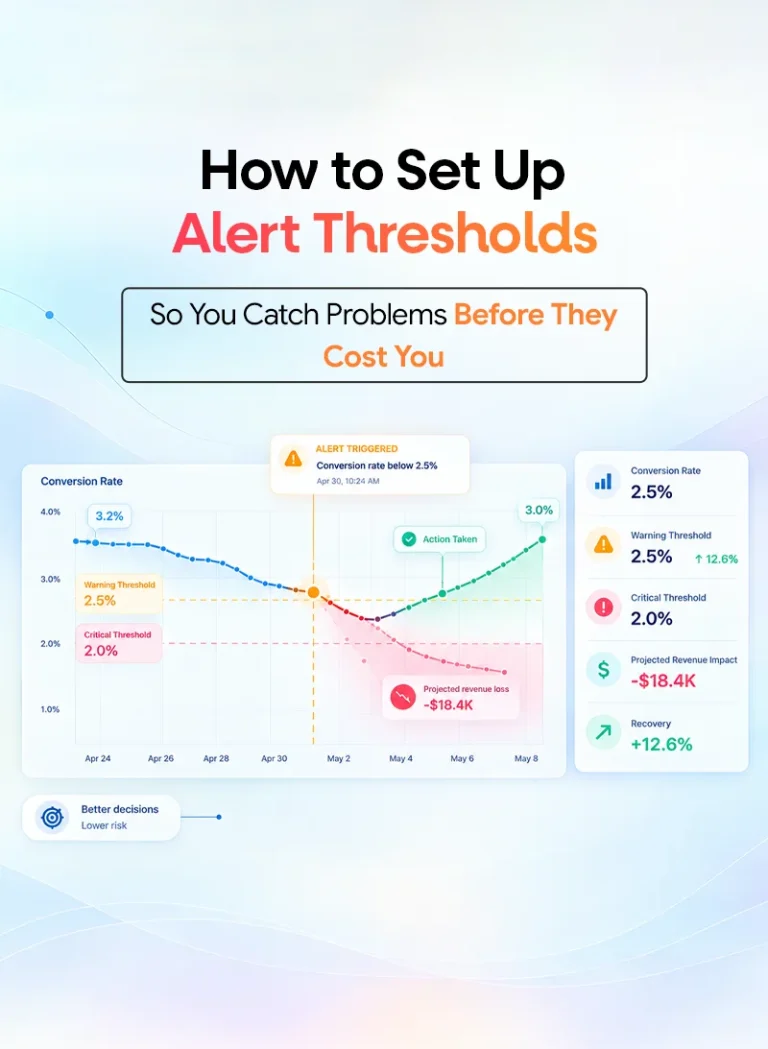
Your ecommerce store already contains the answers. Learn how AI ecommerce analytics helps founders ask business questions, understand what changed and why, and move from scattered data to clearer decisions.
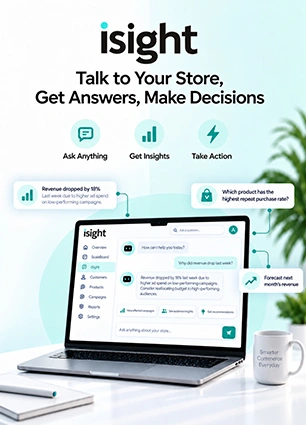
Your ecommerce store already contains the answers. Learn how AI ecommerce analytics helps founders ask business questions, understand what changed and why, and move from scattered data to clearer decisions.
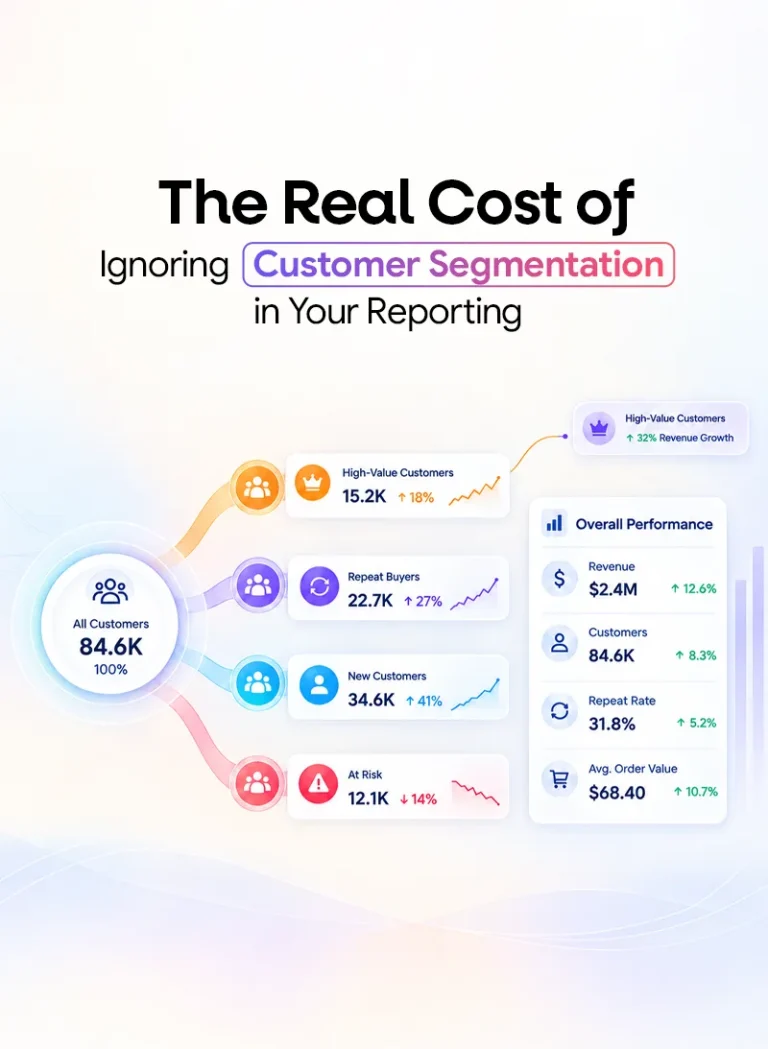
Compare Shopify conversion rate benchmarks by industry, device, traffic source, and customer type. See what a good conversion rate looks like in 2026 and learn how to benchmark your store more accurately.