
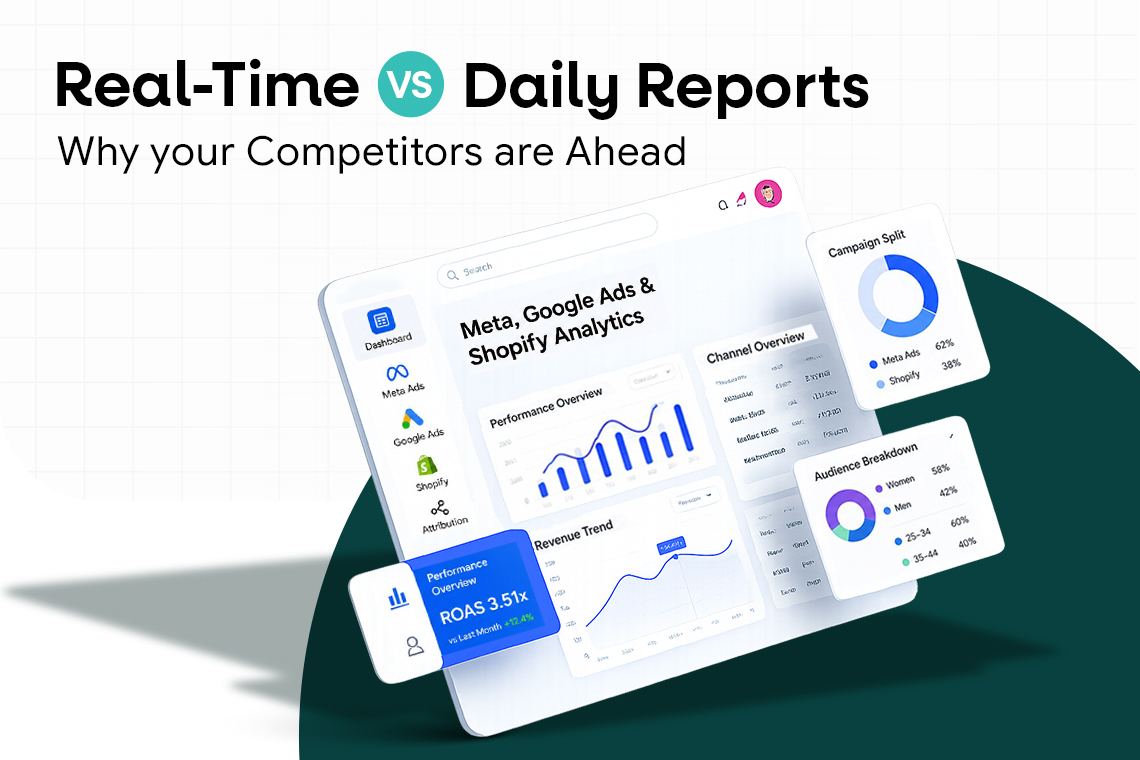
Most eCommerce teams are not struggling because they lack data.
They already have Shopify reports, Meta Ads dashboards, Google Ads numbers, email marketing performance, WhatsApp campaign data, inventory sheets, customer reports, and finance updates. The problem is different. The right number often reaches the right person too late.
By the time yesterday’s report is reviewed, the issue may have already affected revenue. A paid campaign may have spent too much on poor-quality traffic. A bestselling product may have gone out of stock while ads were still running. A checkout issue may have reduced conversions for hours. CAC may have increased during the afternoon, but the team only notices it the next morning.
That delay is exactly why real-time business reporting matters.
In a fast-moving eCommerce business, waiting for daily reports can mean reacting to problems after they have already affected revenue, margin, customer experience, and growth efficiency. Your competitors may not always be ahead because they have bigger budgets or better creatives. Sometimes, they are ahead because they see what is changing earlier and act while the issue is still active.
That is the real difference between daily reporting and real-time reporting.
Real-time business reporting means tracking important business metrics as they change, or close to when they change.
It does not mean every founder, marketer, or operator should stare at dashboards all day. That only creates more noise. The real value is in seeing the right signal at the right time.
For an eCommerce brand, real-time reporting can help spot a sudden revenue drop, a CAC spike, falling ROAS, low product stock, weak landing page conversion, or a drop in repeat purchases. The value is not just that the metric is visible. The value is that the team can respond before the issue becomes expensive.
Imagine your Meta Ads spend starts increasing at 11 AM, but conversions do not rise with it. If your team only checks the daily report the next morning, the budget for the full day may already be used inefficiently. But if the issue appears in a real-time reporting system, the team can investigate whether the problem is creative fatigue, weak traffic quality, product page friction, checkout issues, or low stock.
This is why reporting is not just about measurement. It is about decision-making.
Research also supports the business value of data-driven decision-making. In the paper How Does Data-Driven Decisionmaking Affect Firm Performance?, Brynjolfsson, Hitt, and Kim found that firms using data-driven decision-making had output and productivity around 5 to 6 percent higher than expected, even after accounting for other investments and IT usage.
The lesson is simple. Data is useful only when it helps the team make better decisions at the right time.
Daily reports are not useless. In fact, they are still important for business discipline.
A daily report gives your team a complete view of what happened during a finished period. It helps founders review yesterday’s revenue, compare performance against targets, check campaign summaries, understand product movement, and align the team on priorities.
For leadership teams, daily reports are helpful because they simplify complex business activity into a reviewable format. A founder may not want to check every campaign movement during the day. A daily summary gives them a clean view of what changed, what needs attention, and what should be discussed in the morning meeting.
The problem starts when daily reports become the only way the team understands performance.
Daily reporting explains what already happened. It does not always help when the business needs action now. If your store has a live checkout problem, a daily report is late. If inventory runs out during peak traffic, a morning summary cannot prevent wasted ad spend. If paid CAC increases sharply at 2 PM, tomorrow’s report may only confirm what the team could have acted on earlier.
Daily reports are useful for reflection. Real-time business reporting is useful for responses.
What makes daily reporting different from real-time reporting is more than just speed; it’s actually about the kind of decisions they enable.
In daily reporting, you can look at past performance. In real-time reporting, you can react while the performance is still in flux.
Imagine you have a D2C brand that runs campaigns on Meta Ads and Google Ads. Last day’s report shows you that you’ve seen an 18% decrease in your revenue. Now, that is good information, but your next step will be to figure out why you had a drop in your performance. Could it be less traffic? Or lower conversion rate? Maybe a campaign has stopped spending? Was it out-of-stock products or failed checkouts? Mobile page speed impacting buyers?
The ability to provide real-time reporting could give the team an opportunity to detect the problem early on and minimize its consequences.
This is important as the issues in eCommerce usually occur as part of a chain reaction. The product goes out of stock, the ROAS falls, the CAC grows, the efficiency ratio of marketing becomes lower, and the team spends the following day understanding why it was such a bad day.
Daily reports give the final picture, and real-time reporting enables one to spot the pieces of the puzzle before the final picture gets worse.
See what is changing in your business before yesterday’s report slows you down
eCommerce is highly vulnerable to time.
Traffic fluctuates from hour to hour. Ad platforms change the delivery process on the go. The inventory changes fast. Customers’ prices compare instantly. Competitors refresh their offers. Any delay of several hours may impact revenue, CAC, conversion rates, and customer experience.
Page load time is just one clear example. According to Google Mobile Page Speed Guidelines, 53% of all visits will probably be abandoned if loading time exceeds three seconds. This is not just a technological aspect of eCommerce for its team. This can easily turn into a revenue, CAC, and conversion issue if no one pays attention.
According to Google Core Web Vitals Guidelines, Largest Contentful Paint should happen within 2.5 seconds, Interaction to Next Paint should be lower than 200 milliseconds, and Cumulative Layout Shift should be equal to 0.1 or lower.
Now tie this all up with reporting. If your landing page becomes slower when you run your paid campaign, then the ad dashboard will reflect spendings. Traffic will remain active as well. However, conversions may quietly drop. The next day, the report will display this decrease. Real-time business reporting may help to detect this issue before it happens.
Research on eCommerce traffic and conversion behaviour also supports this point. The 2024 research paper From Clicks to Conversions: Analysis of Traffic Sources in E-Commerce focuses on user interactions, conversion metrics, traffic sources, device behaviour, browser behaviour, and the customer journey from product details to checkout.
When the buying journey changes quickly, reporting should not move slowly.
A competitor with better visibility does not need to be perfect. They only need to act faster in the moments that matter.
If CAC starts rising, they can investigate before the full day’s budget is spent. If a high-margin product starts converting well, they can increase support while the opportunity is still active. If repeat purchases slow down, they can check retention journeys before churn gets worse. If revenue drops suddenly, they can look at product, traffic, checkout, and campaign signals before waiting for a delayed report.
That is where real-time business reporting becomes a competitive advantage.
McKinsey’s article Five facts: How customer analytics boosts corporate performance found that intensive users of customer analytics were 23 times more likely to outperform competitors in new-customer acquisition, 9 times more likely to outperform in customer loyalty, and almost 19 times more likely to achieve above-average profitability compared with laggards.
This does not mean every brand will get the same result by adding a dashboard. The stronger point is that teams using customer and business data more effectively tend to make better decisions across acquisition, retention, profitability, and growth.
For eCommerce brands, speed and clarity both matter. Seeing the metric early is useful. Understanding what needs action is what creates the advantage.
A daily report is often clean, structured, and easy to read. But it can hide the messy reality behind the numbers.
Suppose the report says yesterday’s revenue was down. That one line may trigger five different teams to investigate. The paid media team checks campaign delivery. The store team checks conversion rate. The merchandising team checks inventory. The retention team reviews email and WhatsApp performance. The founder asks whether the drop is temporary or serious.
Everyone is looking at the same outcome, but not the same cause.
This is where daily reports can slow teams down. They tell people something changed, but they often do not show why it changed quickly enough.
Scattered dashboards make the problem worse. Shopify has order data. Meta Ads has paid traffic data. Google Ads has search and shopping performance. Email and WhatsApp tools show retention activity. Inventory tools show stock levels. Finance reports reveal margin later.
When teams work like this, the daily report becomes the start of the investigation, not the solution.
That is also why many teams feel like they are drowning in data. They have numbers everywhere, but those numbers are not always connected to action. This blog on how to stop drowning in data explains why eCommerce teams need connected decision-making, not just more reporting.
Customer Acquisition Cost does not rise in isolation.
CAC may increase because ad costs went up. It may also rise because the landing page stopped converting, the offer became weaker, a product went out of stock, or the campaign started attracting low-intent traffic.
That is why real-time reporting is useful for marketing teams. It helps them look beyond surface-level ad metrics.
A Meta Ads dashboard may show spend, clicks, CTR, CPC, and ROAS. But it may not show whether the promoted product has enough stock, whether the margin is healthy, whether customers repeat, or whether revenue per customer is improving.
The same applies to Google Ads. A campaign may drive conversions, but if those customers buy low-margin products and never return, the campaign may not improve long-term profitability.
This is where metrics like paid CAC, blended CAC, marketing efficiency ratio, revenue per customer, and LTV:CAC ratio become important.
A brand asking how to reduce customer acquisition cost should not only look for cheaper clicks. It should understand which campaigns bring profitable customers, which products recover acquisition cost faster, and which channels create repeat buyers.
For a deeper view of acquisition and lifetime value, read this guide on CAC vs LTV for D2C brand profitability.
Real-time reporting helps because it makes these signals easier to monitor before a full day, week, or month of spend is already committed.
A reporting delay does not only affect marketing. It can affect the full eCommerce operation.
Revenue can drop because of a campaign issue, but it can also fall because a top product is out of stock, a discount code is not working, a payment method is failing, or mobile conversion suddenly declines.
Inventory decisions also become sharper when teams see movement earlier. If a product starts selling faster than expected, the brand can protect stock, adjust campaign spend, or prepare replenishment. If a slow-moving product suddenly receives paid traffic but does not convert, the team can question whether the issue is pricing, positioning, demand, or product-market fit.
Retention teams benefit in a different way. If repeat purchases slow down, the issue may be connected to onboarding, product education, replenishment reminders, customer support, or win-back timing. Waiting for a weekly or daily summary can delay action when customer behaviour is already changing.
Research on personalised product recommendations also shows the importance of speed and behavioural signals in eCommerce. The 2025 paper Real-time and personalized product recommendations for large e-commerce platforms presents a methodology for accurate, scalable recommendations with minimal response times, focused on large eCommerce environments.
In practical terms, eCommerce brands need reporting that reflects how customers actually behave: quickly, across channels, and often with very little patience.
AI is changing how teams interact with business data, but AI does not fix poor reporting by itself.
Deloitte’s article AI and the future of human decision-making reports that 60 percent of executives now regularly use AI to support their decisions. It also notes that AI use in decision-making is growing quickly, but organisations still need stronger oversight, decision rights, and trust in the data behind those decisions.
For eCommerce brands, this is a useful warning.
An AI assistant can answer questions faster, but it still needs reliable, connected, and timely data. If the data is delayed, fragmented, or missing important context, the answer may not help the team act confidently.
Real-time business reporting becomes more powerful when it is combined with clean data, clear ownership, useful alerts, and decision-ready explanations.
Netsights.ai helps eCommerce teams connect store, marketing, product, customer, inventory, and revenue data in one decision-ready view.
Instead of checking Shopify in one tab, Meta Ads in another, Google Ads somewhere else, and retention tools separately, teams can bring key business signals together. This matters because eCommerce problems rarely come from just one place.
A revenue drop may be connected to a campaign issue. A CAC spike may be caused by weak conversion. A strong ROAS campaign may still be poor for profitability if contribution margin is low. A product may sell well but hurt customer experience if inventory runs out.
iSight helps teams view store performance, Shopify analytics, customer behaviour, product performance, and revenue trends in one place.
Netification helps teams receive KPI alerts when important changes happen, such as revenue drops, CAC spikes, campaign performance shifts, inventory movement, or retention changes.
Netty helps teams ask questions about revenue, CAC, ROAS, churn, repeat buyers, products, and profitability without manually switching between dashboards.
The goal is not to replace human judgment. The goal is to help teams see business signals faster, understand them better, and make clearer decisions before small issues become expensive.
Connect your eCommerce signals and act faster when CAC, revenue, or retention changes.
A balanced reporting system does not remove daily reports.
Daily reports are still valuable for reviewing patterns, aligning teams, and setting priorities. Founders still need daily and weekly summaries to understand business direction. This guide on 5 weekly eCommerce metrics is useful for deciding what to review regularly.
The mistake is relying only on daily reports for decisions that require faster action.
A good reporting rhythm uses both. Real-time reporting catches important changes during the day. Daily reports help the team review what happened and plan what to improve next.
One supports action. The other supports reflection.
Together, they help teams avoid both extremes: reacting to every small fluctuation or waiting too long to respond to serious issues.
Real-time business reporting is not about creating another dashboard for the sake of it.
It is about reducing the gap between what is happening and when your team can respond.
In eCommerce, that gap can be expensive. A few hours of wasted ad spend can increase CAC. A delayed stock alert can hurt revenue. A missed checkout issue can reduce conversions. A slow response to falling repeat purchases can weaken retention.
Daily reports help teams understand the past. Real-time reporting helps teams act while the present is still changeable.
That is why competitors using faster reporting often appear more agile. They are not simply looking at numbers sooner. They are making decisions before the opportunity disappears or the problem becomes bigger.
If your team wants to move from delayed reporting to clearer, faster decision-making, start your free trial and explore how Netsights.ai helps eCommerce brands turn real-time business reporting into action.
Connect your eCommerce signals and act faster when CAC, revenue, or retention changes.
A: Real-time business reporting means tracking important business metrics as they change, or close to when they change. It helps teams see issues earlier and act before the next daily report.
A: Real-time reporting helps teams respond while something is happening. Daily reports summarise what already happened during a completed period.
A: Yes. Daily reports are useful for reviews, planning, trend analysis, and team alignment. They are just not enough for urgent decisions during the day.
A: It helps teams spot CAC increases earlier and investigate the cause. The issue may be ad cost, conversion rate, landing page performance, product margin, or customer quality.
A: Brands should track revenue, CAC, ROAS, conversion rate, inventory movement, repeat purchase rate, product performance, marketing efficiency ratio, and customer behaviour.
A: No. Real-time reporting does not guarantee growth by itself. It helps teams see problems earlier, but results depend on how clearly and quickly the team acts.
We write about growth, retention, and the numbers that actually predict what happens next for D2C brands. Have a topic you'd like us to cover? Get in touch .
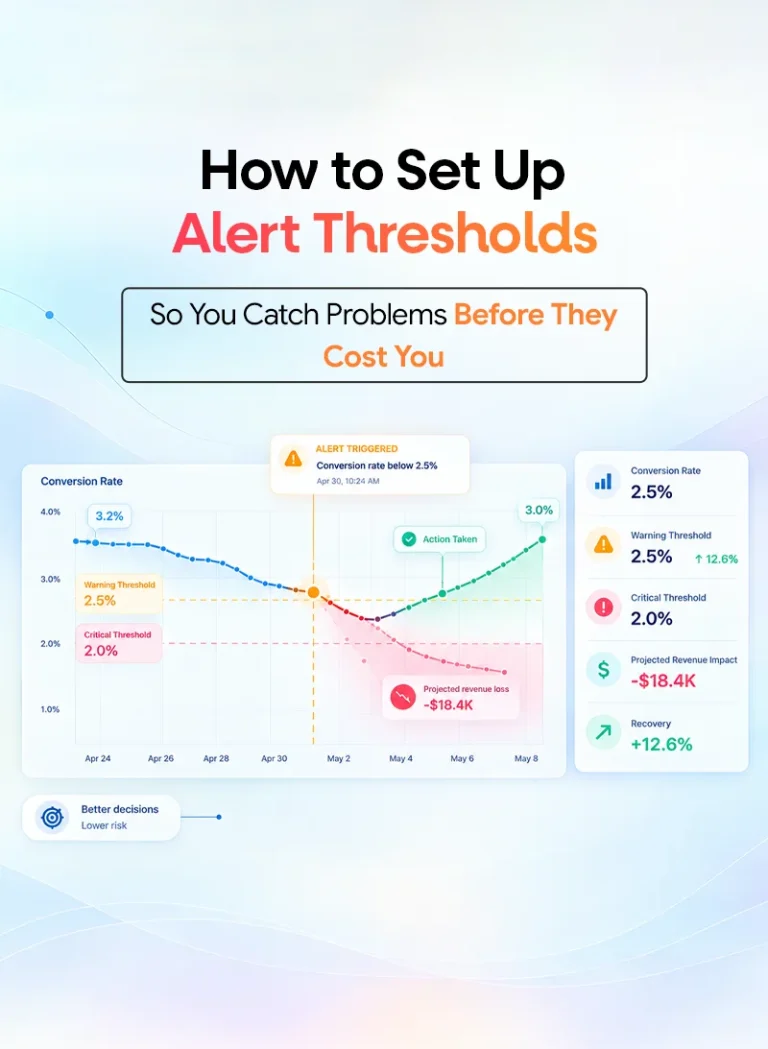
Your ecommerce store already contains the answers. Learn how AI ecommerce analytics helps founders ask business questions, understand what changed and why, and move from scattered data to clearer decisions.
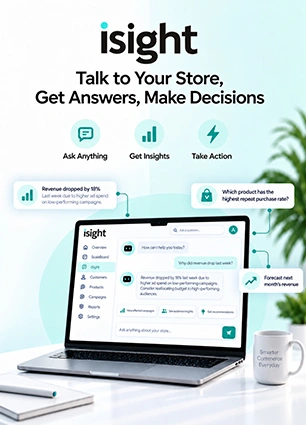
Your ecommerce store already contains the answers. Learn how AI ecommerce analytics helps founders ask business questions, understand what changed and why, and move from scattered data to clearer decisions.
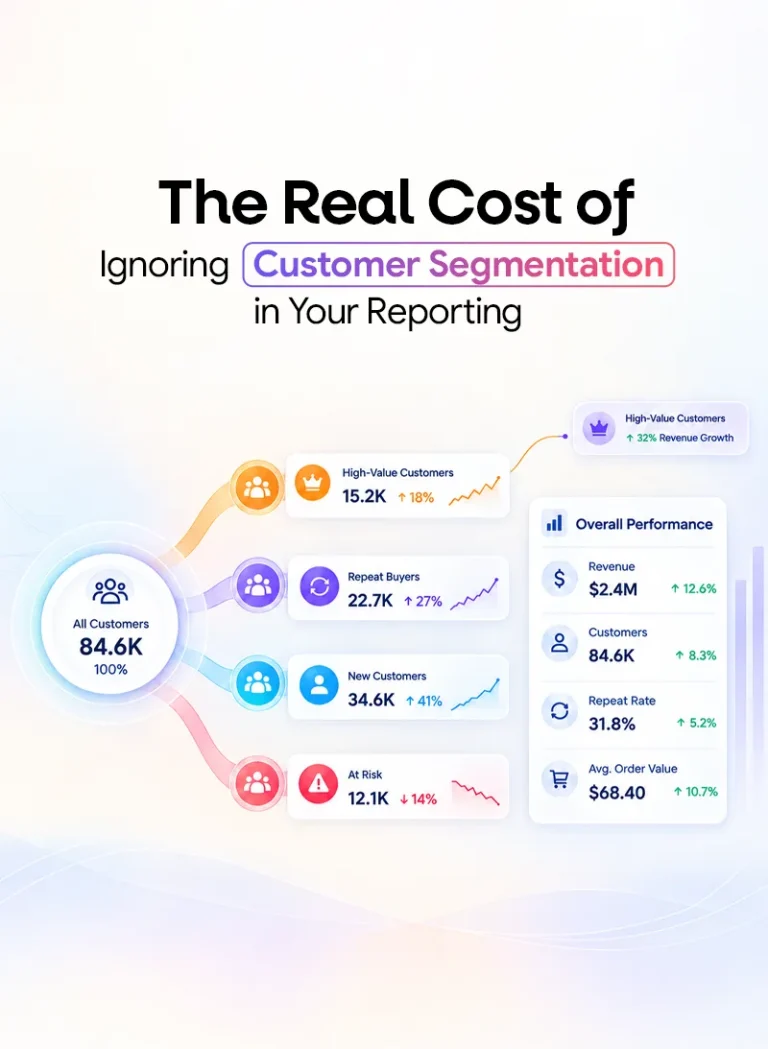
Compare Shopify conversion rate benchmarks by industry, device, traffic source, and customer type. See what a good conversion rate looks like in 2026 and learn how to benchmark your store more accurately.