
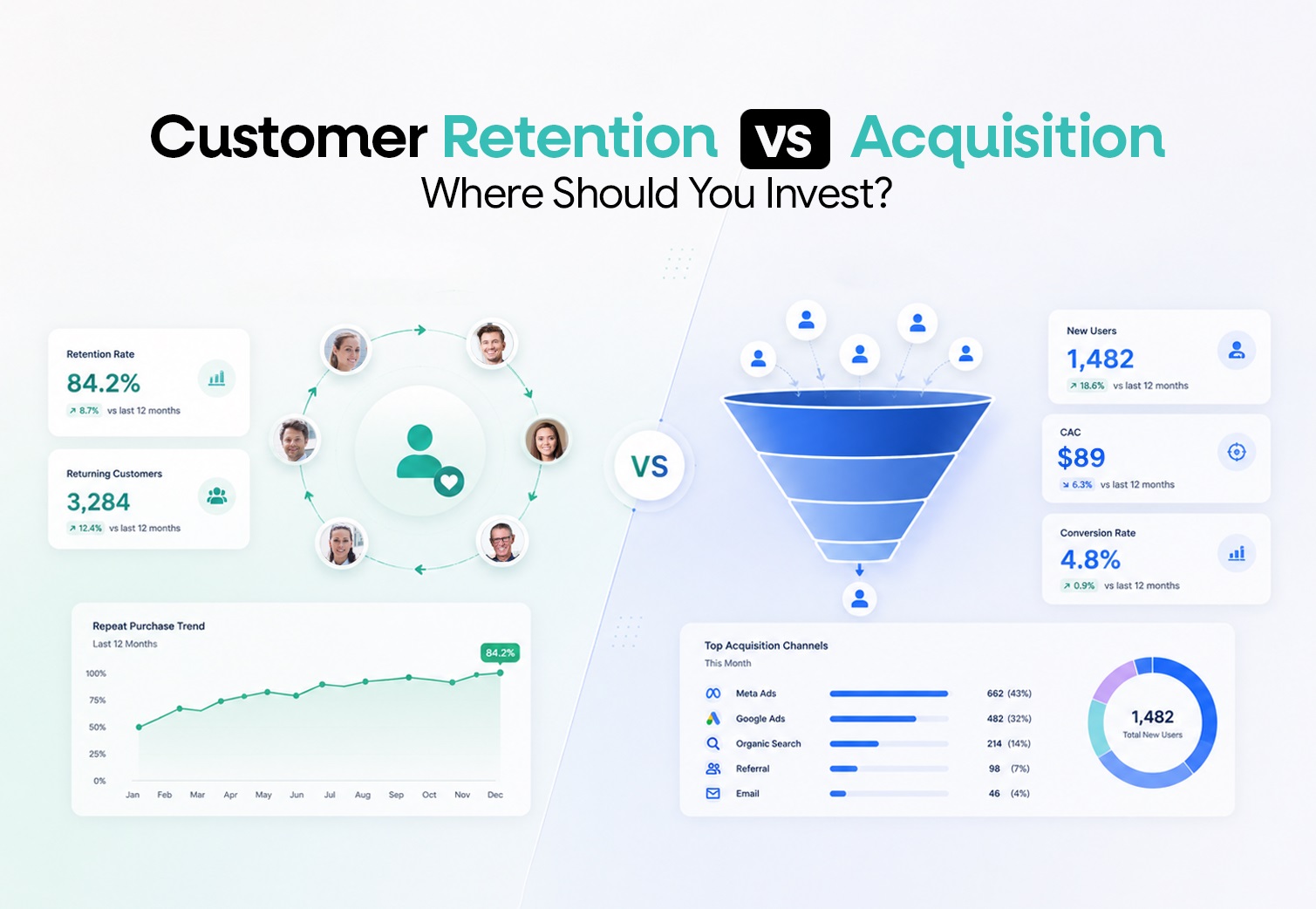
For most eCommerce brands, there is one common initial strategy: to attract new customers.
It is obvious. New customers generate revenues, create awareness, and momentum. Advertising, SEO, influencers, marketplaces, referrals, and landing pages attract potential customers that are not familiar with the brand yet.
However, sooner or later, most founders realize an unpleasant thing.
The brand is attracting orders, but at the same time, it is spending more and more money on advertisements. New customers are acquired, but they do not come back again and again. The brand spends more money on acquiring new customers, and existing ones fade away after one order.
Here comes the main dilemma for the founders. Do they invest more in customer acquisition, or do they invest more in customer retention?
It is not about whether retention is better than acquisition, or vice versa. Both strategies are needed for growing brands. However, the ratio is critical.
Overinvestment in acquisition but having poor retention would mean that you continue to invest in replacing your lost clients. Investing only in the retention of your existing customers without acquiring new customers would cause your growth rate to slow. The best way to go about it is to consider CAC, CLTV, churn rate, repurchase rate, NPS, customer loyalty, and revenue per customer together.
This is why customer retention vs customer acquisition is an important business decision, not marketing.
ROAS is calculated using a simple formula:
ROAS = Revenue from ads ÷ Ad spend
If you spend ₹50,000 on ads and generate ₹2,00,000 in revenue, your ROAS is 4x. That means every ₹1 spent on ads generated ₹4 in revenue.
That sounds useful, and it is. But it becomes risky when teams treat ROAS as the only success metric.
ROAS shows revenue efficiency. It does not show what happened after the order came in. It does not include product cost, discounts, returns, payment fees, shipping, packaging, fulfilment, or customer support costs.
This is where many brands make the wrong call. They scale the campaign with the best platform ROAS, only to realise later that the product margin was weak, repeat purchases were low, or the customers were not valuable enough.
WARC’s ROI Benchmarks Report also highlights this difference. Its analysis of successful campaigns found a median revenue ROI of 4.33:1, while the median profit ROI was lower at 2.5:1. That gap is a good reminder that revenue return and profit return are not the same thing.
For a deeper view of this difference, you can also read Netsights.ai’s guide on profitable revenue vs ROAS.
See whether your growth is coming from better acquisition or stronger retention
Customer acquisition is the process of bringing new customers into your business.
For an eCommerce or D2C brand, this can include Meta Ads, Google Ads, SEO, influencer marketing, marketplaces, referrals, affiliate campaigns, landing pages, lead magnets, email capture, and conversion-focused content.
Acquisition is important because every brand needs fresh demand. New customers help you enter new markets, test new audiences, launch new products, and build awareness.
But acquisition has a cost.
Every new customer usually requires some mix of media spend, creative testing, offers, website optimisation, retargeting, and follow-up. If your customer acquisition cost is high and your customer lifetime value is low, growth can become expensive very quickly.
Think of it this way. If it costs ₹1,000 to acquire a customer and that customer buys only once, you need to recover most of that cost from the first order. But if that customer buys three or four times, the same acquisition cost becomes easier to justify.
That is why CAC should not be reviewed alone. It should be reviewed with repeat purchase rate, margins, churn, and payback period. For a deeper view of this relationship, read this guide on customer acquisition cost payback period.
Customer acquisition brings new customers into the business.
Customer retention increases the value of customers you already have.
Acquisition creates reach. Retention creates depth. Acquisition expands the customer base. Retention improves customer lifetime value, repeat revenue, and stability.
The strongest brands do not treat these as separate worlds. They understand that acquisition and retention are connected.
If retention is weak, acquisition becomes harder to sustain because the brand must keep buying new customers to replace the ones it is losing. If retention is strong, the business can invest more confidently in acquisition because each new customer has more long-term value.
Harvard Business Review’s article on keeping the right customers refers to research by Frederick Reichheld of Bain & Company showing that increasing customer retention rates by 5% can increase profits by 25% to 95%. The same article also notes that acquiring a new customer can cost anywhere from five to 25 times more than retaining an existing one, depending on the industry.
That does not mean acquisition should be ignored. It means retention needs a serious place in the growth conversation.
To understand this balance better, read this guide on CAC vs LTV for D2C brand profitability.
Compare CAC, CLTV, churn, and repeat purchase behaviour in one decision-ready view
Retention is often cheaper because the relationship already exists.
A new customer has to discover your brand, trust your offer, compare alternatives, click an ad or search result, visit your website, and complete the first purchase. That journey can be expensive.
An existing customer already knows your brand. They have already trusted you once. You may already know what they bought, when they bought, which category they prefer, how often they purchase, and what type of communication they respond to.
That existing relationship makes retention marketing more efficient.
HubSpot’s guide on customer acquisition vs retention also states that acquiring a new customer can cost five times more than retaining an existing one.
Still, retention is not automatically easy. If your product experience is weak, delivery is poor, customer support is slow, or buyers do not see enough value, no WhatsApp flow or email campaign can fully fix the problem.
Retention works best when product quality, customer experience, timing, communication, and relevance are aligned.
This is where connected reporting helps. Instead of looking only at campaign revenue, teams should review repeat purchase rate, time to second purchase, churn signals, average order value, CLTV, and product-level retention patterns together.
Find out whether your customer database is creating enough repeat revenue
You should invest more in customer acquisition when your brand needs new demand, market expansion, and a larger customer base.
This is usually true when the business is still young, the audience is small, organic visibility is limited, or product-market fit is still being tested. Acquisition also deserves more investment when your retention engine is already working and your CLTV is strong enough to support CAC.
For example, if customers regularly buy again, margins are healthy, and CAC payback is clear, acquisition becomes easier to scale. You are not just buying a first order. You are acquiring a customer who may create value over time.
Acquisition is also important when entering a new category, launching a new product line, expanding into a new city or country, or building awareness in a market where the brand is not yet known.
The mistake is not investing in acquisition. The mistake is scaling acquisition when the business has no clear view of payback, repeat purchase behaviour, or customer quality.
If your team is spending heavily on acquisition, it should also review ROAS, CAC, and efficiency regularly. This 12-point ROAS optimization checklist can help identify whether paid media is creating healthy growth or only short-term revenue.
Retention deserves more investment when customers are buying once and not coming back.
You may see this when repeat purchase rate is low, churn rate is rising, CAC is increasing, or your customer database is growing but not producing enough repeat revenue. Another common sign is when paid ads are still bringing orders, but profitability is not improving.
For Shopify store owners and D2C founders, this often happens after the early growth stage. Acquisition gets the brand moving, but retention decides whether the business becomes stable.
If you already have thousands of customers but no clear segmentation, no post-purchase flows, no winback journeys, no NPS feedback, and no repeat purchase tracking, you are probably underinvesting in retention.
A simple way to think about it is this: acquisition fills the bucket, but retention checks whether the bucket is leaking.
If the leaks are large, pouring more money into acquisition will only hide the problem for a short time.
Churn happens when customers stop buying, stop engaging, or move to another brand.
In eCommerce, churn is not always visible immediately. A customer may not cancel a subscription or complain to support. They simply do not come back. That makes churn harder to catch unless you are tracking repeat purchase behaviour, buying frequency, and customer cohorts.
To reduce churn, start by understanding where customers drop off.
Are first-time buyers not placing a second order? Are loyal customers slowing down? Are customers from certain acquisition channels less likely to repeat? Are specific products attracting one-time buyers? Are delivery issues, returns, or support complaints affecting loyalty?
McKinsey’s personalisation research found that 71% of consumers expect personalised interactions, and 76% get frustrated when this does not happen. The same research also found that personalised communications can influence brand consideration and repeat purchases.
That matters because generic retention campaigns often miss the real reason a customer is drifting away.
A better retention marketing strategy uses customer behaviour. For example, a replenishment reminder should go to customers who are likely to need the product again. A winback offer should go to customers who have gone quiet. Product education should go to buyers who may need help getting more value from what they bought.
A churn problem is easier to fix when the team sees the signal early. Netification fits naturally here because alerts can help teams notice important changes in metrics before they become bigger revenue problems.
Spot churn signals before they quietly reduce revenue
Customer lifetime value, or CLTV, helps you understand how much value a customer may create over time.
This is one of the most important metrics when deciding between customer retention and acquisition.
If CLTV is high, the business can usually afford to spend more on customer acquisition because each customer is likely to return more value over time. If CLTV is low, acquisition becomes risky because the brand has to recover most of its CAC from the first purchase.
For example, a brand with strong repeat purchase behaviour can accept a longer CAC payback period. A brand with weak retention needs faster first-order profitability.
This is why CLTV should be reviewed with CAC, LTV:CAC ratio, repeat purchase rate, contribution margin, and revenue per customer.
A tool like iSight becomes useful when teams need to connect customer behaviour, revenue, product performance, and campaign signals together. Instead of asking only, “How much did we spend to acquire this customer?”, teams can ask, “What happened after we acquired them?”
Did they buy it again? Did they buy a higher-margin product? Did they come from a channel that brings better repeat customers? Did they respond to retention campaigns? Did they increase or reduce their buying frequency? These questions make the investment decision clearer.
If customers are returning, buying higher-margin products, and increasing in value over time, the brand may have room to scale acquisition. But if customers are not coming back, the priority may be retention, customer experience, or fixing gaps in the post-purchase journey.
To understand how CAC and customer value work together, read NetSights.ai’s guide on CAC vs LTV for D2C brand profitability.
You can also read this article on customer acquisition cost payback period to see how long it takes to recover the cost of acquiring a customer.
See whether your CAC is supported by strong customer lifetime value
A good retention marketing strategy starts after the first order.
Many brands put a lot of effort into getting the first purchase, but very little effort into what happens next. The customer receives an order confirmation, maybe a delivery update, and then the brand goes quiet until the next sale campaign.
That is a missed opportunity.
Retention marketing should make the customer journey feel thoughtful, useful, and relevant. It can include post-purchase WhatsApp flows, email education, product usage tips, replenishment reminders, loyalty programs, VIP segments, NPS surveys, feedback loops, winback campaigns, and personalised product recommendations.
CRM tools like HubSpot and Salesforce can support customer segmentation, lifecycle marketing, and customer communication. But the strategy should not depend only on the tool. The real value comes from knowing what customer behaviour means.
Salesforce’s customer expectations research reports that 80% of customers say the experience a company provides is as important as its products and services.
That is why retention is not only about loyalty points or discounts. It is also about customer experience.
Was delivery smooth? Was the product easy to use? Did the customer feel supported? Did the brand communicate at the right time? Did the customer receive relevant recommendations? Did the post-purchase journey make them more confident about buying again?
A strong customer loyalty strategy answers these questions before the customer disappears.
Acquisition and retention are often managed by different teams.
The performance marketing team focuses on CAC, ROAS, and new customers. The retention team focuses on email, WhatsApp, repeat purchases, and loyalty. The founder looks at revenue. Finance looks at margins. Customer support sees complaints. Operations sees delivery and stock issues.
Each team may be looking at a different part of the same customer journey.
That creates a problem.
A campaign may acquire customers at a low CAC, but those customers may never return. A retention campaign may improve repeat purchases, but only for customers from one product category. A product may sell well on the first order but fail to create loyalty. A high-ROAS campaign may bring low-CLTV buyers.
When these signals are disconnected, decisions become slower and less confident.
This is why eCommerce decision intelligence matters. It helps teams connect acquisition, retention, customer behaviour, product performance, and revenue quality so they can make decisions with better context.
It also reduces the pressure of manual reporting. If your team spends more time collecting data than acting on it, this guide on how to stop drowning in data and start making decisions may be useful.
Choosing between retention and acquisition is rarely a one-time decision.
It changes every week.
One week, CAC may rise and push the team to improve retention. Another week, repeat purchase rate may improve, giving the brand more confidence to scale acquisition. Sometimes, churn increases because a specific product disappoints customers. Other times, the problem is not churn at all, but poor visibility into which channels bring better customers.
This is where NetSights works as an AI Scaleboard for eCommerce teams.
The useful part is not simply having another dashboard. It is having a clearer decision workflow.
A traditional dashboard may show CAC, CLTV, churn, repeat purchase rate, and revenue in different places. A Scaleboard is more useful when it connects those signals and helps the team understand what decision needs attention.
For example, intelligence cards can highlight issues such as rising CAC, weaker repeat purchases, low-margin products, or customer segments that are not coming back. WhatsApp insights can make this easier for founders and CXOs who do not want to spend the morning checking multiple platforms.
When a founder needs to ask, “Are we spending too much on acquisition compared to lifetime value?” or “Which customer segment is most likely to buy again?”, Netty can act like a WhatsApp AI Copilot for asking business questions in plain language.
This matters because the best decision is rarely “only retention” or “only acquisition.”
The better question is, “What does the data say we should fix first?”
Use AI-powered eCommerce intelligence to decide where your next growth rupee should go
The best answer depends on your current business stage and customer economics.
Invest more in acquisition when your retention is healthy, CLTV supports CAC, product margins are strong, repeat purchases are stable, and there is still room to expand into new audiences.
In this case, acquisition can accelerate growth because the business knows how to turn new customers into long-term value.
Invest more in retention when CAC is rising, churn is high, repeat purchases are weak, paid media efficiency is declining, customers buy once and disappear, or your customer database is underused.
In this case, spending more on acquisition may only hide the deeper issue. The brand may need to improve post-purchase journeys, customer experience, loyalty, segmentation, and repeat purchase behaviour first.
McKinsey’s customer analytics research found that intensive users of customer analytics were 23 times more likely to outperform competitors in new-customer acquisition, 9 times more likely to outperform in customer loyalty, and almost 19 times more likely to achieve above-average profitability.
This supports a simple point: strong growth teams do not rely on guesswork. They use customer data to understand whether the next investment should go into acquisition, retention, or improving the customer journey.
To understand how decision-ready analytics is different from normal reporting, read this guide on the difference between dashboards and a Scaleboard.
If your team often feels stuck between too many reports and unclear next steps, this article on decision fatigue in business analytics is also relevant.
Customer acquisition helps your brand reach new people. Customer retention makes that reach more valuable.
A strong growth strategy needs both.
Acquisition brings new customers into the business. Retention decides whether those customers stay, buy again, and become more valuable over time.
If you focus only on acquisition, you may keep spending more to bring in new customers without improving long-term customer value. If you focus only on retention, you may protect your existing customer base but limit your ability to reach new markets.
The better approach is to connect both.
Use acquisition to attract the right customers. Use retention to increase the value of those customers. Use CLTV to understand how much you can afford to spend on acquisition. To understand this balance better, read this guide on CAC vs LTV for D2C brand profitability
You should also look at NPS, CRM data, loyalty program performance, customer feedback, and product performance to understand whether customers have a strong reason to return.
Most importantly, do not make this decision based on one KPI alone.
A high CAC is not always bad if CLTV is strong. A low CAC is not always good if customers never buy again. Acquisition will not create sustainable growth if retention is weak. Retention will not be enough if the brand stops reaching new customers.
So the real question is not, “Should we focus on customer retention or customer acquisition?”
The better question is, “Which part of our growth engine needs more attention right now?”
When eCommerce teams answer this with connected data, they make better growth decisions. They stop reacting to isolated reports and start understanding the full customer journey, from first purchase to repeat revenue.
If your team wants to stop guessing between retention and acquisition, start your free trial and explore how Netsights helps eCommerce teams see where growth is really coming from.
Stop guessing between retention and acquisition. Let your data show where to invest next
A: Customer acquisition brings new customers to a business. Customer retention keeps existing customers engaged and encourages them to buy again.
A: Customer retention is often cheaper because existing customers already know and trust the brand. Acquisition usually needs more ad spend, offers, and conversion effort.
A: Customer retention helps eCommerce brands increase repeat purchases, improve CLTV, reduce pressure on paid ads, and create more stable revenue.
A: A brand should focus more on acquisition when it needs new demand, market expansion, or a larger customer base, and when CAC is supported by healthy CLTV.
A: A brand should focus more on retention when churn is rising, repeat purchases are weak, CAC is increasing, or existing customers are not buying again.
A: eCommerce brands can reduce churn by tracking repeat purchases, improving post-purchase journeys, using WhatsApp and email flows, collecting feedback, and acting on churn signals early.
A: CLTV shows how much value a customer creates over time. Strong CLTV supports acquisition, while weak CLTV often signals a need to improve retention.
A: High churn makes acquisition more expensive because the brand must keep spending to replace lost customers instead of growing from repeat revenue.
A: A good D2C retention strategy includes post-purchase flows, product education, replenishment reminders, loyalty programs, winback campaigns, and personalised WhatsApp or email journeys.
A: NetSights helps eCommerce teams connect CAC, CLTV, churn, repeat purchases, revenue, and KPI alerts so they can decide where to invest next.
We write about growth, retention, and the numbers that actually predict what happens next for D2C brands. Have a topic you'd like us to cover? Get in touch .
Your ecommerce store already contains the answers. Learn how AI ecommerce analytics helps founders ask business questions, understand what changed and why, and move from scattered data to clearer decisions.
Your ecommerce store already contains the answers. Learn how AI ecommerce analytics helps founders ask business questions, understand what changed and why, and move from scattered data to clearer decisions.
Your ecommerce store already contains the answers. Learn how AI ecommerce analytics helps founders ask business questions, understand what changed and why, and move from scattered data to clearer decisions.