
A data warehouse provides a D2C brand with one point of unifying data from Shopify, marketing platforms, analytics software, customers, and operations. However, having a data warehouse does not necessarily mean that the reporting will become clear and decision-making better.
What you should be concerned about is whether disunified data has started making crucial decisions more difficult than necessary.
Imagine a performance review Monday morning meeting where Shopify reports strong sales, Meta reports good ROAS, and Google Ads announces its own conversions. According to GA4, there is more traffic.
Meanwhile, Finance has lower revenue numbers after the calculations for refunds and cancellations. Operations are facing increasing returns, and you have to deal with a shortage of stock of two of your best-sellers.
All these numbers could be true, but each team has its version of the reality. This is often when a data warehouse becomes inevitable.
However, even with a data warehouse, you will still need a clear measurement framework, accurate metrics, and understanding what decisions this data will inform.
Data warehousing is an approach that is meant to provide a single place to organise and analyse the data collected from various business sources. Your shop’s database is processing orders and maintaining your inventory. Data warehousing is designed to do a completely different job.
As AWS states, data warehousing is a central repository used to collect information coming from transactional systems and other sources for analysis.
In the case of D2C commerce, this means collecting data related to orders in Shopify, behavior in GA4, performance of Meta and Google Ads campaigns, products, customers, inventory, refunds, returns and fulfillment data. All these datasets can be combined within a data warehouse.
And instead of just asking:
Which Meta campaign had the highest ROAS?
you can ask:
Which campaigns have acquired the most successful customers in terms of realised revenues taking into account all possible discounts, refunds and returns?
This is a completely different level of analysis.
A warehouse can easily be referred to as a “single source of truth”. It is a term that is quite useful, but not completely.
Putting all your data into one system does not make it accurate.
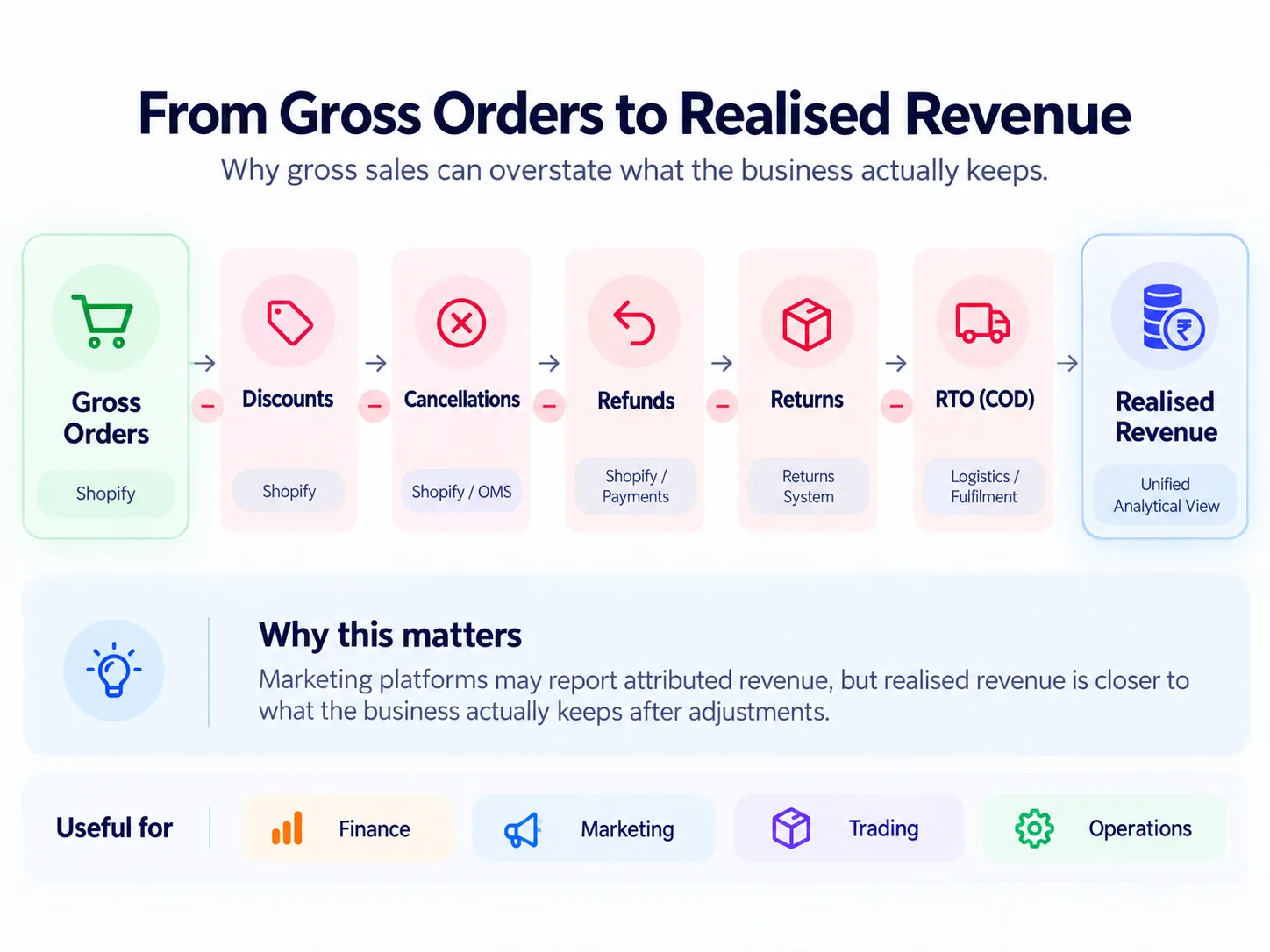
For instance, let’s assume that the marketing department defines revenue as platform attributions, ecommerce department utilizes Shopify gross sales while the finance department uses sales minus returns and cancellations. All these metrics can easily be stored in the warehouse and the issue of definition will remain. The key difference is that the company has agreed on the definition.
For example:
Gross Order Value -> Discounts -> Cancellations -> Refunds -> Returns or RTO -> Realized Revenue
Every brand will have its own formula. While some brands might utilize a different approach to fulfillment for the first time payment and cash-on-delivery. What is important in both cases is that all these companies use the same approach.
The fact is that CAC can have one meaning on Monday and another meaning in the board deck. That is why warehouse does not solve the problem of different meanings of the metrics. In this case, founders have to define the ecommerce metrics prior to making decisions.
The basic data warehouse architecture is easier to grasp if you follow a single piece of information from source to final report.
A typical flow looks like this:
Data Source → Data Collection → Cleaning and Transformation → Warehouse → Analysis & Decisions
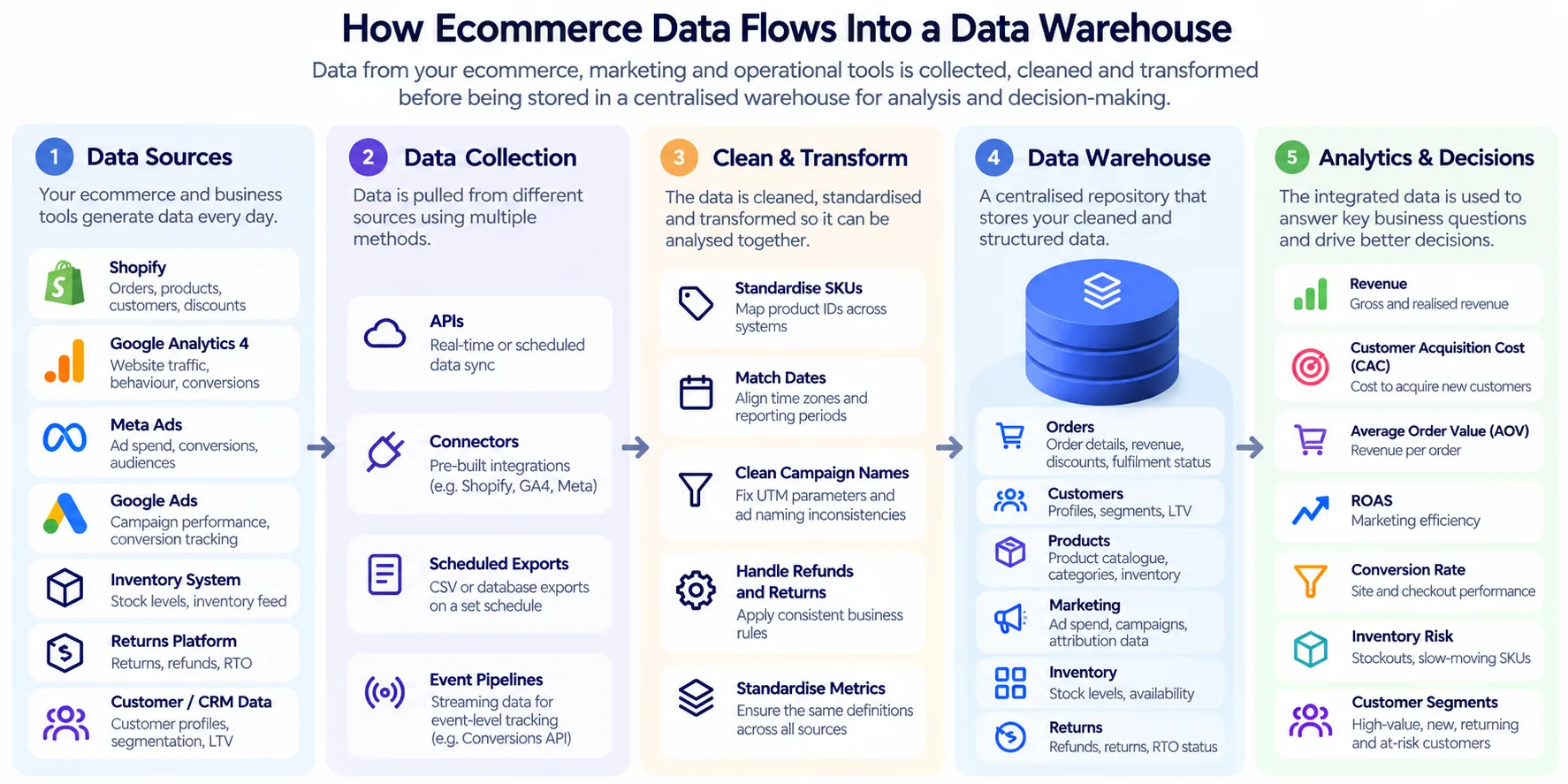
These are the systems you have in place that run various aspects of your business. Shopify stores orders, products, and customers. GA4 captures sessions and checkout behavior. Meta and Google Ads capture performance of campaigns. Inventory management software stores inventory data and returns platforms store reason and fulfillment information about returned items. None of these were designed with all your business questions in mind.
The next step is to extract data from these source systems, either through API’s, connectors, scheduled exports, or event pipelines. For example, Shopify allows bulk actions on their GraphQL Admin API for asynchronous extraction of large amounts of data.
The raw data usually needs processing. For example, the campaign names may be inconsistent, the dates can be stored in various time zones, the SKUs format doesn’t match and so on.
ETL is used to solve these problems. It stands for Extract, Transform and Load. There is an alternative approach called ELT which involves loading the data first into the data warehouse and transforming it there.
After cleaning, the data is organized into analytical tables. Some examples of tables that could be used in a D2C warehouse are order tables, customer tables, product tables, refund tables, marketing cost tables, web behavior tables, and inventory tables.
It’s not about creating many tables. It’s about structuring the data in such a way that the company can ask questions and not rebuild everything every week.
Cloud warehouses have made storage much easier, but that doesn’t make building a reliable one easy. The difficulty sits in the details.
Shopify will assign one row for each order placed. Meta will assign one row for each campaign per day. GA4 can have event level data, and the inventory will be on a daily basis. Linking these without caution will duplicate the values, and that is how you end up with more orders or revenue.
Shopify customer ID is not always the equivalent of GA4 users, while ad platforms typically attribute conversion data according to a model instead of actual customer identity. The customer data warehouse must have strict rules on what can be linked together and what is to remain aggregated.
The finance department might be completely satisfied with last year’s figures. A performance team might require notifications of budget expenditure per hour. An operations department might require current stock level visibility. The right refresh rate is a function of the decision.
Additionally, Google Analytics also points out that there may be discrepancies between the data exported from BigQuery and the data generated by GA4 reports. This is because both systems have a different way of processing and presenting data.
The answer becomes obvious when the query spans multiple domains. For example, a Diwali campaign. The orders are increasing, the Meta ROAS is good, the traffic is high, and thus it seems that the campaign is doing well.
Then you peel off the layers. The discount rate is higher than normal. There is an increase in COD orders, and RTO is on the rise in a few locations. Two of the hero products sold out sooner than expected, and there was an increase in the refund amount post-campaign.
The relevant query moves from:
What was our Meta ROAS?
to:
Was the campaign successful in driving profitable revenue post-marketing costs and discounts, refunds, and returns?
No single advertising dashboard answers that well. This is where an ecommerce data warehouse starts earning its place. It also shows why marketing attribution needs to be viewed alongside wider business outcomes.
A warehouse can also enhance customer analytics. Shopify provides information about who bought the products. GA4 gives insights about how visitors interacted with your website. The email service will know who opened or clicked on the email and ad services will give you insights regarding acquisition. Combining all that, you can formulate some great questions. For instance, you can get information about customers who:
This is way more beneficial compared to segmenting customers based on the latest purchase period.
This is perhaps one of the most common errors to be made. The warehouse can help make poor data easy to work with, but it will never alert you that your tracking was originally incorrect.
Even if the Meta Pixel fires twice, the warehouse cannot know that one of those events is a duplicate.
When the Conversions API is configured incorrectly, the problem gets passed on directly to the reporting layer.
When Google Ads tracks the wrong conversion action, the central storage of that data does not help its accuracy.
When UTM parameters are inconsistent, campaign analysis will still be messy.
What the right sequence would look like is this:
Tracking → Validation → Metric Definitions → Reconciliation → Storage → Analysis → Decision
This sequence matters. When the underlying problem is poor measurement, improve the measurement. If the issue is five hours of manual reporting every week, then it is the reporting process that needs to be improved. And when the company needs five years of customer, product and operational analysis, a warehouse becomes justified.
In NetSights’ guide on how to stop data overload from preventing you from making decisions, the problem is approached from the decision perspective.
These systems are related, but they aren’t interchangeable.
|
System |
Main Purpose |
Ecommerce Example |
|
Database |
Run applications and transactions |
Process orders, customers and accounts |
|
Data warehouse |
Analyse structured data across systems |
Join Shopify, marketing, customer and inventory data |
|
Data lake |
Store large volumes of raw and varied data |
Raw events, logs, files and machine learning datasets |
|
CDP |
Build and activate customer profiles |
Segmentation, personalisation and audience creation |
To cut to the chase, databases typically help run the business while warehouses help analyze it. Data lakes provide more options for storage of raw or heterogeneous data, whereas CDP is more about identifying, segmenting, and engaging customers.
Modern platforms are already making these distinctions less clear-cut. In the CIDR paper on lakehouse architecture in 2021, an architectural model that leverages some of the flexibility of data lakes but also incorporates the management and analysis power of data warehouses was outlined. But for most D2C organizations, the technical name is not so important.
The cloud data warehouse may appear to be inexpensive, provided that storage costs alone are considered. A more comprehensive picture would include storage, computing, connectivity, transformation, orchestration, monitoring, BI software and engineer hours.
There are some operations to be done anyway. APIs keep changing, pipelines break down, metrics definitions shift, new platforms are introduced, access must be controlled and unanticipated shifts must be investigated.
Hence, the first question should not be:
Which data warehouse should we purchase?
It should be:
Which business questions cannot be answered confidently?
It will result in a much better architectural choice.
There’s no sensible rule saying every business should build one once it hits a certain GMV or order volume. Complexity matters more than size. A smaller D2C brand selling through Shopify, marketplaces, COD and several ad channels may need stronger infrastructure earlier than a bigger brand with a simpler setup.
A useful way to judge readiness is to look at the work your team is already doing.
|
Current Situation |
What It Suggests |
|
A few platforms and standard KPI reporting |
Connected analytics may be enough |
|
Weekly CSV exports and spreadsheet joins |
Warehouse becoming more useful |
|
Regular finance and marketing reconciliation |
Stronger data model needed |
|
Complex customer and product analysis |
Warehouse increasingly valuable |
|
Long-term cohort and seasonal analysis |
Historical warehouse data helps |
|
Forecasting and custom modelling |
Warehouse or lakehouse more justified |
A few signs stand out. If you rebuild the same spreadsheet every week, you already have a data pipeline; it’s just being run by hand. If the business keeps arguing over which revenue number is right, you need stronger metric definitions and reconciliation.
If your questions regularly cross marketing, inventory, customer and finance data, platform-level reporting is showing its limits. And if nobody owns data quality, modelling and maintenance, building a warehouse may be premature.
Every D2C reporting issue isn’t necessarily a warehouse issue. Let’s say that you’re most interested in:
These are all important questions, but not always an occasion for developing a custom warehouse solution. When the information is contained in Shopify, GA4 and your marketing channels, there may be something else that needs to happen first.
This is the distinction between infrastructure and decision-making. A warehouse manages the underlying data. A decision layer helps people identify what needs action. Eventually, some companies will need both.
If your team already has the information but still spends too much time jumping between dashboards, improving the decision layer may be the more useful next step.
See how iSight helps teams investigate ecommerce performance
Instead of approaching the whole warehouse as a package deal, it makes sense to develop the data stack gradually.
That is also the approach we advocate in ecommerce decision intelligence, the data stack needs to support decisions, not be the decision itself.
NetSights operates closer to the decision layer than the warehouse layer. It allows us to differentiate between two distinct problems.
The first one is:
“We cannot store and model our data correctly.”
The second one is:
“We have the data, yet it still takes too much time to comprehend what changed and why.”
While a warehouse could be considered an excellent solution to the first problem, the second one could probably be solved faster by building a D2C layer that brings ecommerce, marketing and customer signals together in a better decision-making process.
iSight allows teams to analyze their performance, Netification highlights key KPI changes, and Netty allows making questions about business data in a conversational manner.
This does not mean that building a warehouse becomes redundant.
A more mature company might consider running a warehouse under and decision tools above. The key idea is to build a correct layer for a particular problem.
So what is the true value of a data warehouse to a D2C company? It’s not how much data it holds but how many critical questions it can help to answer correctly and consistently.
The greater its value will be in cases where the reporting is overly dependent on manual joins, where history is impossible to analyze, where teams require the same data to be used differently and business questions are constantly spanning across multiple platforms.
But if the biggest pain point for you is the inconsistency in data tracking, KPIs being contradictory to each other and the time required to interpret results, a warehouse may simply shift this complexity into another, more technical layer.
First of all, make the decision.
Define the metrics.
Solve the issue of data tracking.
Connect the data that you’ve got.
And then build additional infrastructure if the business needs it.
If your team already has plenty of data but still struggles to see what deserves attention, focus first on making that information easier to understand and act on.
A: A data warehouse is a central system that combines information from several sources for reporting, historical analysis and business intelligence.
A: Data is extracted from source systems, cleaned and transformed, then stored in a structured format that can be queried for analysis and reporting.
A: No. A warehouse becomes useful when a brand needs repeated cross-platform analysis, deeper historical reporting, complex customer segmentation or regular reconciliation.
A: Yes, but company size isn’t the main factor. Complexity, reporting needs, data volume and the questions the business needs to answer matter more.
A: A database usually handles live transactions and application data. A warehouse is designed mainly for analytics across several systems.
A: A warehouse usually holds structured data prepared for analysis. A data lake can hold larger amounts of raw and varied information.
A: A warehouse supports broad business analysis. A CDP is mainly designed to create unified customer profiles for segmentation, personalisation and activation.
A: Consider one when teams repeatedly join the same datasets, need long-term historical analysis, reconcile data across systems or require custom customer, product and operational models.
We write about growth, retention, and the numbers that actually predict what happens next for D2C brands. Have a topic you'd like us to cover? Get in touch .
Your ecommerce store already contains the answers. Learn how AI ecommerce analytics helps founders ask business questions, understand what changed and why, and move from scattered data to clearer decisions.
Your ecommerce store already contains the answers. Learn how AI ecommerce analytics helps founders ask business questions, understand what changed and why, and move from scattered data to clearer decisions.
Your ecommerce store already contains the answers. Learn how AI ecommerce analytics helps founders ask business questions, understand what changed and why, and move from scattered data to clearer decisions.