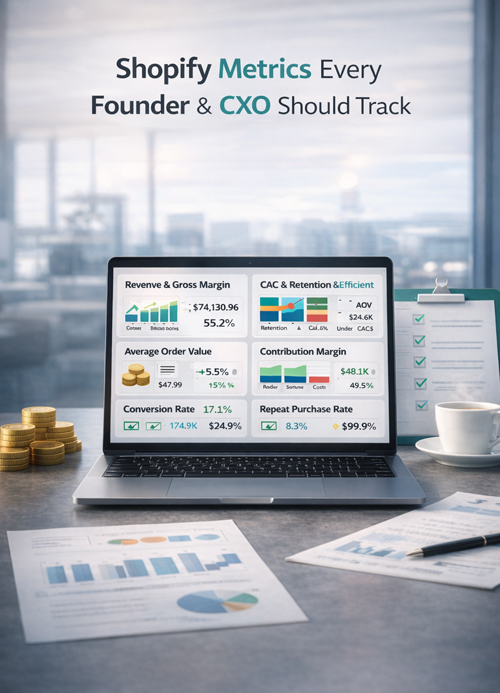

Shopify provides a steady stream of numbers that describe what is happening in a business at any given moment. Sales figures, traffic reports, advertising metrics, and operational data are all easily accessible. Despite this visibility, many founders struggle to translate these numbers into clarity and direction.
Reading Shopify data like a founder requires a shift in perspective. Instead of focusing on isolated metrics or daily fluctuations, leadership teams must look for patterns, relationships, and signals that reveal the true state of the business.
Most Shopify analytics interfaces are built to support execution. They are detailed, granular, and highly configurable. While this level of detail is useful for teams managing campaigns and operations, it often overwhelms founders.
Founders do not need to examine every metric daily. Their responsibility is to understand whether the business is moving in the right direction. This requires stepping away from dashboards and focusing on what the data is collectively saying about growth, efficiency, and risk.
Individual metrics only show a moment in time. Reading data effectively means understanding how metrics move together over time. Revenue, for example, gains meaning when viewed alongside margins, acquisition costs, and repeat behaviour. Traffic numbers matter when connected to conversion rates and customer quality.
When metrics are read in isolation, they often create false confidence or unnecessary concern. Founders benefit most when they view Shopify data as an ongoing story rather than a series of disconnected snapshots.
Shopify data contains both signal and noise. Daily spikes, short-term dips, and campaign-level fluctuations can distract leadership teams from what truly matters.
Signal appears in trends, not daily changes. A gradual decline in margins, a consistent rise in acquisition costs, or a steady drop in repeat purchases carries far more importance than a single strong or weak day. Founders should focus on directional movement rather than momentary performance.
Growth is one of the most celebrated outcomes in ecommerce, but not all growth is equal. Founders must learn to read growth through the lens of sustainability.
Revenue growth supported by stable margins and improving retention reflects a healthy business. Growth driven primarily by higher ad spend and discounts often introduces hidden risks. Reading Shopify data effectively involves understanding whether growth is strengthening the business or increasing dependency on external inputs.
Marketing metrics are often the most visible and frequently reviewed numbers in a Shopify business. However, clicks, impressions, and return on ad spend rarely tell the full story.
Founders should focus on how marketing activity affects overall profitability and cash flow. Data becomes useful when advertising performance is connected to contribution margins, customer lifetime value, and operational costs. This approach allows leaders to evaluate marketing as a business investment rather than a performance scoreboard.
Data becomes powerful when it informs action. Founders should use trends to guide decisions around scaling, optimisation, and prioritisation.
Improving margins may signal readiness to scale. Declining conversion rates may indicate the need to revisit messaging or traffic sources. Weak repeat behaviour may highlight the need for retention-focused initiatives. Reading data with intent transforms analytics into a decision-making tool.
One of the most common challenges founders face is analysis paralysis. With so much data available, it becomes tempting to wait for perfect clarity before acting.
Effective leaders recognise that data rarely provides absolute certainty. Instead, it provides enough insight to make informed decisions. Reading Shopify data like a founder means balancing analysis with action and trusting well-framed signals over exhaustive reports.
Shopify delivers information, but clarity comes from interpretation. Founders benefit most from views that summarise what matters and highlight what requires attention.
Executive-level summaries, KPI views, and insight-driven interpretations help leaders stay focused on decisions rather than data management. This approach reduces cognitive load and enables faster, more confident action.
Reading Shopify data like a founder is not about mastering analytics tools. It is about understanding what the numbers reveal about business health, sustainability, and direction.
When data is interpreted through trends, relationships, and outcomes, it becomes a strategic asset. This clarity allows founders and CXOs to lead with confidence and build businesses that scale with purpose rather than pressure.