

Google Ads is often one of the first growth channels Shopify businesses scale. Sales increase, traffic looks strong, and dashboards show steady performance. On the surface, everything appears to be working.
However, sales growth alone does not guarantee business health. Many founders discover later that despite rising orders, profitability remains flat or even declines. Understanding whether Google Ads is truly driving profit requires looking beyond surface-level metrics.
Sales numbers are easy to celebrate, but they aren’t the full story. Google Ads can generate demand quickly, especially when budgets are increased or keywords are expanded. This often results in higher-order volumes without improving overall efficiency.
When advertising costs rise at the same pace as revenue, profit growth stalls. In some cases, fulfilment costs, discounts, and returns further reduce margins. Founders who rely only on sales performance risk scaling activity rather than value.
Return on ad spend is one of the most commonly used Google Ads metrics. While ROAS provides a quick sense of efficiency, it has clear limitations for leadership decision-making.
ROAS does not account for fulfilment costs, payment fees, or operational overheads. It also ignores customer quality and long-term value. A campaign can show a strong ROAS while contributing little to actual profit. For CXOs, this creates a false sense of confidence.
Contribution margin provides a clearer view of advertising impact. It shows what remains after marketing spend and variable costs are deducted from revenue.
When Google Ads campaigns are evaluated through contribution margin, patterns become clearer. Some campaigns drive volume but dilute margins. Others generate fewer sales but contribute meaningfully to profit. Founders should prioritise campaigns that strengthen contribution margin rather than those that inflate topline numbers.
Google Ads performance often looks stronger when branded traffic dominates results. Customers already familiar with the brand convert easily, producing high ROAS and low acquisition costs.
Non-branded campaigns, however, tell a different story. These campaigns introduce new customers but usually come with higher costs and lower conversion rates. Founders must understand how much growth is coming from existing demand versus genuine market expansion. Without this clarity, ad performance can be misinterpreted.
Google Ads should not be evaluated solely on first-purchase outcomes. Customer lifetime value plays a crucial role in determining long-term profitability.
When customers acquired through Google Ads return and purchase again, higher acquisition costs can be justified. If repeat behaviour remains weak, continued scaling of ads increases pressure on margins and cash flow. Founders should always read Google Ads performance alongside retention metrics.
Even profitable campaigns can strain cash flow. Google Ads often require upfront spend, while revenue is realised later. As budgets grow, this gap becomes more pronounced.
Founders must assess whether the business can comfortably support increased ad spend without creating operational stress. Profitability on paper does not always translate to financial flexibility in practice.
Google Ads dashboards are designed for campaign optimisation, not executive clarity. Founders benefit from stepping back and reviewing summarised signals that reflect business outcomes.
Metrics such as contribution margin trends, blended acquisition cost, and repeat purchase behaviour provide a clearer picture of whether ads are strengthening the business. This approach allows leaders to make informed decisions without getting lost in campaign-level details.
Google Ads should support the broader business strategy, not dictate it. When advertising decisions are made purely on short-term performance, long-term profitability often suffers.
Founders who align Google Ads with margin goals, retention strategies, and operational capacity build more resilient businesses. Ads become a growth lever rather than a dependency.
Google Ads can drive impressive sales growth, but sales alone do not define success. True performance lies in profitability, sustainability, and long-term value creation.
When founders evaluate Google Ads through the lens of contribution margin, customer value, and cash flow, advertising becomes a strategic advantage rather than a financial risk. That clarity allows businesses to scale with confidence instead of complexity.
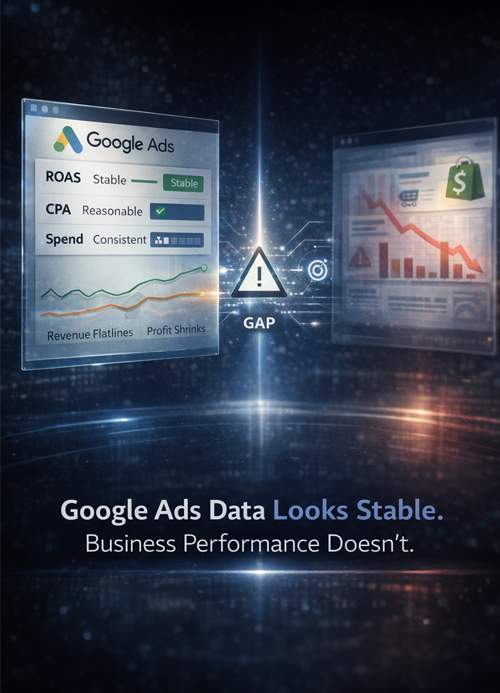
This is one of the most confusing moments in scaling a business. Google Ads looks stable: Yet overall performance slows. Revenue flattens. Profit shrinks. Confidence fades. So what’s actually happening? Google Ads is telling the truth—just not the whole truth Google Ads reports on its own system. It answers: What it doesn’t show: When founders […]

Founders don’t lack data.They lack time to interpret it correctly. Between Shopify, Google Ads, Meta, and dashboards, insight is buried under noise. This is where AI becomes genuinely useful—not as automation hype, but as a thinking assistant. AI as an interpretation layer Good AI doesn’t replace analytics.It connects them. Instead of asking: That shift is […]
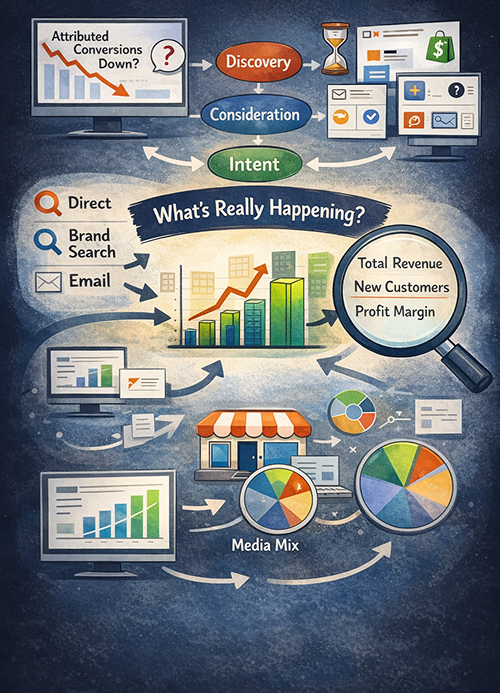
It’s become a common narrative: “Meta Ads don’t work like they used to.” But in many cases, performance hasn’t collapsed. Measurement has. The post-tracking reality Privacy changes didn’t kill Meta Ads.They broke how performance is observed. Founders now see: The mistake is assuming the channel is failing—when visibility is. Last-click bias hurts Meta the most […]