

Many Shopify founders reach a familiar stage in their growth journey. Advertising platforms show strong performance. Traffic is steady. Sales continue to come in. From the outside, everything appears to be functioning well.
Yet despite this activity, profitability feels underwhelming. Growth feels harder than it should. Decisions become reactive instead of deliberate. This disconnect often stems from a deeper issue. Ads may be working, but the underlying strategy is not.
Advertising platforms are designed to optimise delivery, not business outcomes. When ads generate clicks, conversions, and reported returns, they are doing their job. However, ad performance alone does not ensure that the business is moving in a healthy direction.
Without a clear strategy guiding where ads should lead, advertising becomes a volume engine rather than a growth engine. Sales may increase, but margins, retention, and long-term value remain fragile.
Many businesses invest heavily in tactical optimisation. Campaigns are refined, creatives are tested, and audiences are expanded. These actions improve efficiency at the channel level but do not address strategic alignment.
When ads are scaled without clarity on margin targets, customer quality, or retention goals, they amplify existing weaknesses. Tactical excellence cannot compensate for strategic gaps. Founders must ensure that optimisation serves a clear business objective.
Channel dashboards highlight metrics such as ROAS, cost per conversion, and click-through rates. While these metrics are useful for teams managing campaigns, they rarely reflect business health.
A campaign can show strong ROAS while contributing little to profit. Another may appear inefficient while acquiring high-value customers. Strategy requires stepping beyond channel-level metrics and evaluating how advertising supports broader business goals.
Advertising often accelerates exposure faster than a business can absorb. Traffic increases, but operations, fulfillment, and retention systems lag behind. This creates pressure across the organisation.
When ads outpace readiness, issues surface in returns, customer experience, and margins. Founders must ensure that growth initiatives align with operational capacity. Strategy requires sequencing growth, not forcing it.
Ads are effective at delivering short-term results. Promotions drive spikes. New audiences respond to offers. Revenue rises quickly. These wins can mask structural issues within the business.
Without a strategy focused on repeat behavior, pricing discipline, and customer value, businesses become dependent on constant acquisition. Over time, acquisition costs rise and profitability erodes. Sustainable growth requires looking beyond immediate performance.
Effective strategy starts with clarity on what the business is optimising for. Profitability, contribution margin, repeat purchase behavior, and cash flow must guide advertising decisions.
When these priorities are clear, ads become a tool rather than a crutch. Budgets are allocated intentionally. Campaigns are evaluated through business outcomes, not isolated performance metrics.
Strong strategies recognise that ads play different roles at different stages of the customer lifecycle. Acquisition introduces the brand. Retention builds value. Re-engagement sustains momentum.
When advertising is aligned with lifecycle stages, spend becomes more efficient and outcomes improve. Founders who view ads as part of a broader system build resilience into their growth model.
Activity creates motion. Strategy creates direction.
Founders who rely solely on advertising performance often feel busy without feeling in control. Intentional growth comes from understanding where the business is heading and using ads to support that direction.
This shift requires stepping back from daily performance metrics and focusing on signals that reflect long-term health. Ads should reinforce strategy, not define it.
Advertising platforms can deliver impressive results, but they cannot replace strategy. When ads work in isolation, they generate activity without stability.
Founders who align advertising with business fundamentals build stronger, more durable growth. When strategy leads and ads support it, growth becomes intentional, profitable, and sustainable.
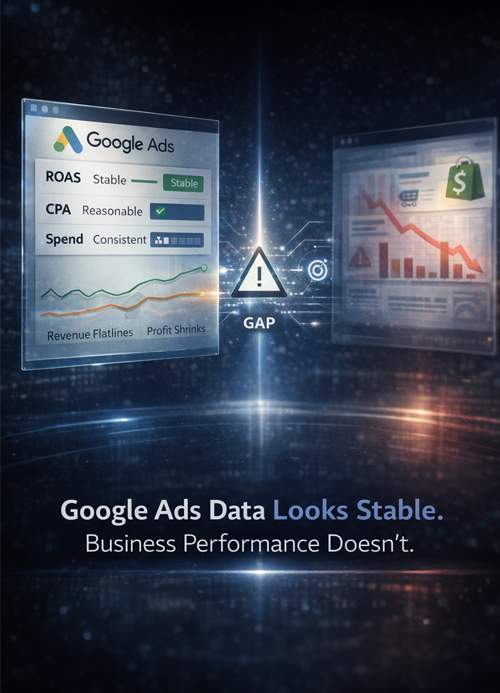
This is one of the most confusing moments in scaling a business. Google Ads looks stable: Yet overall performance slows. Revenue flattens. Profit shrinks. Confidence fades. So what’s actually happening? Google Ads is telling the truth—just not the whole truth Google Ads reports on its own system. It answers: What it doesn’t show: When founders […]

Founders don’t lack data.They lack time to interpret it correctly. Between Shopify, Google Ads, Meta, and dashboards, insight is buried under noise. This is where AI becomes genuinely useful—not as automation hype, but as a thinking assistant. AI as an interpretation layer Good AI doesn’t replace analytics.It connects them. Instead of asking: That shift is […]
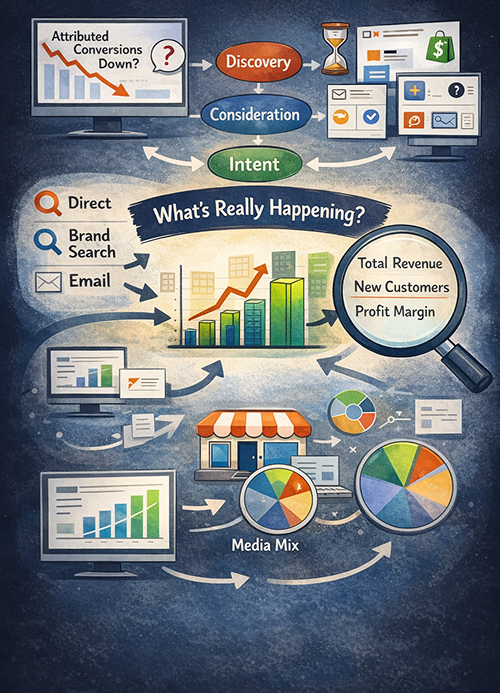
It’s become a common narrative: “Meta Ads don’t work like they used to.” But in many cases, performance hasn’t collapsed. Measurement has. The post-tracking reality Privacy changes didn’t kill Meta Ads.They broke how performance is observed. Founders now see: The mistake is assuming the channel is failing—when visibility is. Last-click bias hurts Meta the most […]