

It’s become a common narrative:
“Meta Ads don’t work like they used to.”
But in many cases, performance hasn’t collapsed. Measurement has.
Privacy changes didn’t kill Meta Ads.
They broke how performance is observed.
Founders now see:
The mistake is assuming the channel is failing—when visibility is.
Meta influences demand early:
But last-click models credit whoever closes the loop.
So Meta “loses” conversions to:
Meta didn’t stop working.
It stopped getting visible credit.
When founders cut Meta based on incomplete data:
Short-term efficiency improves. Long-term growth suffers.
The real question isn’t:
“What does Meta say?”
It’s:
When Meta is evaluated in context, a different picture emerges.
Founders who understand this stop chasing perfect attribution. They look for directional truth.
They connect:
Netsight helps surface these relationships—not by claiming certainty, but by restoring decision confidence.
Meta didn’t get worse.
Measurement got noisier.
The winners adapt how they read the signals.
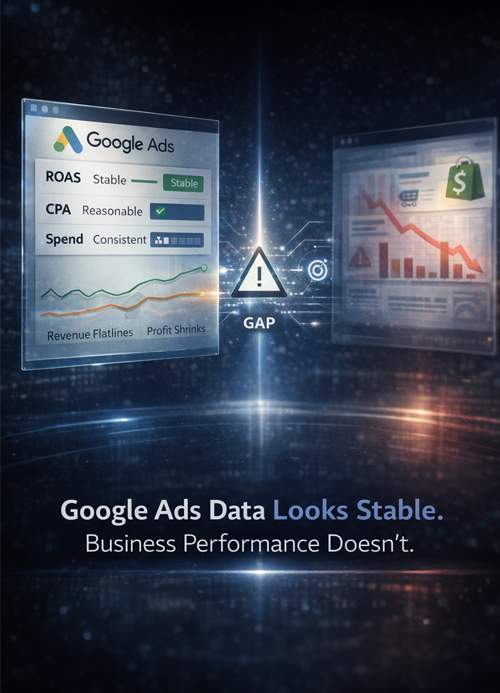
This is one of the most confusing moments in scaling a business. Google Ads looks stable: Yet overall performance slows. Revenue flattens. Profit shrinks. Confidence fades. So what’s actually happening? Google Ads is telling the truth—just not the whole truth Google Ads reports on its own system. It answers: What it doesn’t show: When founders […]

Founders don’t lack data.They lack time to interpret it correctly. Between Shopify, Google Ads, Meta, and dashboards, insight is buried under noise. This is where AI becomes genuinely useful—not as automation hype, but as a thinking assistant. AI as an interpretation layer Good AI doesn’t replace analytics.It connects them. Instead of asking: That shift is […]
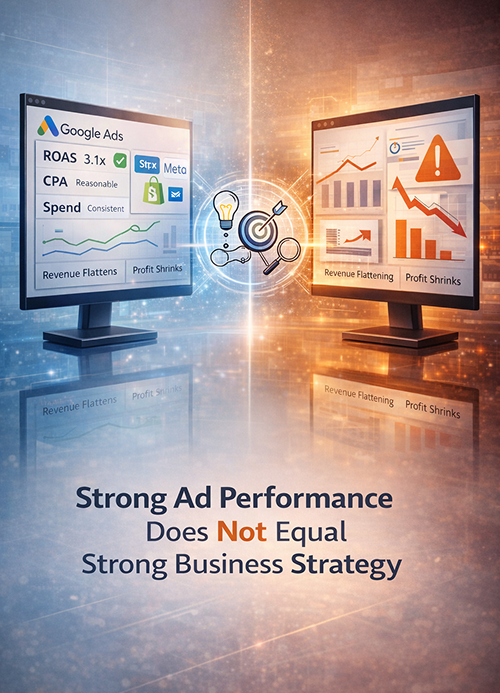
Many Shopify founders reach a familiar stage in their growth journey. Advertising platforms show strong performance. Traffic is steady. Sales continue to come in. From the outside, everything appears to be functioning well. Yet despite this activity, profitability feels underwhelming. Growth feels harder than it should. Decisions become reactive instead of deliberate. This disconnect often […]