

Most e-commerce brands operate in silos.
Each tells a different story.
When data is scattered:
Founders spend more time reconciling data than acting on it.
Every platform measures differently:
This creates multiple versions of the truth.
In short: bad decisions driven by incomplete data
Instead of relying on individual platforms, leading brands use a centralized analytics layer.
This approach:
Platforms like iSight are built for this—bringing Shopify, ads, and analytics into one cohesive system.
You don’t need more data.
You need connected data.
Because clarity doesn’t come from more tools—
it comes from better structure.
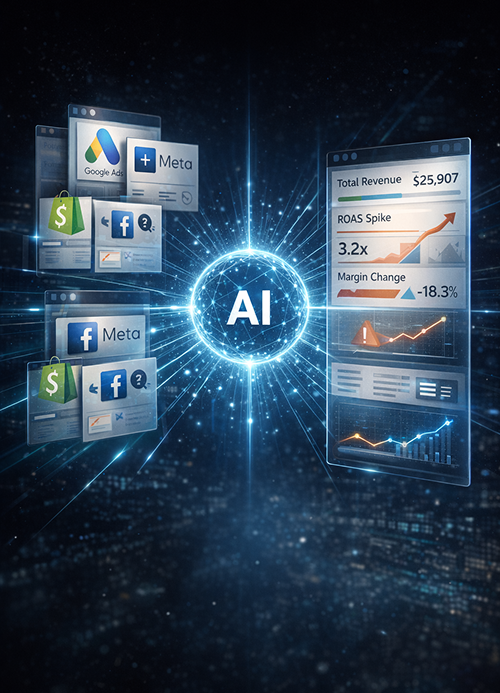
Founders don’t lack data.They lack time to interpret it correctly. Between Shopify, Google Ads, Meta, and dashboards, insight is buried under noise. This is where AI becomes genuinely useful—not as automation hype, but as a thinking assistant. AI as an interpretation layer Good AI doesn’t replace analytics.It connects them. Instead of asking: That shift is […]

Shopify Analytics looks reassuring at first glance.Revenue is up. Orders are steady. Conversion rate seems healthy. On paper, the business looks fine. But most founders eventually run into a frustrating moment:“If everything looks good here, why does growth feel harder than it should?” The gap between Shopify Analytics and business reality is subtle—but costly. The […]