
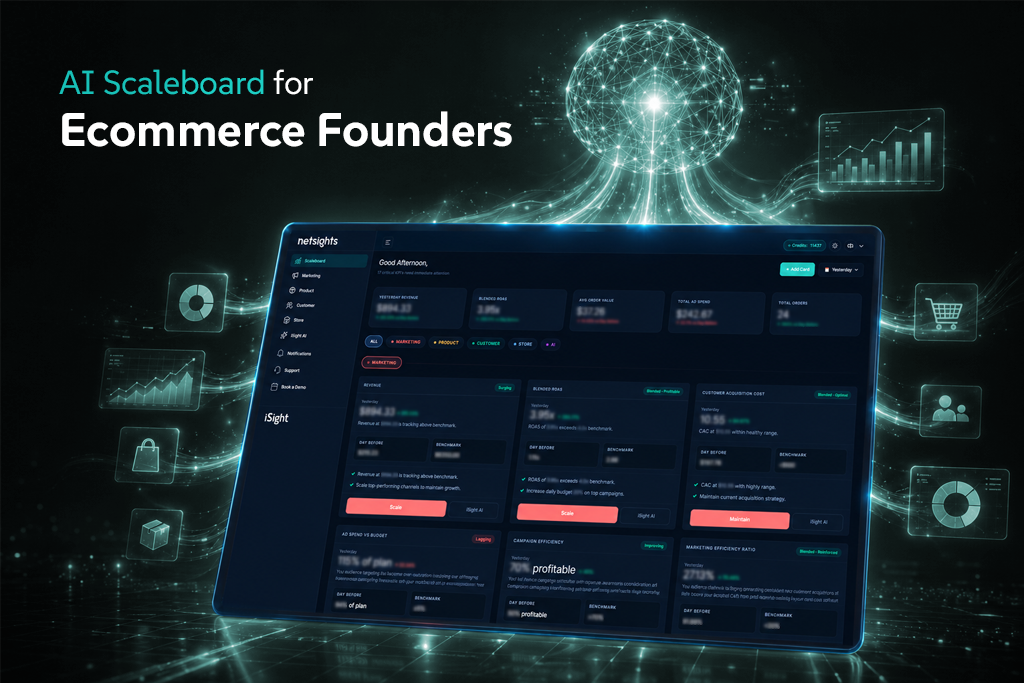
Ecommerce founders do not struggle because they lack data. They struggle because their data is scattered across Shopify, Meta Ads, Google Ads, GA4, CRM tools, finance reports, retention platforms, and fulfillment systems.
Shopify shows revenue. Meta Ads shows ROAS. Google Ads shows CPC. GA4 shows traffic and user behaviour. But these platforms rarely connect the dots to explain what changed, why it changed, what it is costing the business, and what action should be taken next.
In a typical ecommerce setup, a founder may check revenue in Shopify, ROAS in Meta Ads, CPC in Google Ads, and traffic in GA4, but still not know which issue needs action first. This is where daily reporting often becomes time-consuming, confusing, and difficult to act on.
This is where an AI Scaleboard becomes valuable.
Built for ecommerce founders and D2C brands, NetSights helps businesses move beyond traditional reporting. Instead of adding another ecommerce dashboard filled with charts, the platform connects key business data and turns it into daily, actionable insights.
Its positioning is simple: “Not just a Dashboard. A Scaleboard.” The official website describes it as an AI operating layer for D2C founders that helps them know what changed, what it is costing, and what to do next through WhatsApp before they open their laptop.
In simple words, it helps ecommerce founders stop checking multiple dashboards and start receiving decision-ready ecommerce business insights.
NetSights is an ecommerce analytics platform designed to help founders, CXOs, growth heads, and performance marketing teams understand business performance across revenue, marketing, product, customer, store, and operational metrics.
Unlike a normal ecommerce reporting tool, it is built around the idea of an AI Scaleboard. This means it does not just show data. It helps businesses understand what the data means and make better growth decisions.
A traditional ecommerce dashboard usually displays numbers like revenue, orders, sessions, ROAS, CAC, conversion rate, AOV, cart abandonment, or repeat purchase rate. These numbers are useful, but they still require manual interpretation.
The founder still has to ask:
An AI Scaleboard solves this by connecting multiple business systems into one intelligence layer, the platform brings together Shopify, Meta Ads, Google Ads, GA4, Search Console, Klaviyo, Shiprocket, Razorpay, Stripe, WooCommerce, and other ecommerce tools to create a unified view of performance.
This makes it more than an ecommerce dashboard. It becomes an AI dashboard for ecommerce that explains the business situation in a founder-friendly way.
For ecommerce businesses that want to understand the platform directly, the NetSights AI Scaleboard page explains how it turns scattered data into clear, actionable insights.
Most ecommerce businesses use several platforms at the same time. Shopify tracks sales and orders. Meta Ads tracks ad performance. Google Ads tracks paid search and shopping campaigns. GA4 tracks website behaviour and ecommerce events. CRM and retention tools track customer journeys, email, WhatsApp, cohorts, and repeat purchases.
Each tool is important, but each one only shows part of the picture.
For example, a founder may see that sales are down in Shopify, but the real reason could be rising ad costs, lower website sessions, poor product availability, or a drop in conversion rate. Without connecting these signals, teams often spend more time finding the problem than solving it.
Shopify Analytics helps merchants review store activity, visitors, web performance, and transactions from a unified reporting experience. Google Analytics ecommerce measurement helps businesses collect and analyse how customers interact with an online store.
These platforms are valuable. However, ecommerce founders often need a layer above them. They need a system that connects revenue, traffic, ad spend, product performance, customer behaviour, and operations into one clear business view.
That layer is the AI Scaleboard.
An AI Scaleboard helps ecommerce founders answer practical questions such as:
This is where the platform becomes useful for D2C brands. It does not simply display ecommerce performance tracking metrics. It converts those metrics into ecommerce business insights.
A dashboard shows data. A Scaleboard supports decisions.
That difference matters because founders do not need more tabs, charts, or reports. They need clarity. They need to know what is happening in the business, why it matters, and what action can protect or improve growth.
| Comparison Point | Traditional Ecommerce Dashboard | NetSights AI Scaleboard |
| Core Purpose | Shows ecommerce data and metrics. | Guides founders with decision-ready insights. |
| Main Function | Tracks sales, traffic, orders, ROAS, CAC, conversion rate, and product performance. | Explains what changed, why it changed, what it means, and what action to take next. |
| Founder Effort Required | The founder needs to manually interpret the data. | AI helps interpret the data and gives clear recommendations. |
| Data View | Usually shows numbers, charts, and reports. | Shows intelligence cards with data, comparison, diagnosis, recommendation, and CTA. |
| Decision Support | Mainly reporting-focused. | Built for decision intelligence and faster business action. |
| Problem Detection | Shows that a metric has changed. | Highlights the possible reason behind the change and its business impact. |
| Example Insight | “ROAS dropped by 18%.” | ROAS dropped because spending increased while conversions declined. Review the campaign before scaling the budget. |
| Business Impact Visibility | Does not always show the cost of ignoring the issue. | Highlights cost-of-inaction alerts to show potential revenue or performance impact. |
| Cross-Platform Understanding | Often requires manual comparison between tools. | Connects data from Shopify, Meta Ads, Google Ads, GA4, and more. |
| Best For | Teams that only need visibility into ecommerce metrics. | Ecommerce founders and D2C brands that need clarity, speed, and smarter growth decisions. |
The official NetSights website explains this shift clearly: traditional dashboards require users to interpret data themselves, while a Scaleboard gives decisions with cost-of-inaction context, blended metrics, and AI-led diagnosis.
One of the strongest features is its WhatsApp-first delivery model. The platform sends a daily operating brief at 6 AM with revenue, ad performance, anomalies, and the one alert that needs attention.
This is useful because founders do not always have time to log into multiple tools every morning. A short WhatsApp brief can help them understand business health before starting the day.
For a D2C founder, this means fewer manual checks and faster decisions.
The AI Scaleboard includes intelligence cards across Marketing, Product, Customer, and Store, including blended cards that no single platform can build alone.
These cards are designed to cover important ecommerce growth areas such as:
This makes it a useful ecommerce growth dashboard for founders who need a complete view of their store.
One major challenge in ecommerce analytics is that no single platform tells the full story. Meta Ads may show one version of ROAS. Google Ads may show another. Shopify may show total revenue. GA4 may show traffic and conversion behaviour. Finance tools may reveal margin pressure.
The platform connects these signals to build blended metrics. For example, the official website describes True Blended CAC as a metric that can combine Meta, Google, agency fees, tool costs, and Shopify orders.
For ecommerce founders, this is important because a profitable scale depends on understanding the full cost of growth, not just platform-reported performance.
The platform also includes iSight AI intelligence, an AI-powered revenue intelligence engine. It analyses Shopify store data, ads, and customer data, then explains what is happening and what to do next.
iSight is designed to monitor performance metrics, detect anomalies, identify root causes, forecast revenue, and recommend actions. Its core capabilities include AI anomaly detection, predictive revenue forecasting, performance intelligence, inventory risk modelling, and budget optimisation signals.
This makes it valuable for D2C founders, growth heads, performance marketers, and ecommerce agencies that need faster insight into daily revenue movement.
Netification KPI alerts help ecommerce teams monitor important business metrics and get notified when something needs attention.
For ecommerce businesses, this is valuable because many issues become expensive when they are discovered late. A sudden ROAS drop, conversion rate decline, spend spike, revenue dip, or SKU stock issue can directly affect daily growth.
By surfacing alerts faster, Netification helps founders and teams act before small issues become bigger problems.
Netty WhatsApp AI Copilot makes ecommerce analytics more conversational. Instead of opening dashboards and searching through reports, users can ask business questions directly through WhatsApp.
The iSight page explains Netty as the way users access the intelligence engine instantly on WhatsApp. Sample questions include “What’s today’s revenue?”, “Why did ROAS drop?”, “Which campaign should I scale?”, and “Forecast month-end revenue.”
For busy founders, this makes analytics easier to access and faster to use.
Revenue is not affected by one factor alone. It can change because of traffic, conversion rate, AOV, ad spend, product availability, discounting, customer demand, or repeat purchase behaviour.
An AI Scaleboard helps ecommerce founders connect these signals instead of reviewing them separately. This gives leadership teams a clearer view of what is actually driving growth.
Performance marketing teams often track Meta Ads, Google Ads, CAC, ROAS, CTR, CPC, CVR, and spend separately. The challenge is not tracking these metrics. The challenge is knowing what they mean together.
Google Ads documentation explains Target ROAS as a bidding strategy available for individual campaigns or across multiple campaigns. While platform-level ROAS is useful, founders also need to understand business-level performance.
For example, a campaign may show a good ROAS, but if discounts are high, CAC is rising, repeat purchase is weak, or margin is low, the business may still be under pressure.
This is why an AI analytics tool for ecommerce business should connect ad performance with revenue, margins, and customer behaviour.
A product may generate high revenue but low margin. Another SKU may sell slowly but attract loyal customers. A bundle may improve AOV. A hero product may drive first purchases but fail to create repeat customers.
The AI Scaleboard helps ecommerce founders look beyond surface-level sales numbers and understand product performance in relation to growth.
This is especially useful for Shopify brands, D2C companies, and ecommerce teams managing multiple product categories.
Ecommerce growth requires daily decision-making. Waiting for weekly reports or manual analysis can slow down the business.
In fast-moving D2C brands, even a one-day delay in spotting a ROAS drop, checkout issue, or inventory risk can affect revenue. This is why founders need insights that are not only accurate, but also timely and easy to act on.
An AI-powered ecommerce reporting tool helps teams move faster by surfacing anomalies, risks, and opportunities in a format that founders can understand quickly.
This is especially useful for brands spending heavily on ads, managing inventory cycles, and tracking daily revenue targets.
A founder wakes up and sees that yesterday’s revenue dropped by 14%. A normal ecommerce dashboard may show the decline, but the founder still has to investigate.
With an AI Scaleboard, the system can connect multiple signals and help identify whether the drop came from lower traffic, reduced conversion rate, ad performance decline, product availability, or checkout friction.
The founder can then act faster instead of spending the morning checking several different platforms.
A performance marketer may see strong ROAS inside Meta Ads, but the founder may still feel cash flow pressure. This can happen when CAC is high, discounts are heavy, shipping cost is increasing, or repeat purchase rate is weak.
The platform helps by looking at blended metrics and business-level impact, not just ad platform numbers.
This allows founders to understand whether growth is actually profitable.
A product may be performing well, but if stock is running out, the brand may lose revenue in the coming days.
iSight includes inventory risk modelling, stock-out timelines, revenue at risk, and SKU velocity changes as part of its intelligence capabilities.
This helps ecommerce teams plan restocking, marketing budgets, and product pushes more intelligently.
Instead of opening Shopify, Meta Ads, Google Ads, GA4, and retention dashboards, the founder receives a WhatsApp brief showing the most important business signals.
This makes the platform helpful for founders who want daily clarity without dashboard fatigue.
A growth team may need to decide whether to increase spend, reduce spend, shift budget, pause an ad set, or push a stronger product.
iSight includes budget optimisation signals such as campaigns to scale, ad sets to pause, underperforming spend, and reallocation opportunities.
This helps teams turn ecommerce analytics into action.
AI is becoming more important in ecommerce because businesses are dealing with more data, more channels, and faster decision cycles.
Modern ecommerce brands need to understand customer journeys across ads, search, store behaviour, product performance, checkout, retention, and fulfilment. Manual reporting can show what happened, but AI can help identify patterns, detect anomalies, and recommend next steps.
McKinsey notes that AI and generative AI can help companies scale their ability to personalise experiences as consumers seek more tailored online interactions.
For ecommerce founders, this shift is not only about customer-facing personalisation. It is also about internal decision-making. An AI Scaleboard can help founders understand performance, reduce guesswork, and make faster decisions based on connected data.
NetSights is designed for ecommerce teams that want clearer visibility, faster reporting, and smarter growth decisions from one connected intelligence layer.
| Ideal Users | How NetSights Helps |
| Ecommerce Founders | Get daily clarity on revenue, sales, ads, and business performance without checking multiple platforms. |
| D2C Brand Owners | Understand what is driving growth, where performance is dropping, and what needs attention. |
| Shopify Store Owners | Connect store data with marketing, customer, and operational insights in one place. |
| Growth Heads | Track key metrics like CAC, ROAS, AOV, CVR, LTV, and revenue trends more effectively. |
| Performance Marketing Teams | Monitor Meta Ads, Google Ads, campaign performance, spend efficiency, and ROAS movement. |
| Ecommerce Agencies | Manage multiple brand accounts with faster insights, clearer reporting, and better client recommendations. |
| Revenue Leaders and CXOs | Access decision-ready insights that support faster planning, forecasting, and growth decisions. |
| Teams Facing Dashboard Fatigue | Replace scattered reports and manual checks with AI-powered ecommerce insights. |
Ecommerce brands are no longer struggling with a lack of data. They are struggling with scattered data, delayed reporting, and unclear decision-making. Founders need more than a dashboard that only shows numbers. They need a system that explains what changed, why it matters, and what action should be taken next.
That is where an AI Scaleboard creates real value. It connects ecommerce performance across sales, ads, customer behaviour, product movement, and operations, then turns that data into clear business insights. Instead of spending time switching between Shopify, Meta Ads, Google Ads, GA4, and other tools, founders can focus on decisions that directly impact growth.
For D2C brands and ecommerce teams, NetSights brings this intelligence into one place with daily insights, KPI alerts, WhatsApp updates, and AI-powered recommendations. It helps teams reduce guesswork, act faster, and scale with more confidence.
If you are ready to move beyond traditional ecommerce dashboards, explore NetSights AI Scaleboard and see how it can help your brand turn scattered data into smarter growth decisions. Start your Free trial today and discover what your ecommerce data is trying to tell you.
Your ecommerce store already contains the answers. Learn how AI ecommerce analytics helps founders ask business questions, understand what changed and why, and move from scattered data to clearer decisions.
Your ecommerce store already contains the answers. Learn how AI ecommerce analytics helps founders ask business questions, understand what changed and why, and move from scattered data to clearer decisions.
Your ecommerce store already contains the answers. Learn how AI ecommerce analytics helps founders ask business questions, understand what changed and why, and move from scattered data to clearer decisions.