
Running a successful ecommerce business means making dozens of decisions every single day. What products should you push harder? Which marketing channels deliver the best return? Why is your conversion rate dropping? Should you increase inventory for this SKU? These questions demand answers fast.
The challenge is that data for ecommerce decision-making lives everywhere. Your Shopify store tracks sales and customer behavior. Google Ads shows your spending and ROAS. GA4 captures user interactions. Klaviyo holds customer segmentation and email performance. Meta Ads reveals campaign performance. Meanwhile, your actual business questions, the ones that drive revenue, often get buried under scattered data and delayed reporting.
This is where eCommerce decision intelligence enters the picture. It’s the difference between having data and using data to drive growth. For D2C founders, Shopify store owners, and ecommerce agencies, decision intelligence has become essential infrastructure, not a nice-to-have feature.
Platforms like NetSights are transforming how ecommerce businesses operate by connecting all their data in real-time and delivering AI-powered insights that drive immediate action.
Let’s explore what eCommerce decision intelligence actually is, why it matters for your bottom line, and how forward-thinking ecommerce businesses are leveraging it to outpace the competition.
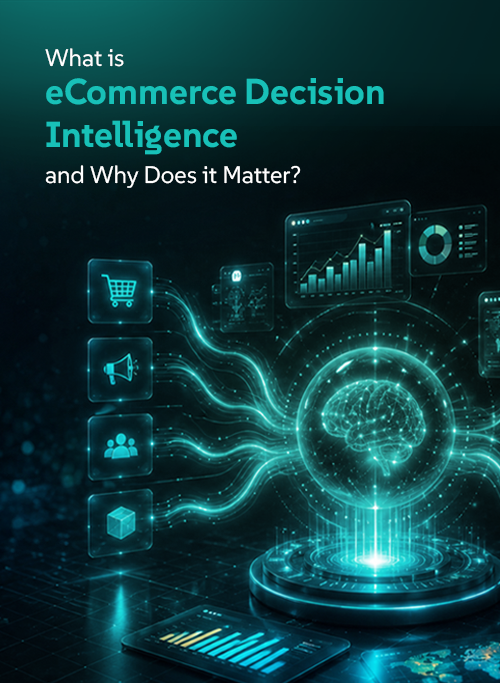
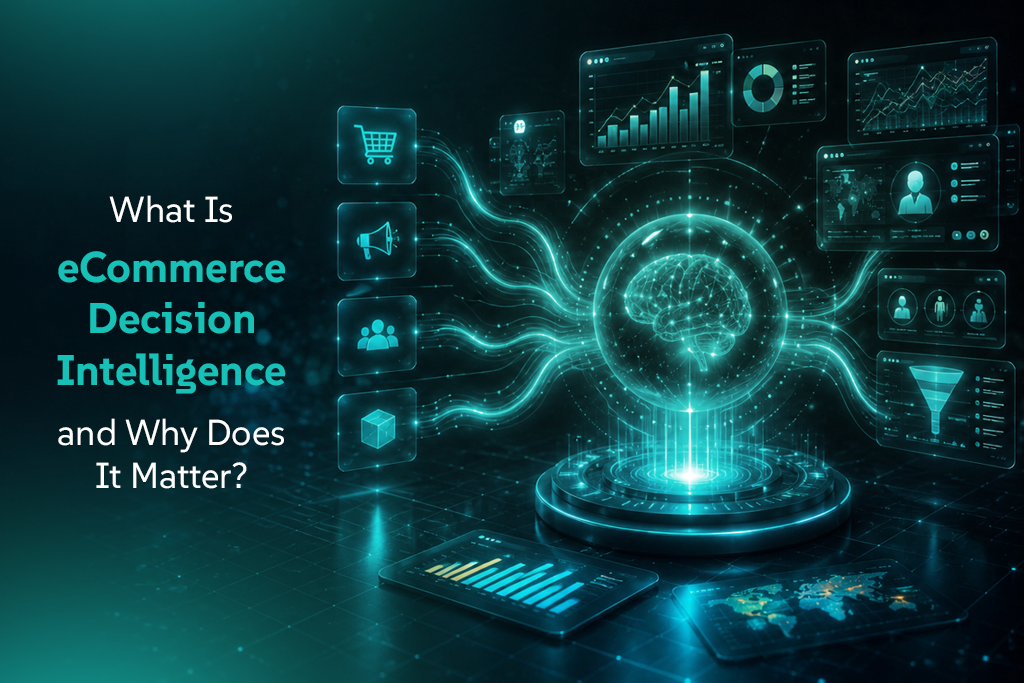
eCommerce decision intelligence refers to the ability to gather, connect, and analyze business data across all your ecommerce platforms and then translate that analysis into actionable insights you can act on immediately.
It’s more than just ecommerce analytics. Traditional ecommerce analytics tools tell you what happened. A dashboard shows you had 500 orders yesterday, your AOV was $45, and your conversion rate was 2.3%. That’s useful, but it doesn’t answer the real questions.
Decision intelligence answers why things happened and what to do about it. Why did cart abandonment spike on Tuesday? Which customer acquisition channel delivers the best LTV? Is your CAC justified by customer lifetime value? Should you pause this campaign or scale it?
The foundation of decision intelligence relies on:
1. Connected ecommerce analytics:
Real-time integration across Shopify, WooCommerce, Google Ads, Meta Ads, GA4, Google Search Console, Klaviyo, and other core business intelligence platforms. Rather than logging into five different dashboards, you see all your data in one connected ecosystem.
2. Real-time analytics and alerts:
Instead of discovering a problem days later when you review reports, decision intelligence systems flag issues as they happen. A sudden drop in conversion rate. Unusual cart abandonment patterns. Revenue leakage you might otherwise miss.
3. Predictive analytics and forecasting: Going beyond what happened to predict what will happen. Will this trend continue? How will we perform next month based on current velocity? What’s the revenue impact of this decision?
4. AI-powered insights: Machine learning models that detect anomalies, identify patterns, and surface the insights that matter most. For busy founders and revenue leaders, AI-powered insights cut through the noise.
5. Blended metrics: Understanding how metrics connect to each other. Your conversion rate might look fine, but when you blend it with your CAC and LTV, and see the LTV:CAC ratio, you realize your customer acquisition cost is unjustified. Decision intelligence frameworks bring these blended metrics together in one view.
Most ecommerce businesses operate with what we call “dashboard fatigue.” You have GA4 for traffic data, Shopify for orders, Google Ads for spend, Klaviyo for retention, and a dozen other data sources. Getting a complete picture requires jumping between platforms, manually pulling numbers, and hoping you’re comparing the same date ranges.
This scattered data approach creates real business problems:
For D2C brands and Shopify store owners, these inefficiencies aren’t abstract, they translate directly to lost revenue and missed growth.
Sarah manages paid ads for a D2C brand selling premium skincare. She’s profitable, but she’s hitting a growth ceiling. Her ROAS looks healthy across Google Ads and Meta Ads, but something doesn’t feel right.
Without decision intelligence, she’d spend days analyzing data:
With ecommerce decision intelligence (like AI Scaleboard), she sees immediately:
With these insights, Sarah adjusts strategy: She allocates more budget to email and SMS for existing customers (higher LTV), refines her paid ads to target customers with higher repurchase intent, and launches a re-engagement campaign for past buyers. Within two months, her blended LTV:CAC ratio improved to 2.8:1, a profitable foundation for scaling.
Raj runs a Shopify store managing three product categories with different margins and seasonality. As his business grows, he’s increasingly blind to what’s actually driving revenue.
His manual process:
With ecommerce analytics powered by decision intelligence, Raj gets:
Now Raj makes decisions confidently. He pauses underperforming SKUs before they drain margin. He spots trends early and adjusts inventory. He scales winning campaigns with confidence. His ecommerce business intelligence system has become an essential infrastructure for growth.
Effective decision intelligence doesn’t just track individual metrics—it connects them into a cohesive story about your business health.
These metrics individually are useful. Connected together, they tell the real story of business health and opportunity.
Decision intelligence requires seamless integration across your entire tech stack. For most ecommerce businesses, this includes:
Rather than building integrations to each platform, modern decision intelligence platforms use unified connectors that automatically sync data in real-time. NetSights connects all these sources automatically, giving you a unified view of your entire business.
Beyond data connection, decision intelligence uses AI and machine learning to:
This AI component is critical. With thousands of data points, manual analysis becomes impossible. AI surfaces the 3-5 insights that actually matter for your business right now.
Instead of static reports generated on a schedule, modern decision intelligence delivers:
NetSights users get access to iSight, a real-time analytics platform that delivers insights as they happen, plus Netification for automated customer communication insights.
What platforms currently hold your business data? Shopify, Google Ads, GA4, Klaviyo, Meta Ads, CRM, inventory management system, etc. Document which systems are critical for your business decisions.
What do you wish you could answer faster? For D2C founders, this might be: “Will we hit our revenue target this month?” For performance marketers: “Which channels drive the highest LTV?” For ecommerce agencies: “What’s the true profitability of each client’s marketing mix?”
Look for platforms that:
NetSights is purpose-built for D2C and ecommerce founders with all these features. The platform connects your entire tech stack automatically and delivers insights that drive immediate action. Most NetSights users see time savings within the first week and revenue impact within 30 days. Start with AI Scaleboard for growth-focused insights or iSight for real-time ecommerce analytics.
What are the 8-10 metrics that matter most for your business? These should be metrics you check weekly or more frequently—the ones that drive business decisions. Configure these in your decision intelligence system with appropriate thresholds and alerts.
Decision intelligence is only valuable if your team uses it. Ensure that:
|
Factor |
Manual Analytics |
Decision Intelligence |
|
Data Freshness |
Daily/Weekly reports |
Real-time updates |
|
Time to Insight |
2-5 days (manual pulls) |
Immediate (automated alerts) |
|
Accuracy |
Prone to human error |
Consistent and reliable |
|
Anomaly Detection |
Missed until review |
Automatic flagging |
|
Predictive Capability |
Manual guessing |
AI-powered forecasting |
|
LTV:CAC Visibility |
Requires manual calculation |
Always current |
|
Team Time Cost |
10-20 hours/week |
0-2 hours/week (setup only) |
|
Scaling Cost |
Increases with company growth |
Minimal (automated) |
|
Decision Speed |
Weeks to implement changes |
Days to weeks |
|
Attribution Clarity |
Manual channel analysis |
Blended metrics across sources |
eCommerce competition has shifted. Success is no longer about having data, it’s about acting on data faster than your competitors.
The D2C brands, Shopify store owners, and ecommerce agencies that win in 2024 and beyond are those that:
eCommerce decision intelligence is no longer a competitive advantage, it’s becoming table stakes. Your competitors are already making decisions faster and with better data visibility. The question isn’t whether to implement decision intelligence, but when.
If you’re ready to stop struggling with scattered data and start making faster, more confident decisions, get started with NetSights. See how connected ecommerce analytics and AI-powered insights can transform your business.
Ready to transform how you run your ecommerce business?
NetSights is purpose-built for D2C founders, Shopify store owners, and ecommerce agencies who want to stop guessing and start deciding with confidence. Connect your entire tech stack in minutes. Get AI-powered insights in real-time. Scale profitably with complete visibility.
Start your free trial today and see how NetSights can help you make faster, smarter decisions. Most users see measurable time savings within a week and revenue impact within 30 days.
Your data is already telling a story. It’s time to start listening.
A: Traditional BI requires SQL knowledge and technical setup. Decision intelligence is built for ecommerce operators like founders and marketers who need instant answers without coding expertise.
A: Yes. Small stores save the most time by eliminating manual reports and spotting issues faster. Real-time alerts help founders make quick decisions with limited data.
A: Most decision intelligence platforms integrate with multiple ecommerce systems. Check compatibility before committing. The core benefits like real-time alerts and AI insights work across platforms.
A: Basic setup takes 1-2 weeks. Full team adoption takes 4-6 weeks. ROI appears immediately through time savings on reporting.
A: No. It augments human decisions by surfacing patterns and alerts. Your team still sets strategy and implements changes. The system makes decisions faster and more confidently.
A: Focus on revenue-impacting metrics: conversion rate, AOV, CAC, LTV, repeat purchase rate, and inventory. Track 8-12 core metrics closely rather than 50 loosely.
A: Choose platforms with strong validation. Audit integrations quarterly. Spot-check automated insights against raw data. Most issues are from misconfiguration, not platform errors.
A: Yes. Agencies save hours per week on reporting and deliver better client results. Real-time performance dashboards improve client retention.
Netsights delivers AI-Powered Decision Intelligence for Founders and CXOs
Helping eCommerce businesses turn scattered data into clear, actionable insights. It connects key business systems to provide a unified view of performance across revenue, marketing, operations, and inventory.
Through automated analysis, smart alerts, and conversational insights, Netsights highlights what is working, what needs attention, and where growth opportunities exist. It enables leadership teams to move from raw data to faster, confident decision – without manual analysis or complex reporting.
We use cookies to enhance your browsing experience. By clicking Accept, you consent to our use of cookies.