
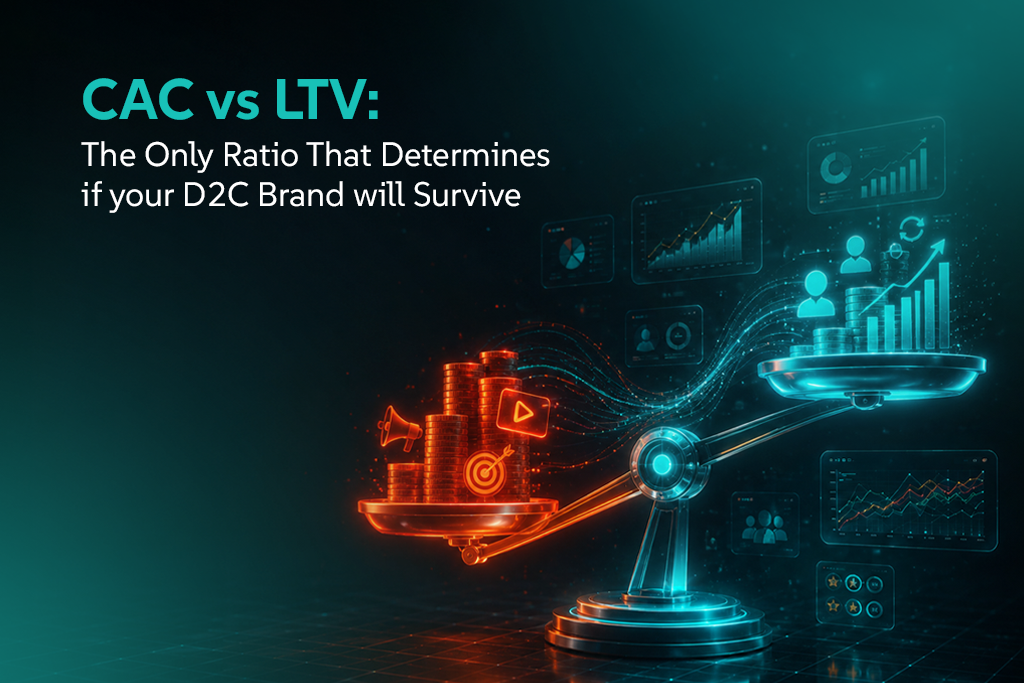
A D2C brand can look successful on the surface and still be financially weak underneath.
Revenue may be growing. Orders may be increasing. Meta Ads and Google Ads may be bringing traffic. Shopify may show a healthy topline. But if the brand is spending too much to acquire customers who do not return, growth can quickly become expensive, unstable, and difficult to sustain.
This is why CAC and LTV are two of the most important numbers for ecommerce founders.
CAC, or customer acquisition cost, tells you how much it costs to acquire one new customer. LTV, or lifetime value, tells you how much value that customer brings to the business over time. When these two metrics are compared, they show whether a brand is growing profitably or simply paying too much for short-term revenue.
For D2C founders, growth teams, performance marketers, and revenue leaders, the CAC vs LTV relationship is not just a marketing metric. It is a business survival metric.
A brand with rising CAC, low LTV, weak retention, and poor repeat purchase behaviour may keep spending on acquisition to maintain revenue. But if each customer does not generate enough lifetime value, the business becomes dependent on constant paid acquisition. Over time, this creates pressure on margins, cash flow, and profitability.
In this blog, we will break down what CAC and LTV mean, how to calculate the LTV:CAC ratio, why it matters for D2C brands, and how ecommerce teams can improve this ratio for more sustainable growth.
Customer acquisition cost is the amount a brand spends to acquire a new customer. The basic formula is simple:
CAC = Total Sales and Marketing Cost ÷ Number of New Customers Acquired
For example, if a brand spends ₹5,00,000 in a month and acquires 2,000 new customers, the CAC is ₹250.
But the formula is only the starting point. The real challenge is deciding what should be included in the acquisition cost. Many D2C brands look only at ad spend, which makes CAC appear lower than it actually is. In reality, acquisition costs may include Meta Ads, Google Ads, influencer fees, creative production, agency retainers, landing page tools, first-purchase discounts, affiliate commissions, and other campaign-related costs.
This is where many founders misread performance.
A campaign may look profitable inside an ad platform, but once creative cost, agency fees, discounts, shipping, payment fees, and returns are considered, the actual cost of acquiring that customer may be much higher.
For D2C brands, CAC should not be treated as just a media buying number. It should be treated as a business efficiency number. It tells you how expensive growth has become and whether your acquisition engine is sustainable.
LTV is an acronym for Lifetime Value which means the total contribution of that particular customer during their entire tenure.
The most simple way to compute Lifetime Value is through using this formula:
LTV = Average order Value x Purchase frequency x Customer lifespan
Thus, if we take an example and assume the Average Order Value is ₹1,500 per purchase per individual customer, 3 purchases per year, and customer longevity is 2 years, then the computed lifetime value will come out to ₹9,000.
However, this number may turn out to be somewhat deceiving as only the revenue has been taken into account. When a customer spends ₹9,000, lifetime value won’t just equal ₹9,000. Cost of the product, delivery charges, transaction fees, discount rates, refund rates, customer support expenses, marketing costs can alter the lifetime value.
For instance, this is the reason why successful ecommerce companies prefer to measure their LTV on the basis of margin adjusted figures.
A major advantage of a brand having a high lifetime value is its ability to attract repeat customers. However, the problem arises when those repeated purchases turn out to be discounted purchases. This means there won’t be much profit left for the company at all.
This becomes particularly relevant for direct to consumer categories like fashion, beauty, wellness, foods, jewelry, and lifestyle goods.
LTV is not just about how much a customer spends. It is about how much value the customer creates after all business costs are considered.
Looking at CAC alone tells you how expensive acquisition is. Looking at LTV alone tells you how valuable customers may become. But looking at CAC vs LTV tells you whether the business model can survive.
The relationship is measured through the LTV:CAC ratio:
LTV:CAC Ratio = Customer Lifetime Value ÷ Customer Acquisition Cost
If your LTV is ₹3,000 and your CAC is ₹1,000, your LTV:CAC ratio is 3:1.
This means every ₹1 spent on acquisition generates ₹3 in lifetime value.
A 3:1 ratio is often considered a healthy benchmark for ecommerce businesses, but it should not be treated as a fixed rule for every brand. A premium skincare brand, a low-margin apparel brand, and a subscription-based wellness brand will all have different economics.
The right ratio depends on gross margin, category behaviour, payback period, repeat purchase rate, customer retention, and cash flow.
If the ratio is too low, the brand may be spending too much to acquire customers. If the ratio is too high, it may mean the brand has strong retention, but it could also suggest that the business is under-investing in growth.
The aim is not to chase the highest possible ratio. The aim is to understand whether acquisition, retention, and profitability are working together.
The LTV:CAC ratio gives founders a quick way to understand acquisition efficiency. But the number only becomes useful when it is interpreted in context.
|
LTV:CAC Ratio |
What It Usually Indicates |
|
Below 1:1 |
The brand may be losing money on acquisition |
|
1:1 to 2:1 |
Revenue may be growing, but profitability is likely weak |
|
Around 3:1 |
Often considered a healthy and scalable range |
|
4:1 to 5:1 |
Strong customer value, but growth investment should be reviewed |
|
Above 5:1 |
May indicate strong retention, or possible under-investment in acquisition |
This table should be used as a guide, not a universal rule.
For example:
A brand with high gross margin and strong repeat purchase behaviour can afford a higher CAC because customers are likely to generate more value over time. A low-margin brand with high shipping costs, high returns, or low repeat purchase rate needs to recover acquisition cost much faster.
This is why CAC vs LTV should always be reviewed with payback period, contribution margin, retention rate, and repeat purchase behaviour.
A good ratio is only good if the business has enough margin and cash flow to support it.
Many D2C brands first notice a CAC problem when revenue is growing but cash flow still feels tight.
The ads are active. Orders are coming in. Campaign reports may look acceptable. But after product cost, discounts, agency fees, shipping, returns, packaging, and payment fees are accounted for, the brand may realise that each new customer is contributing very little profit.
This is a unit economics problem.
High CAC becomes risky when the first order does not recover enough contribution margin and customers do not return quickly enough. In that situation, the business has to keep spending more money to acquire the next customer, the next order, and the next revenue spike.
This creates acquisition-heavy growth.
A founder may feel that the brand is scaling because revenue is increasing. But if the business depends too heavily on paid acquisition and does not build retention, growth becomes fragile.
For example:
A fashion brand may spend aggressively on Meta Ads during a sale period. The campaign may generate strong order volume, but if most customers buy only once because of a discount and do not return at full price, the brand may have acquired low-value customers at a high cost.
In this situation, ROAS alone will not show the full picture. The founder needs to understand CAC, LTV, blended CAC, repeat purchase rate, and customer payback period together.
Low LTV usually means the brand is not generating enough value after the first purchase.
This can happen for many reasons. Customers may not have a strong reason to return. The product may not naturally support repeat buying. The post-purchase journey may be weak. The brand may not be educating customers, cross-selling relevant products, or building loyalty. In some cases, the customer experience itself may be hurting retention.
Low lifetime value makes acquisition more dangerous because the brand has fewer chances to recover CAC.
For example:
A skincare brand may acquire a customer through a first-purchase discount. If the customer does not receive proper product education, routine guidance, replenishment reminders, or relevant product recommendations, they may never place a second order.
The acquisition cost is paid upfront, but the expected lifetime value never arrives.
This is why retention marketing is not just a CRM activity. It is a profitability function.
Email automation, WhatsApp journeys, loyalty programmes, subscription models, replenishment reminders, winback campaigns, cross-selling, upselling, and customer segmentation all play a role in increasing LTV.
For many D2C brands, the second and third orders are where the business starts becoming healthier.
Let us take a realistic example.
A D2C apparel brand spends ₹10,00,000 in a month on customer acquisition. It acquired 4,000 new customers, so its CAC is ₹250.
At first glance, this looks efficient.
Now let us look deeper.
|
Metric |
Value |
|
Monthly acquisition spend |
₹10,00,000 |
|
New customers acquired |
4,000 |
|
CAC |
₹250 |
|
Average order value |
₹900 |
|
Gross margin |
45% |
|
First-order gross profit |
₹405 |
|
Estimated LTV |
₹1,100 |
|
LTV:CAC ratio |
4.4:1 |
The ratio looks healthy. But the picture changes once the brand accounts for shipping cost, return rate, discounts, payment gateway fees, packaging, and fulfillment cost.
If the first order contributes very little after all variable costs, the brand depends heavily on repeat purchases to become profitable. If repeat purchase rate is weak, the attractive LTV:CAC ratio may not translate into strong cash flow.
This is why founders should not review CAC vs LTV as a vanity calculation. They should ask:
This type of interpretation is what turns CAC and LTV from spreadsheet metrics into business decision tools.
As D2C brands grow, CAC and LTV need to be measured with more precision.
Channel CAC is useful for understanding how Meta Ads, Google Ads, influencer campaigns, SEO, affiliates, or referral programmes perform individually. However, customers rarely follow a straight path from one channel to purchase.
A customer may see a Meta ad, search the brand on Google, browse the Shopify store, receive a WhatsApp message, and then purchase after an email reminder. If every channel claims credit, platform-level CAC can become confusing.
This is where blended CAC becomes useful.
Blended CAC looks at total acquisition spend across channels and compares it with total new customers acquired. It gives founders a cleaner view of what the business is actually paying to acquire customers overall.
Payback period is another important metric. It shows how long it takes to recover the cost of acquiring a customer. A brand may have a good LTV:CAC ratio, but if it takes six or nine months to recover CAC, cash flow may still become tight.
Margin-adjusted LTV adds another layer of clarity. It helps founders understand customer value after gross margin and variable costs, not just revenue.
Together, blended CAC, payback period, and margin-adjusted LTV help D2C brands understand whether growth is truly sustainable.
Improving the CAC vs LTV ratio does not mean cutting marketing spend blindly. It means making acquisition more efficient while increasing the value of each customer.
The first step is to reduce waste in acquisition. This usually starts with better campaign structure, stronger creative testing, sharper audience segmentation, better landing pages, and clearer product positioning. If conversion rate improves, the brand can acquire more customers from the same traffic, which naturally reduces CAC.
But reducing CAC is only half the equation.
The bigger long-term opportunity is improving LTV.
A brand can increase lifetime value by improving post-purchase journeys, encouraging repeat purchases, building loyalty, offering relevant product bundles, using replenishment reminders, and personalising retention campaigns. The goal is to make customers return because the brand experience and product value are strong, not only because another discount is offered.
For example:
A wellness brand can improve LTV by guiding customers through routines and subscription options. A fashion brand can improve LTV through seasonal recommendations, style-based product journeys, and loyalty-led retention. A beauty brand can improve LTV through replenishment reminders, product education, and cross-selling complementary products.
The best D2C brands do not treat acquisition and retention as separate teams with separate goals. They connect both sides of the customer journey.
A customer acquired through paid ads should enter a strong post-purchase experience. That experience should improve repeat purchase behaviour, which improves LTV, which then makes CAC easier to justify.
Most founders understand that CAC and LTV matter. The real challenge is tracking them accurately across different systems.
CAC may be spread across Meta Ads, Google Ads, influencer spends, agency fees, creative costs, affiliate payouts, and promotional discounts. LTV may depend on Shopify orders, repeat purchase behaviour, customer cohorts, CRM data, email engagement, WhatsApp journeys, and product-level margins.
When these signals sit in separate tools, founders often struggle to see the full picture.
That is where decision intelligence becomes useful.
A connected system can help ecommerce teams understand whether rising CAC is a campaign issue, a conversion issue, a channel mix issue, or a retention issue. It can also help teams see whether LTV is improving because customers are buying more often, spending more per order, or staying active for longer.
For brands still relying on static reporting, the comparison between traditional dashboards and a decision-focused layer is important. This is explained further in the blog on NetSights vs ecommerce dashboards and Scaleboard difference.
For founders who want a broader view of how an AI-led operating layer supports ecommerce growth, the guide on AI Scaleboard for ecommerce founders provides useful context.
The challenge with CAC and LTV is not only calculation. It is consistent.
If acquisition data sits in ad platforms, customer data sits in Shopify, retention data sits in CRM tools, and profitability lives in spreadsheets, teams may spend more time reconciling numbers than acting on them.
NetSights AI Scaleboard helps ecommerce teams connect these signals across revenue, marketing, customers, products, and operations. This makes it easier to view CAC, LTV, blended CAC, ROAS, AOV, retention rate, repeat purchase rate, and profitability signals together.
iSight AI revenue intelligence supports deeper performance analysis by helping teams identify revenue movement, risks, and business signals that need attention.
Netification KPI alerts helps teams stay updated when important metrics move in the wrong direction, such as revenue drops, rising CAC, ROAS decline, or inventory risk.
For teams that want faster access to insights, Netty WhatsApp AI Copilot allows ecommerce decision-makers to ask business questions and access insights without switching between multiple dashboards.
This makes CAC vs LTV easier to monitor as part of a broader profitability and decision intelligence system.
A founder may see that Meta Ads are generating consistent orders and feel ready to increase budget. But before scaling, they need to know whether CAC is stable, whether new customers are repeating, and whether LTV justifies the higher spend.
If CAC rises faster than LTV, scaling ads may increase revenue while weakening profitability. The smarter decision may be to improve conversion rate, landing page clarity, or retention journeys before increasing spend.
A retention team may notice that first-time customers are not returning after the first purchase. Instead of focusing only on winback discounts, they need to understand why customers are dropping off.
The issue may be product education, timing, customer segmentation, delivery experience, or lack of relevant recommendations. Improving LTV requires understanding the customer journey, not just sending more campaigns.
A growth team may see different CAC numbers across Meta Ads, Google Ads, influencers, and affiliates. Platform-level reports may make each channel look different, but leadership needs a blended view.
Blended CAC helps the team understand whether overall acquisition is becoming more expensive, even if one channel appears efficient in isolation.
An ecommerce agency may report ROAS, CPC, CTR, CPA, and campaign performance every week. But founders increasingly want to know whether marketing spend is producing profitable customers.
By connecting CAC with LTV, repeat purchase rate, and payback period, agencies can move from campaign reporting to business-level growth recommendations.
For D2C brands, growth is not only about acquiring more customers. It is about acquiring the right customers at a cost the business can recover, then building enough lifetime value to make that acquisition worthwhile.
That is why CAC, customer acquisition cost, LTV, and lifetime value should sit at the centre of every growth discussion.
A brand with high CAC, weak retention, low repeat purchase rate, and poor unit economics may look like it is scaling, but the business can quickly become unsustainable. A brand that understands its LTV:CAC ratio can make better decisions around ad spend, pricing, product bundling, retention, customer journeys, and profitability.
NetSights helps ecommerce teams move beyond scattered reporting and track the business signals that matter most. From CAC and LTV to blended metrics, revenue movement, ROAS, repeat purchases, and profitability signals, it gives founders a clearer way to understand whether growth is truly sustainable.
If your team wants to know whether your acquisition cost is justified by customer lifetime value, start your free trial with NetSights and turn your ecommerce data into clearer, profit-led growth decisions.
A: CAC vs LTV compares customer acquisition cost with customer lifetime value. CAC shows how much it costs to acquire a customer, while LTV shows how much value that customer brings to the business over time.
A: CAC vs LTV matters because it shows whether acquisition is profitable and sustainable. If customer acquisition cost is high and lifetime value is low, the brand may grow revenue but struggle with profitability.
A: A commonly used benchmark is around 3:1, meaning customer lifetime value is three times customer acquisition cost. However, the ideal ratio depends on category, gross margin, repeat purchase behaviour, payback period, and cash flow.
A: D2C brands can reduce CAC by improving conversion rate, creative quality, landing page experience, audience segmentation, organic visibility, and channel mix. The goal is not only cheaper traffic, but better acquisition efficiency.
A: Ecommerce brands can improve LTV by increasing repeat purchases, improving retention journeys, building loyalty, using product bundles, strengthening post-purchase communication, and personalising customer experiences.
A: Blended CAC is important because customers often interact with multiple channels before purchasing. It gives founders a clearer view of total acquisition cost across the business instead of relying only on platform-level CAC.
We write about growth, retention, and the numbers that actually predict what happens next for D2C brands. Have a topic you'd like us to cover? Get in touch .
Your ecommerce store already contains the answers. Learn how AI ecommerce analytics helps founders ask business questions, understand what changed and why, and move from scattered data to clearer decisions.
Your ecommerce store already contains the answers. Learn how AI ecommerce analytics helps founders ask business questions, understand what changed and why, and move from scattered data to clearer decisions.
Your ecommerce store already contains the answers. Learn how AI ecommerce analytics helps founders ask business questions, understand what changed and why, and move from scattered data to clearer decisions.