
Most ecommerce teams are not short of test ideas. Every week, someone wants to test a new Meta Ads creative, a different landing page headline, a bigger discount, a new CTA, or a fresh product page layout.
The real problem is different.
Too many tests create movement on dashboards but no meaningful improvement in ROAS. A creative may increase CTR but bring weaker buyers. A discount may improve conversion rate but damage profit margin. A landing page may generate more clicks but lower AOV.
That is why we treat testing as a decision-making system, not a random marketing activity.
At NetSights, we believe a strong A/B testing framework should help ecommerce teams answer one important question: will this test improve profitable growth, or will it only improve a surface-level metric?
For D2C founders, Shopify store owners, performance marketers, revenue leaders, and ecommerce growth teams, this distinction matters. Better testing should improve ROAS, reduce CAC, strengthen conversion rate optimization, increase AOV, protect margins, and support better customer lifetime value.
An A/B testing framework is a structured way to plan, run, measure, and learn from controlled experiments.
In simple terms, we compare one version against another. Version A is usually the control, which means the current ad, landing page, product page, offer, audience, or checkout flow. Version B is the variant, which includes the change we want to test.
The framework becomes valuable when it goes beyond “which version won?” A proper test includes a hypothesis, one main test variable, a control group, a variant, a primary metric, secondary metrics, sample size, test duration, and a decision rule.
Research Insight:
Google’s experiment documentation explains that campaign experiments work by splitting traffic between a control group and one or more treatment groups, then comparing performance metrics to evaluate whether the change worked.
That is exactly how we think about ecommerce testing. The goal is not to run more experiments. The goal is to make cleaner decisions.
Many ecommerce teams start testing only when performance drops. ROAS falls, CAC rises, CPM increases, or conversion rate slows down. Suddenly, the team starts throwing ideas at the problem.
One person wants to change the ad hook. Another wants to reduce the price. Someone else wants to redesign the landing page.
These ideas may not be wrong. The issue is that they are often disconnected from the real bottleneck.
A Meta Ads A/B testing experiment may show that one creative has better CTR. But that does not automatically mean it improves ROAS. The creative could be attracting more curiosity clicks and fewer purchase-ready buyers.
A Google Ads A/B testing experiment may improve traffic quality but fail if the landing page does not match the search intent. A product page test may lift add-to-cart rate but still fail if checkout friction remains high.
This is why A/B testing for ROAS must look at the full customer journey, not just one platform metric.
Research Insight:
Harvard Business Review’s article “The Surprising Power of Online Experiments” highlights how online experiments help teams move away from opinion-led decisions and toward evidence-based decision-making. For ecommerce teams, this supports a simple point: testing should reduce guesswork, not create more dashboard noise.
Before we run a test, we first study the ecommerce funnel. This helps us avoid testing the wrong thing.
We look at impressions, CTR, CPC, CPM, landing page conversion rate, add-to-cart rate, checkout start rate, purchase rate, AOV, CAC, ROAS, LTV, repeat purchase rate, and contribution margin.
A weak CTR usually points toward creative testing or audience testing. Strong traffic with weak product page conversion may point toward product page testing or landing page A/B testing. High add-to-cart with poor purchase completion usually points toward checkout optimization.
Research Insight:
Google Analytics 4 ecommerce measurement includes events such as add_to_cart and purchase, which are useful for understanding where customers move through the ecommerce journey and where they drop off.
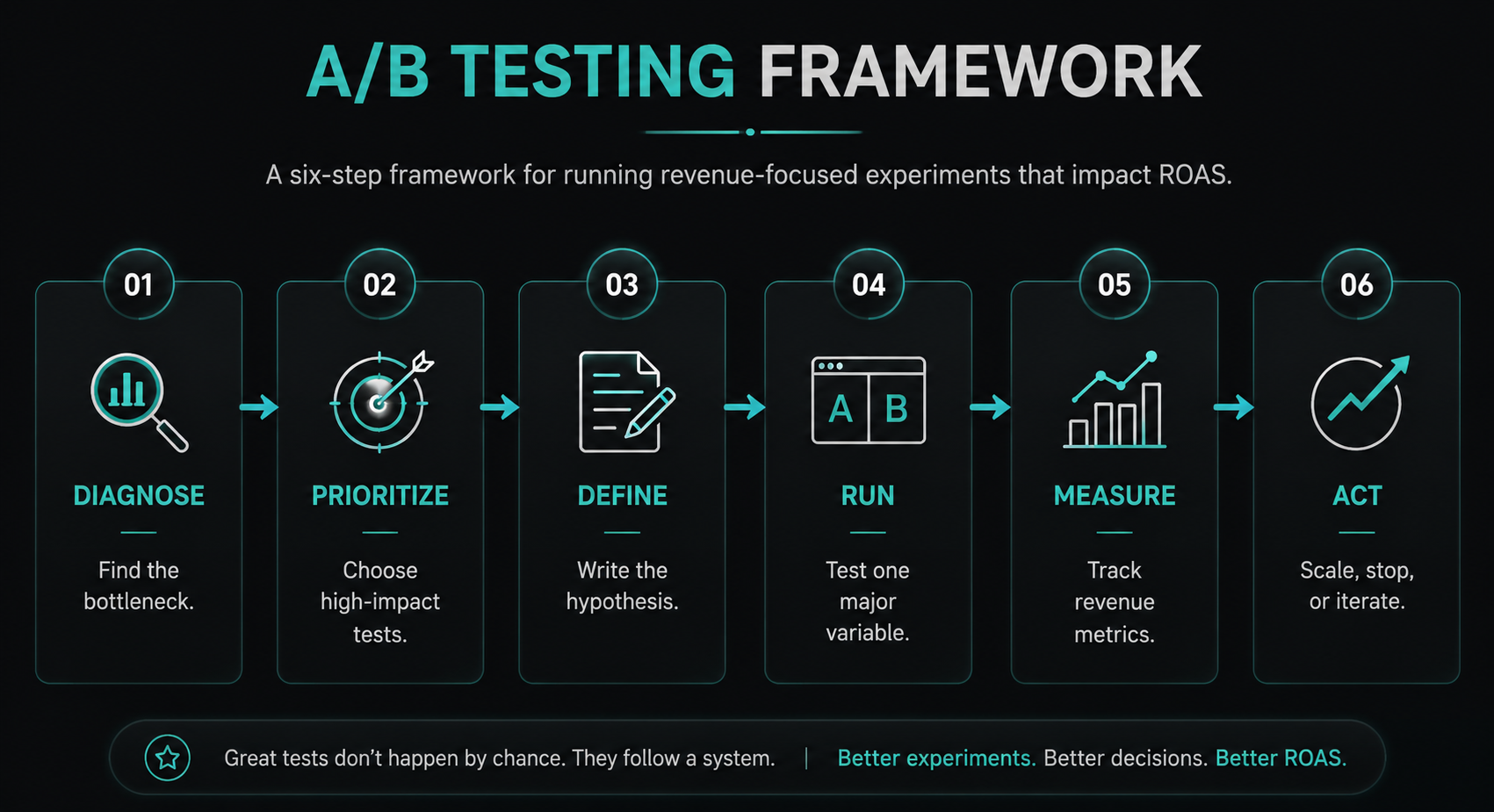
We use a six-step testing process: diagnose, prioritize, define, run, measure, and act.
This structure keeps the team focused on business impact instead of random activity.
Every test should begin with a real performance problem.
A drop in ROAS is not enough information by itself. We need to understand why ROAS dropped. The reason could be higher CPM, weaker CTR, lower landing page conversion rate, poor offer clarity, lower AOV, checkout abandonment, or weaker retention.
Once the bottleneck is clear, the test becomes sharper.
For example, a fashion brand may notice strong ad engagement but weak product page conversion. In that case, the next test should not be another ad creative. The better test may be product image hierarchy, size guide placement, product description clarity, or social proof.
A skincare brand may see strong add-to-cart activity but poor checkout completion. That points toward checkout optimization, shipping clarity, payment trust, or discount visibility.
This is where ecommerce decision intelligence becomes useful. Instead of checking Shopify, Meta Ads, Google Ads, GA4, and retention tools separately, teams need connected insight into what changed and what to test next.
Not every idea deserves to become a test.
Some ideas are easy but low impact. Others require more effort but can improve revenue meaningfully. A CTA testing idea may be simple, but a pricing test, offer test, or checkout optimization test may produce a stronger business outcome.
We prioritize tests using four factors: expected impact, confidence, effort, and risk.
Expected impact shows how much the test can influence revenue or ROAS. Confidence shows whether data supports the idea. Effort shows how difficult it is to launch. Risk shows whether the change could hurt margin, trust, or customer experience.
This is how a testing roadmap becomes practical. It tells the team what to test first, what to delay, and what not to test at all.
A weak test says, “Let’s test a new landing page.”
A useful test hypothesis says, “We believe adding customer reviews above the fold will increase product page conversion rate because first-time visitors need social proof before buying.”
That one sentence gives the test direction.
A good test hypothesis includes the change, the expected result, and the reason behind it. It connects experiment design with customer behavior.
For ecommerce brands, this is important because customers rarely leave only because the product is bad. They often leave because something is unclear. They may not understand the benefit, delivery timeline, return policy, sizing, ingredients, product use case, or offer value.
A strong hypothesis helps the team test the exact barrier.
Testing too many things at once creates confusion.
When a team changes the headline, image, CTA, offer, review placement, and layout together, the result may improve. But nobody knows what caused the improvement.
A clean split testing strategy needs one major variable.
For example, test the offer structure. Or test the hero message. Or test the checkout shipping note. Or test the creative hook.
There are cases where a larger redesign test makes sense, especially when a page is clearly weak. Even then, we prefer to document every major change so the learning can be reused later.
Every test should have a primary metric.
For ROAS optimization, the primary metric may be purchase ROAS, revenue per visitor, conversion rate, CAC, AOV, or contribution margin.
Secondary metrics can include CTR, CPC, add-to-cart rate, checkout start rate, purchase rate, bounce rate, scroll depth, and repeat purchase rate.
This keeps the team from celebrating the wrong win.
A creative that improves CTR but lowers purchase rate is not a real winner. A discount that increases orders but hurts profit margin needs deeper review. A landing page that improves conversion rate but lowers AOV may not support profitable growth.
Better testing looks at the full business impact.
Research Insight:
Baymard Institute’s cart and checkout research has tracked global cart abandonment for years and currently places average cart abandonment around 70%. For ecommerce teams, this makes checkout optimization a serious revenue opportunity, not a small UX task.
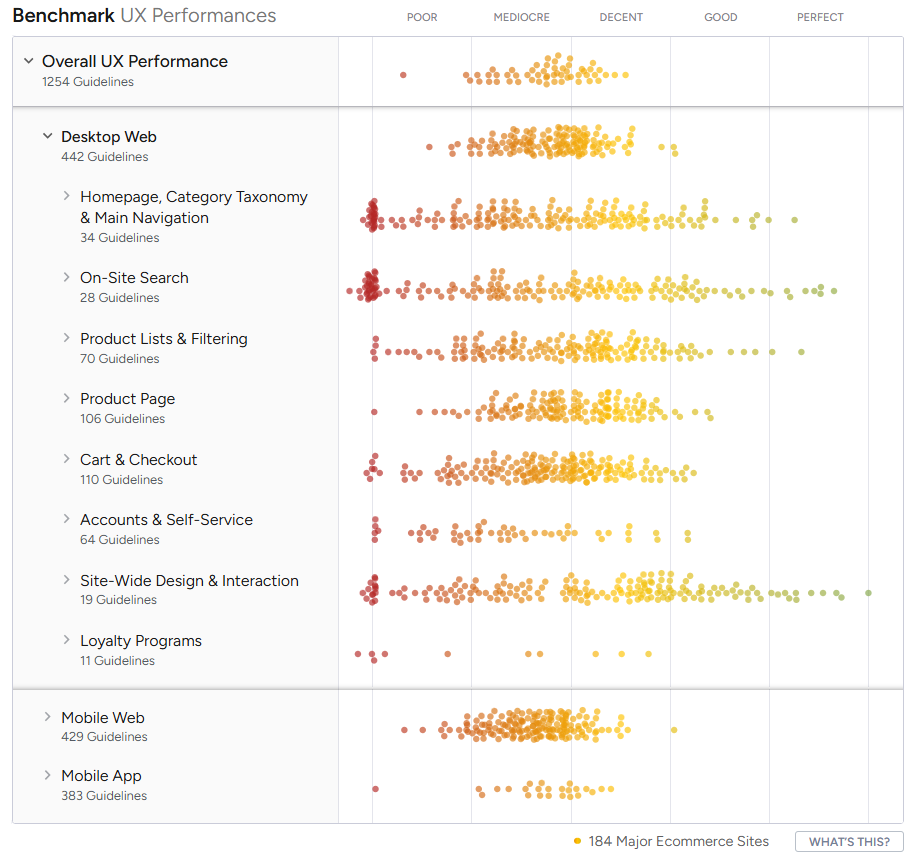
Reference: Baymard Institute
A test should not end with “winner” or “loser.”
It should end with a decision.
Scale it. Stop it. Segment it. Re-test it. Apply the learning to another campaign. Use the insight to build the next experiment.
For example, a UGC creative may work well for prospecting but fail in retargeting. A product page layout may improve mobile conversion but make no difference on desktop. A free shipping threshold may increase AOV but reduce margin.
The right action depends on the full result.
This is how a test-and-learn framework becomes useful. Each test should make the next decision better.
Area | Random Testing | Revenue-Focused A/B Testing Framework |
Starting Point | Opinions and ideas | Funnel diagnosis and business problem |
Main Goal | More clicks or conversions | Better ROAS, CAC, AOV, LTV, and margin |
Metrics | CTR, likes, engagement | Revenue, purchase rate, ROAS, CAC, CVR |
Test Design | Multiple changes together | One clear test variable |
Learning Quality | Often unclear | Actionable and repeatable |
Decision Output | Winner or loser | Scale, stop, segment, or re-test |
ROAS is influenced by the full journey. That is why we look at ads, landing pages, product pages, checkout, and retention together.
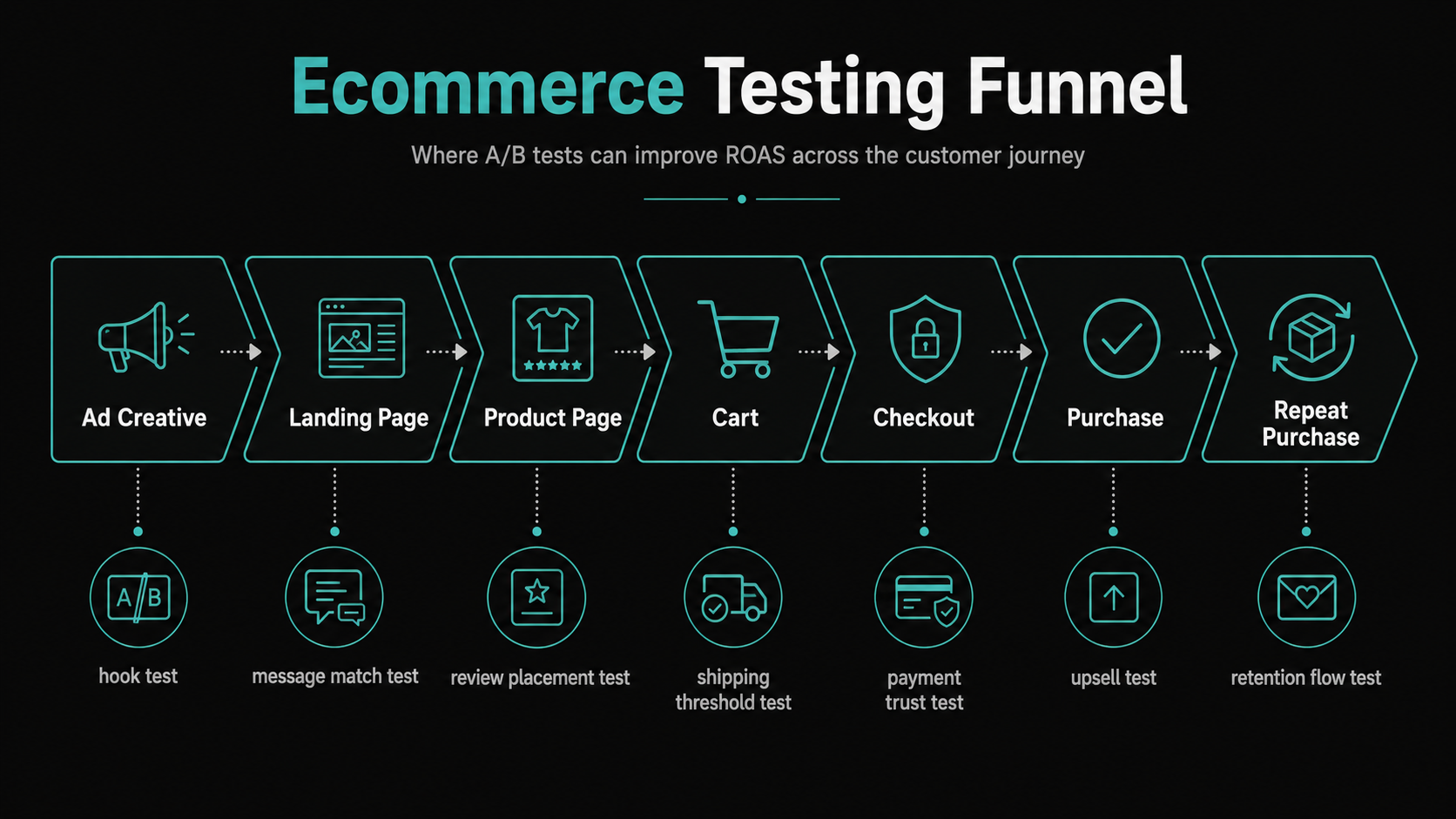
Creative testing is usually the fastest area to test because paid media teams can move quickly.
We test hooks, thumbnails, UGC formats, video openings, static layouts, carousel structures, primary text, headlines, and offer framing.
Still, CTR alone is never enough.
A curiosity-led hook may bring cheap traffic but weak buyers. A benefit-led hook may bring fewer clicks but stronger purchase intent. That is why an ad creative testing framework should always compare creative performance against ROAS, CAC, CVR, AOV, and customer quality.
Research Insight:
A 2025 research paper on Meta advertising experiments analyzed 181,890 A/B tests and 3,204 lift tests. The paper highlights that platform delivery algorithms can create audience imbalance in A/B tests, which means performance results may reflect both creative effect and algorithmic delivery behavior.
For performance marketers, this is a practical warning. Do not blindly assume one creative won only because the creative itself was better. Audience delivery may also influence the result.
Landing pages decide whether paid traffic becomes revenue.
A landing page A/B testing plan may focus on the hero message, offer clarity, social proof, review placement, comparison table, FAQ section, page speed, CTA hierarchy, and mobile readability.
Message matches are especially important. When an ad promises one thing and the landing page explains something else, buyers lose confidence.
For example, an ad may say “high-protein snacks for busy professionals,” but the landing page may open with a generic brand story. Testing a more direct landing page can improve both conversion rate optimization and ROAS optimization.
Product page testing matters because it sits close to the buying decision.
A product page should answer the buyer’s doubts before they become objections. We test product images, product descriptions, benefit hierarchy, reviews, trust badges, shipping messages, size guides, bundles, FAQs, and product comparison content.
For a skincare brand, ingredient clarity may improve trust. For a fashion brand, size guidance may reduce hesitation. For a supplement brand, usage instructions may increase confidence.
The best product pages do more than describe the item. They help the customer decide.
Checkout optimization is one of the most direct ways to improve ROAS because the customer is already close to buying.
Unexpected shipping costs, unclear delivery timelines, long forms, payment friction, or missing trust signals can reduce purchase completion.
Instead of only adding more traffic, brands should test the checkout experience. Better shipping clarity, guest checkout, payment options, trust messages, and discount code behavior can reduce leakage near the final step.
ROAS should not be measured only on the first purchase.
Some campaigns bring customers who repeat. Others bring one-time buyers who never return. That difference matters for profitability.
Retention testing can include post-purchase flows, WhatsApp journeys, email timing, loyalty offers, replenishment reminders, bundles, and product education.
This is where CAC vs LTV analysis for D2C profitability becomes important. A test may look average on first-order ROAS but valuable when repeat purchase behavior is included.
Statistical significance in A/B testing helps us avoid false winners.
A test may look like it is winning after one day. That result may simply be noise. Traffic quality, weekday behavior, seasonality, audience mix, sample size, and campaign delivery can all change the result.
Reliable tests need enough traffic, enough conversions, a clear confidence level, stable test duration, and a decision rule.
Smaller ecommerce websites should be careful with tiny tests. A button color test may need a very large sample to show a meaningful difference. Bigger tests, such as offer structure, landing page message, product page clarity, or checkout trust, usually create stronger signals.
Research Insight:
A 2023 systematic literature review analyzed 141 primary A/B testing studies and found that A/B tests are widely used for data-driven decision-making, with common targets including algorithms and visual elements. The review also highlights the need to strengthen statistical methods and improve testing processes.
This supports a simple point: A/B testing is useful, but only when the process is disciplined.
A/B tests are not free. Every test uses traffic, time, ad spend, and team attention. Poorly designed tests waste all four.
Research Insight:
A 2024 paper on variance reduction in online experiments notes that A/B tests can be expensive because some traffic is assigned to an inferior variant. In a large-scale short-video platform study, the authors found they could improve A/B test confidence in 77% of cases or retain the same confidence with 30% fewer data points using variance reduction methods. [S7]
Ecommerce teams do not need to apply advanced statistical methods from day one. But they should understand the principle: better test design improves learning efficiency.
A growth team launches a new Meta Ads creative. CTR improves. CPC drops. Everyone feels the ad is working.
Then revenue tells a different story.
ROAS drops because the new creative brings low-intent traffic. The hook attracts curiosity but not buyers.
In this case, we would not call the creative a winner. We would compare downstream metrics such as landing page conversion rate, add-to-cart rate, purchase rate, CAC, and AOV.
The next test may focus on message matches. Instead of changing the creative again, the team may test whether the landing page should reflect the exact promise made in the ad.
A Shopify store gets strong paid traffic, but product page conversion remains low.
More ad spend will not fix this problem.
The better move is to study the page. Are the product benefits clear? Are reviews visible? Is the delivery promise easy to find? Does the product description answer buyer objections? Are images strong enough? Does the mobile layout support fast decisions?
The test may move reviews above the fold, rewrite product copy around benefits, or add a comparison table.
This is product page testing with a direct link to ROAS improvement.
Strong ROAS does not always mean strong profitability.
A campaign may show good ROAS because it uses heavy discounts. Once margin is included, the campaign may become less attractive.
That is why we look beyond ROAS. CAC, AOV, contribution margin, LTV, retention, and repeat purchase rate matter too.
For founders and revenue leaders, this changes the way tests are judged. A campaign that looks average on first purchase may be valuable if it brings high-LTV customers. Another campaign may look strong on first-order ROAS but weak once margin and retention are included.
Many ecommerce teams already have dashboards.
They check Shopify, Meta Ads, Google Ads, TikTok Ads, Google Analytics 4, Looker Studio, Klaviyo, Hotjar, Microsoft Clarity, Triple Whale, and Northbeam.
The issue is not access to numbers.
The issue is deciding what to do next.
That is why we built NetSights AI Scaleboard as an ecommerce decision intelligence layer. Our goal is to help teams understand what changed, why it matters, and which action needs attention.
With iSight revenue intelligence, teams can understand KPI movement more clearly. With Netification KPI alerts, they can receive performance and cost-of-inaction alerts. With Netty WhatsApp AI Copilot, teams can ask ecommerce performance questions through WhatsApp instead of jumping across dashboards.
For teams comparing dashboards with decision intelligence, this Scaleboard difference guide explains why static dashboards are often not enough for ecommerce growth.
A marketing test plan should be simple enough to use every week and structured enough to create reliable decisions.
Test Element | Example |
Business Problem | ROAS dropped in Meta prospecting campaigns |
Hypothesis | Stronger product proof will improve buyer confidence |
Control | Current landing page hero |
Variant | Hero with reviews, benefits, and guarantee |
Primary Metric | Purchase conversion rate |
Secondary Metrics | ROAS, CAC, AOV, add-to-cart rate |
Decision Rule | Scale if CVR and ROAS improve without CAC increase |
Next Step | Apply the learning to product pages and ad copy |
This structure turns performance testing into a repeatable growth system.
Testing without a hypothesis is one of the fastest ways to waste time. The team may get a result, but the learning will be weak.
Another common mistake is measuring only clicks. CTR matters, but revenue matters more. A campaign that attracts clicks without purchases does not support profitable growth.
Changing too many variables creates another problem. A test can show a winner, but the team may not know what caused the result.
Audience quality is also easy to ignore. A creative may bring more visitors but worse buyers.
Stopping tests too early creates false confidence. A few early conversions do not always represent a reliable winner.
Poor documentation creates long-term waste. Without proper notes, the team repeats old tests and loses useful learning.
A strong A/B testing framework avoids these mistakes by making every experiment intentional.
A/B testing is not about running more experiments. It is about running better experiments.
A strong A/B testing framework helps ecommerce teams move from random ideas to revenue-focused decisions. It connects paid ads testing, landing page A/B testing, creative testing, product page testing, checkout optimization, funnel optimization, customer journey testing, and ecommerce CRO into one clear system.
For D2C founders, performance marketers, growth teams, revenue leaders, and ecommerce agencies, the best tests are not the ones that create the biggest dashboard spike. The best tests are the ones that improve ROAS, reduce CAC, increase conversion rate, raise AOV, strengthen LTV, and support profitable growth.
https://app.netsights.ai/signup?utm_source=google&utm_medium=seo&utm_campaign=blog-a/b-testing-roas
At NetSights, we help ecommerce teams make testing more decision-led. With AI Scaleboard, iSight, Netification, Netty, WhatsApp insights, KPI alerts, cost-of-inaction alerts, and ecommerce decision intelligence, we help teams move from scattered performance data to clearer growth actions.
Start your free trial with NetSights and run tests that lead to better ecommerce decisions.
A: An A/B testing framework is a structured process for planning, running, measuring, and learning from experiments. It helps ecommerce teams compare a control and variant using metrics such as ROAS, CAC, conversion rate, AOV, LTV, and revenue.
A: A/B testing for ROAS works by testing changes that influence revenue efficiency. This can include ad creatives, landing pages, product pages, checkout flow, offers, pricing, and audience segments. The goal is to improve profitable revenue, not just clicks.
A: Ecommerce brands should test the biggest bottleneck first. Weak CTR may require creative testing. Strong traffic with poor conversion may require landing page or product page testing. High cart activity with low purchases may require checkout optimization.
A: An A/B test should run long enough to collect reliable data across normal buying patterns. The right duration depends on traffic, conversion volume, sample size, confidence level, and expected conversion uplift.
A: A/B tests fail when teams test random ideas, measure only clicks, change too many variables, stop too early, ignore audience quality, or fail to connect the test to a real business problem.
A: NetSights helps ecommerce teams connect ROAS, CAC, conversion rate, AOV, LTV, customer behavior, and product signals in one decision intelligence layer. This makes it easier to identify what to test, why it matters, and what action to take next.
We write about growth, retention, and the numbers that actually predict what happens next for D2C brands. Have a topic you'd like us to cover? Get in touch .
Your ecommerce store already contains the answers. Learn how AI ecommerce analytics helps founders ask business questions, understand what changed and why, and move from scattered data to clearer decisions.
Your ecommerce store already contains the answers. Learn how AI ecommerce analytics helps founders ask business questions, understand what changed and why, and move from scattered data to clearer decisions.
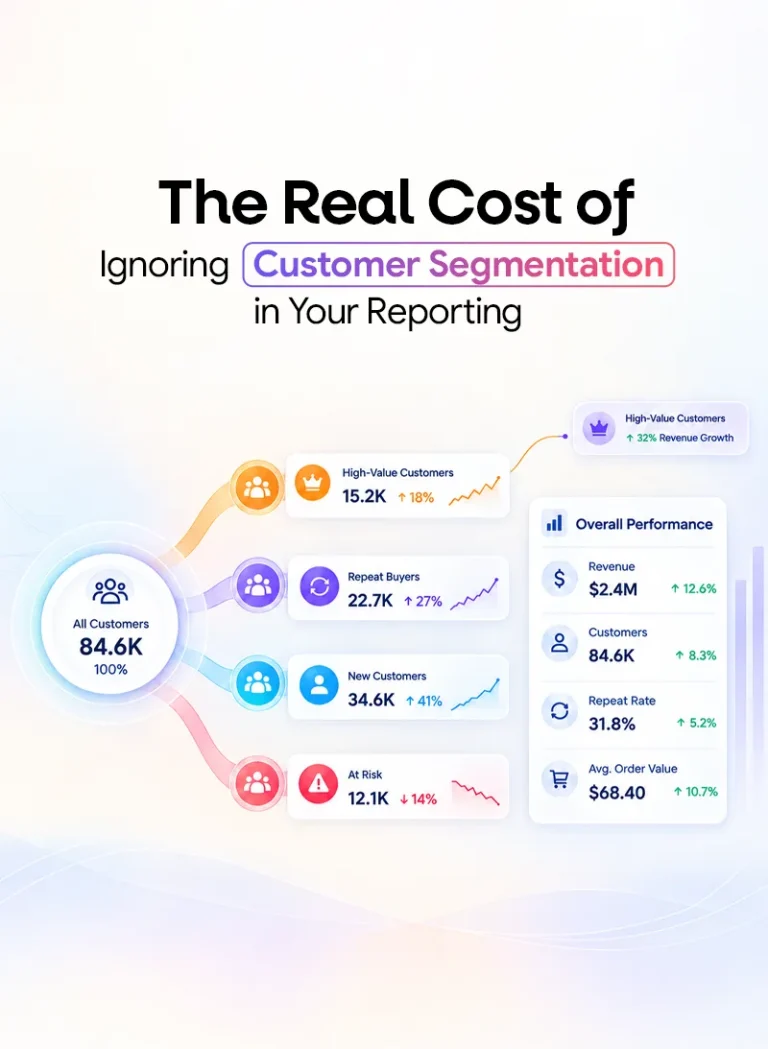
Compare Shopify conversion rate benchmarks by industry, device, traffic source, and customer type. See what a good conversion rate looks like in 2026 and learn how to benchmark your store more accurately.