
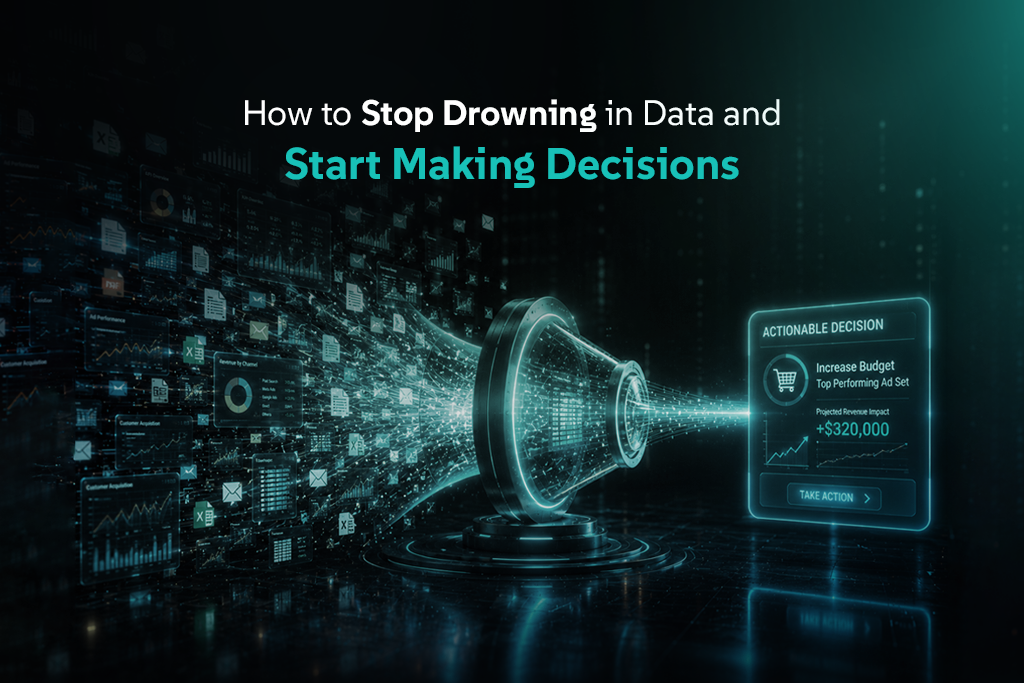
Most ecommerce teams are not short of data. They are surrounded by it.
Shopify shows revenue and orders. Meta Ads shows ROAS and campaign spend. Google Ads shows clicks, CPC, and conversions. GA4 shows website behaviour. CRM and WhatsApp marketing tools show customer journeys, retention, and repeat purchases. Finance sheets show margins, cash flow, and profitability.
On paper, this should make decision-making easier. In reality, it often does the opposite.
When every platform shows a different version of performance, founders and growth teams can quickly feel stuck. They know sales moved, CAC changed, ROAS dropped, or conversion rate shifted, but they still do not know which issue deserves action first.
This is where data-driven decision making needs to evolve.
Good data-driven decisions are not made by staring at more dashboards. They are made by connecting the right signals, understanding business context, and turning ecommerce analytics into decision-ready insights. For D2C brands, the goal is not just to collect data. The goal is to use that data to make faster, clearer, and more profitable online business decisions.
Many ecommerce brands assume that having more dashboards will automatically lead to better decisions. But in practice, more data often creates more confusion when the team does not know how to interpret it.
For example, a founder may see that revenue is down, but that single number does not explain the cause. The drop could be linked to lower traffic, weaker conversion rate, higher cart abandonment, reduced paid media efficiency, poor product availability, or lower repeat purchase behaviour.
This is why data-driven decision making should not stop at reporting. It should help teams understand the relationship between different metrics.
A revenue drop is not just a revenue problem. It may be a marketing problem, a product problem, a website problem, an inventory problem, or a retention problem. The value of decision intelligence is that it helps ecommerce teams connect these signals before taking action.
When data is interpreted in isolation, teams often react too quickly. When data is interpreted with context, teams make better decisions.
When teams are flooded with too many numbers, data overload results.
The founder begins her day with a look at Shopify revenue, Meta Ads ROAS, Google Ads metrics, GA4 sessions, customer retention, inventory risk, and product activity. Each one of those metrics may be correct in their respective platform, but the real issue remains: what happened? Why? And what’s next?
That’s why data overload causes delays in decision making.
One report could tell you that revenue is dropping. The next dashboard would show you that the traffic is steady. In yet another platform, you’d see your CAC increase. Also, you notice cart abandonment growing. You don’t know how they all relate to each other. So, you could spend hours searching for the source of the problem.
It paralyzes your analysis. You have data but lack direction.
Ecommerce founders will lose money due to the delay in identifying problems with conversions, increased acquisition costs, poor retention signals, or inventory issues.
Data-driven decision making does not mean making every decision only because a dashboard number changed. It means using data, context, and business judgement together.
In ecommerce, this means connecting performance across revenue, orders, AOV, CAC, ROAS, LTV, conversion rate, cart abandonment, repeat purchase rate, retention rate, churn rate, SKU performance, and inventory risk.
A brand may have strong revenue but poor profitability. It may have strong ROAS but rising blended CAC. It may have more traffic but weaker conversion. It may have good first purchases but poor repeat purchase behaviour.
Data-driven decisions become useful only when these metrics are interpreted together.
For example, if CAC is rising but LTV is also increasing, the business may still be healthy. But if CAC is rising while repeat purchase rate and retention are weak, the brand may be buying short-term revenue at the cost of long-term profitability.
This is where ecommerce decision intelligence becomes important. It helps teams move beyond reporting and into clearer business interpretation. For a deeper explanation of this concept, the guide on ecommerce decision intelligence explains how connected insights help ecommerce teams make better decisions.
To stop drowning in data, ecommerce teams need a repeatable decision framework. The goal is to move from raw numbers to clear action.
A practical framework has four stages: signal, context, impact, and action.
|
Stage |
What It Means |
Example |
|
Signal |
A metric has changed |
Revenue is down by 12% |
|
Context |
Related metrics explain the change |
Conversion rate is down and cart abandonment is up |
|
Impact |
The business understands the risk |
Lower conversion may affect daily revenue and paid media efficiency |
|
Action |
The team decides what to fix first |
Review checkout flow, product page trust factors, and active campaigns |
This framework helps teams avoid random reactions. Instead of immediately reducing ad spend because ROAS dropped, the team first checks whether the issue is connected to traffic quality, website experience, offer strength, product availability, or customer behaviour.
This is how data-driven decisions become more practical. The team does not simply ask, “What changed?” It asks, “What does this change mean for the business, and what should we do first?”
Ecommerce analytics is valuable. It helps teams understand what is happening across store performance, customer behaviour, marketing campaigns, and sales.
Shopify’s analytics and reports help merchants review store activity, visitors, web performance, and transactions through reporting tools. Shopify Analytics is useful for store-level visibility, especially when teams need to understand sales, products, and customer behaviour.
Google Analytics also supports ecommerce measurement by helping businesses track how customers interact with an online store, including product views, cart actions, and purchases. Google Analytics ecommerce measurement is important for understanding user journeys and website behaviour.
But analytics alone does not always tell the team what to do next.
That is the difference between ecommerce analytics and decision-ready insights.
|
Area |
Ecommerce Analytics |
Decision-Ready Insights |
|
Purpose |
Shows what happened |
Helps explain what should be done next |
|
Output |
Dashboards, reports, charts, and metrics |
Context, alerts, recommendations, and priorities |
|
User Effort |
Team interprets data manually |
Insights highlight what needs attention |
|
Best Use |
Monitoring performance |
Acting on performance changes |
The goal is not to remove analytics. The goal is to make analytics easier to act on.
Ready to move beyond static ecommerce reports?
Start your free trial with NetSights and see how decision-ready insights can help your team make faster, clearer growth decisions.
Dashboard fatigue is one of the biggest reasons ecommerce teams struggle to make fast decisions.
The team may already have access to ecommerce dashboards, CRM reports, marketing dashboards, GA4 reports, product reports, and finance trackers. But when these tools do not speak to each other, the founder has to connect the dots manually.
This is where scattered data becomes a business problem.
A performance marketer may see low ROAS and assume the campaign is weak. But the real issue may be a conversion rate drop on the website. A retention marketer may see lower repeat purchases, but the root cause may be poor delivery experience or product dissatisfaction. A founder may see revenue growth and assume the brand is healthy, while blended CAC and margins may be moving in the wrong direction.
In each case, the data exists. The problem is that it is disconnected.
That is why modern D2C brands need connected ecommerce analytics, business intelligence, and decision intelligence working together. The comparison between static dashboards and a Scaleboard approach is explained further in the blog on NetSights vs ecommerce dashboards and Scaleboard difference.
One of the biggest challenges for ecommerce teams is that different platforms often show different versions of performance.
Meta Ads may report strong ROAS. Google Ads may show rising CPC. Shopify may show flat revenue. GA4 may show lower engaged sessions. A CRM may show weak repeat purchases. None of these platforms is necessarily wrong, but each one is showing performance from its own perspective.
This is where founders need to avoid making decisions based on one dashboard alone.
A better approach is to separate platform-level metrics from business-level metrics. Platform-level metrics help teams understand channel performance. Business-level metrics help founders understand overall growth and profitability.
For example, Meta Ads ROAS may help a marketer optimise campaigns, but blended CAC helps leadership understand the true cost of acquiring customers across all channels. Similarly, GA4 conversion data may help diagnose website behaviour, but Shopify revenue and margin data show the actual business outcome.
When dashboards tell different stories, the team should not ask, “Which dashboard is right?” The better question is, “What part of the customer journey is each dashboard showing?”
This mindset helps teams move away from reporting debates and toward better business decisions.
It all starts with ceasing to see each indicator as equally relevant.
Founders don’t have to jump at every little fluctuation on every dashboard. The true challenge lies in understanding which metrics really matter for the business right now.
A revenue decrease doesn’t necessarily mean that ads are responsible. Traffic, conversion rate, AOV, SKU availability, cart abandonment, and repeat purchase numbers must all be looked at.
A decrease in ROAS shouldn’t be limited to looking at the situation with Meta Ads or Google Ads. Landing pages, products, creatives, offers, and customer behavior at checkout must also be assessed.
An increasing CAC doesn’t mean anything without tying it into lifetime value, blended CAC, conversion rate, retention period, and payback period. While a higher CAC isn’t bad if customers are becoming more valuable, it will eventually backfire as an expense and failure to retain customers.
That is when data analysis becomes useful. Instead of focusing on the numbers, the company looks at their connection.
Not every metric should be reviewed alone. Ecommerce performance is connected, so the most useful decisions come from comparing related metrics.
ROAS should be reviewed with CAC, conversion rate, AOV, and contribution margin. A campaign may show good ROAS, but if discounts are high or repeat purchase rate is weak, the business may still not be growing profitably.
Similarly, revenue should be reviewed with orders, traffic, conversion rate, AOV, product availability, and returning customer contribution. A revenue drop may not be caused by fewer visitors. It may be caused by weaker checkout performance or low stock for a best-selling SKU.
|
If This Metric Changes |
Also Check |
Why It Matters |
|
Revenue |
Orders, AOV, conversion rate, traffic, SKU availability |
Helps identify whether the issue is demand, pricing, conversion, or inventory |
|
ROAS |
CAC, CPC, CTR, CVR, landing page performance |
Helps understand whether the problem is ads or website conversion |
|
CAC |
LTV, repeat purchase rate, retention rate, blended CAC |
Shows whether acquisition cost is justified by customer value |
|
Conversion Rate |
Traffic quality, product page experience, checkout flow |
Helps identify whether visitors are becoming buyers efficiently |
|
Cart Abandonment |
Shipping cost, payment issues, checkout UX, trust signals |
Helps find friction before purchase |
|
Repeat Purchase Rate |
Customer experience, product quality, retention campaigns |
Shows whether customers are coming back after the first order |
|
Inventory Risk |
SKU velocity, ad spend, revenue contribution |
Helps avoid promoting products that may go out of stock |
This type of connected analysis is what separates basic ecommerce analytics from decision intelligence.
Imagine a D2C brand starts Monday morning with these performance signals:
|
Metric |
Change |
|
Revenue |
Down 13% |
|
ROAS |
Down 16% |
|
CAC |
Up 11% |
|
Conversion Rate |
Down from 2.5% to 2.0% |
|
Cart Abandonment |
Up 8% |
|
Top SKU Stock |
Running low |
A dashboard-heavy team may look at ROAS first and reduce ad spend. That may control wasted spend, but it may not solve the real problem.
A decision-led team looks at the relationship between the metrics.
Revenue is down, but conversion rate is also down. Cart abandonment is up, and a top SKU is running low. This suggests that the issue may not be only campaign performance. The team may need to check product availability, landing page messaging, checkout friction, and traffic quality before making budget decisions.
This is what better business decision-making looks like. The team does not just ask, “Which number changed?” It asks, “Which issue is causing the biggest business impact?”
Want to know which ecommerce issue needs attention first?
Try NetSights for free and turn scattered data from sales, ads, customers, and operations into clearer next steps.
Suppose a D2C brand sees revenue drop by 15% in one day. A basic reporting approach may treat this as a sales problem. A stronger decision-making approach looks deeper.
The founder should first check whether traffic dropped. If traffic is down, the issue may be linked to paid media, SEO, campaign delivery, or channel performance. If traffic is stable but conversion rate is down, the issue may be linked to product pages, pricing, trust signals, checkout flow, or offer quality.
If both traffic and conversion are stable, the founder should check AOV and product mix. A lower AOV may mean customers are buying cheaper products, fewer bundles, or discounted items. If AOV is stable but orders are down, the issue may be linked to product availability, payment failures, or purchase friction.
If new customer revenue is down but returning customer revenue is stable, the issue may be acquisition-led. If returning customer revenue is down, the issue may be retention-led.
This is the kind of thinking that turns data into decisions. The founder is not reacting to a single metric. They are following the signal until the most likely business cause becomes clear.
AI-powered insights can help ecommerce teams detect patterns faster than manual reporting.
This does not mean AI replaces founder judgement. It means AI can help organise signals, identify anomalies, highlight risks, and surface priorities that may otherwise be missed.
For example, AI can help flag unusual revenue drops, rising CAC, sudden ROAS changes, inventory risk, declining conversion rate, or customer retention issues. It can also help connect these changes across platforms so teams are not left interpreting every dashboard separately.
McKinsey has written about AI-driven decisioning and personalised customer interactions, noting that AI can support decision-making across use cases such as acquisition and recommendations when integrated data improves over time. McKinsey’s article on AI-powered next best experience supports the broader shift toward AI-assisted decisioning.
For ecommerce businesses, the same principle applies internally. Better decisions come from better-connected data, not just more reports.
To make data useful, ecommerce teams need to design reporting around decisions, not just metrics.
A decision-first reporting system starts with the questions founders actually need answered. These questions include what changed yesterday, why it changed, which metric had the biggest business impact, whether the movement is temporary or part of a trend, which team needs to act, and what should be checked before budget, inventory, or retention decisions are made.
Once these questions are clear, the reporting system becomes more useful. Instead of showing every possible metric, it highlights the signals that matter most.
For a D2C brand, this may mean creating separate views for acquisition, conversion, retention, product performance, and profitability. Acquisition should connect CAC, ROAS, CPC, CTR, CVR, and blended CAC. Conversion should connect traffic, product page performance, checkout behaviour, and cart abandonment. Retention should connect repeat purchase rate, churn, LTV, customer segments, and CRM performance. Profitability should connect revenue, AOV, gross margin, contribution margin, and customer payback.
This structure gives teams a clearer way to act on data.
The goal is not to build a larger dashboard. The goal is to build a decision system that helps the team know what needs attention first.
For many ecommerce teams, the challenge is not knowing that data matters. The challenge is connecting data across Shopify, Meta Ads, Google Ads, GA4, CRM, WhatsApp marketing, customer retention, and finance without losing business context.
NetSights AI Scaleboard is built for this gap. It helps ecommerce founders and growth teams move from scattered reports to connected ecommerce performance intelligence.
Instead of making teams interpret every number manually, NetSights helps surface decision-ready insights across revenue, marketing, product, customer, and operational signals. This supports clearer data-driven decisions because teams can understand what changed, why it matters, and what may need action.
For founders who want to understand how an AI-led operating layer supports ecommerce growth, the blog on AI Scaleboard for ecommerce founders provides useful context.
iSight AI revenue intelligence helps teams analyse revenue movement, risks, and performance signals. This is useful when founders need to understand whether changes in CAC, ROAS, LTV, conversion rate, retention, or SKU performance are affecting growth.
Netification KPI alerts help teams act sooner when important ecommerce metrics move unexpectedly. If revenue drops, ROAS falls, CAC rises, or inventory risk increases, alerts can reduce the delay between noticing a problem and responding to it.
Netty WhatsApp AI Copilot makes ecommerce insights easier to access through a conversational interface. Instead of switching between dashboards, teams can ask business questions and get clearer context from their data.
This combination helps reduce dashboard fatigue and makes ecommerce decision-making faster, more connected, and easier to act on.
Not all growth is healthy growth.
A brand can increase revenue and still weaken profitability if CAC rises, discounts increase, AOV drops, or customers fail to return. That is why ecommerce teams need to connect growth metrics with profitability signals.
For example, CAC and LTV should be read together. If customer acquisition cost is rising but lifetime value is improving, the business may still be moving in the right direction. If CAC is rising while repeat purchase rate and retention are weak, the brand may be building fragile growth.
The detailed relationship between acquisition cost and customer value is covered in the blog on CAC vs LTV for D2C brand profitability.
The broader point is simple: ecommerce teams need fewer isolated metrics and more connected context.
Data-driven decision making is not about tracking every number. It is about knowing which numbers matter together.
Early-stage ecommerce brands can often manage with simple reporting because the business has fewer SKUs, fewer channels, and fewer teams. But as the brand grows, every decision becomes more connected.
Ad spend affects acquisition cost. Acquisition quality affects retention. Retention affects LTV. LTV affects how much the brand can afford to spend on ads. Inventory affects which campaigns should be scaled. Product performance affects revenue, margin, and customer loyalty.
This is why decision intelligence becomes more valuable as the business scales.
Without it, teams may optimise their own metrics without seeing the wider business impact. A marketing team may chase cheaper clicks. A retention team may push discounts. An operations team may focus only on fulfilment. A founder may look only at revenue.
But profitable growth requires all of these signals to be connected.
Decision intelligence helps ecommerce teams see performance as a system. It gives founders a clearer way to understand how marketing, sales, customers, products, and operations influence each other.
A small ecommerce store may be able to manage with basic dashboards. But as the business grows, decision-making becomes more complex.
A brand usually needs decision intelligence when paid media spend increases, SKUs grow, reporting slows down, teams depend on multiple dashboards, and founders still struggle to identify what needs action first.
It is also a strong signal when team meetings are spent debating whose numbers are correct instead of deciding what to fix.
At that stage, the problem is no longer access to data. The problem is lack of data clarity.
Decision intelligence helps ecommerce teams build a more reliable decision flow. It connects signals across platforms, highlights what deserves attention, and supports faster action.
Ready to move from scattered reports to clearer growth decisions?
Start your free trial with NetSights and see how connected ecommerce insights can support your team.
A founder may see that revenue is down and CAC is up. Without connected context, the reaction may be to reduce ad spend. With decision-ready insights, the founder can also check conversion rate, cart abandonment, product availability, and retention before acting.
This creates a better decision because it looks at the business as a system, not as separate reports.
A growth team may notice rising CPC in Google Ads and falling ROAS in Meta Ads. A dashboard shows both numbers, but decision intelligence helps connect them with traffic quality, landing page performance, AOV, and conversion rate.
This helps the team decide whether the issue is media efficiency, website experience, or offer quality.
A retention team may see that repeat purchase rate is falling. Instead of simply sending more discounts, decision intelligence can help identify which customer segments are dropping off, which product categories create repeat behaviour, and where WhatsApp or CRM journeys may improve retention.
Agencies often manage several D2C brands at once. Reports show performance, but clients need recommendations. Decision intelligence helps agencies move beyond reporting and provide clearer insights on revenue leakage, CAC, ROAS, LTV, retention, and campaign optimisation.
Data is only valuable when it helps teams make better decisions.
For ecommerce founders, D2C brands, growth teams, performance marketers, and agencies, the goal is not to check more dashboards. The goal is to understand what changed, why it matters, and what action should come next.
That is why data-driven decision making needs connected ecommerce analytics, business intelligence, AI-powered insights, and decision-ready context. When revenue, ROAS, CAC, LTV, conversion rate, retention, and inventory signals work together, teams can make smarter ecommerce decisions with more confidence.
NetSights helps ecommerce teams move beyond data overload and dashboard fatigue. With its AI Scaleboard, iSight, Netification, Netty, real-time alerts, intelligence cards, and connected performance intelligence, it helps teams turn scattered ecommerce data into clearer growth decisions.
If your team is ready to stop drowning in data and start making faster online business decisions, start your free trial with NetSights.
A: Data-driven decision making in ecommerce means using connected data from sales, ads, customers, products, and operations to guide business decisions. It is not just about reading dashboards. It is about understanding what the data means and what action should follow.
A: Ecommerce brands feel overwhelmed because data is spread across Shopify, Meta Ads, Google Ads, GA4, CRM tools, retention platforms, and finance sheets. When these systems are disconnected, teams may have many reports but little clarity.
A: Teams can turn data into decisions by connecting related metrics, identifying business impact, and prioritising what needs action first. For example, revenue changes should be reviewed with traffic, conversion rate, CAC, ROAS, inventory, and customer retention.
A: AI can help by detecting anomalies, identifying patterns, surfacing alerts, and connecting data across platforms. This helps teams move faster without manually checking every report.
A: Dashboard fatigue happens when teams check too many dashboards but still struggle to understand what action should be taken. It usually happens when ecommerce data is scattered across multiple tools.
A: Important metrics include revenue, orders, AOV, CAC, ROAS, LTV, conversion rate, cart abandonment, repeat purchase rate, retention rate, blended CAC, LTV:CAC ratio, SKU performance, and inventory risk.
We write about growth, retention, and the numbers that actually predict what happens next for D2C brands. Have a topic you'd like us to cover? Get in touch .
Your ecommerce store already contains the answers. Learn how AI ecommerce analytics helps founders ask business questions, understand what changed and why, and move from scattered data to clearer decisions.
Your ecommerce store already contains the answers. Learn how AI ecommerce analytics helps founders ask business questions, understand what changed and why, and move from scattered data to clearer decisions.
Your ecommerce store already contains the answers. Learn how AI ecommerce analytics helps founders ask business questions, understand what changed and why, and move from scattered data to clearer decisions.