
Every Monday, most ecommerce founders open their dashboards with the same set of questions.
How did we perform last week?
Did revenue grow?
Are ads getting more expensive?
Are customers coming back?
Is the business actually healthier, or did we just spend more to make more?
The problem is, the answers are rarely sitting in one place.
Shopify shows revenue and orders. Meta Ads and Google Ads show campaign performance. GA4 shows website behaviour. CRM, email, and WhatsApp tools show retention signals. Finance sheets show margins, cash flow, and profitability.
By the time a founder checks all of this, the real question often remains unanswered: what needs attention this week?
That is why a weekly business metrics review is so important.
For D2C brands, Monday is the right time to step back, review the most important weekly ecommerce metrics, and decide where the team should focus. The goal is not to track every number. The goal is to understand whether the business is growing, converting, retaining customers, and staying financially healthy.
A founder’s weekly check-in should not feel like another reporting task. It should give you clarity before the week begins.
In this blog, we will look at the five business metrics every ecommerce founder should review every Monday, and how each one can help turn ecommerce analytics into better decisions.
Every ecommerce company team reviews their data on a regular basis. They check revenue in Shopify. Spend is monitored in Meta Ads and Google Ads. Behavior is analyzed through GA4. Customer journey analysis happens through their CRM, Klaviyo, WhatsApp marketing, or email campaigns.
The issue here is not the lack of data. It’s the scattered nature of that data.
Founders may see that their revenue shifted, CAC went up, ROAS is down, or conversion rate fluctuated. However, even with these numbers, if there’s no weekly reporting process in place, it can still be hard for teams to understand which one needs attention first.
This is why the weekly Monday business review becomes relevant.
Effective weekly KPI analysis allows founders to get an insight into the current state of business affairs. It helps identify the difference between normal fluctuations and problems that need addressing. It also enables founders to prevent their teams from experiencing dashboard fatigue.
Weekly review of business metrics is especially important for ecommerce entrepreneurs due to the constantly changing nature of performance. Campaign fatigue, inventory level shift, and even reduced margins after a discount are among things that can happen on a regular basis. Moreover, weekly CAC can impact
Daily dashboards are useful for monitoring. Weekly ecommerce metrics are useful for decision-making.
A daily dashboard may show what happened yesterday. A weekly review helps founders understand whether performance is moving in the right direction over a meaningful period.
For example, one bad sales day may not require major action. But a full week of declining conversion rate, rising CAC, and weaker repeat purchases deserves attention.
|
Area |
Daily Dashboard Check |
Weekly Business Metrics Review |
|
Purpose |
Monitor short-term movement |
Understand business direction |
|
Timeframe |
Yesterday or today |
Last 7 days |
|
Best For |
Spotting urgent issues |
Planning actions for the week |
|
Focus |
What changed |
Why it changed and what to do |
|
User |
Marketing, operations, founders |
Founder, growth, retention, finance teams |
This is why a founder dashboard should not only show numbers. It should help translate numbers into priorities.
For a deeper look at why dashboards alone are often not enough, this guide on NetSights vs ecommerce dashboards and Scaleboard difference explains how ecommerce teams can move from static reporting to decision-ready insights.
A founder does not need to review 30 numbers every Monday. That creates data overload and slows decision-making.
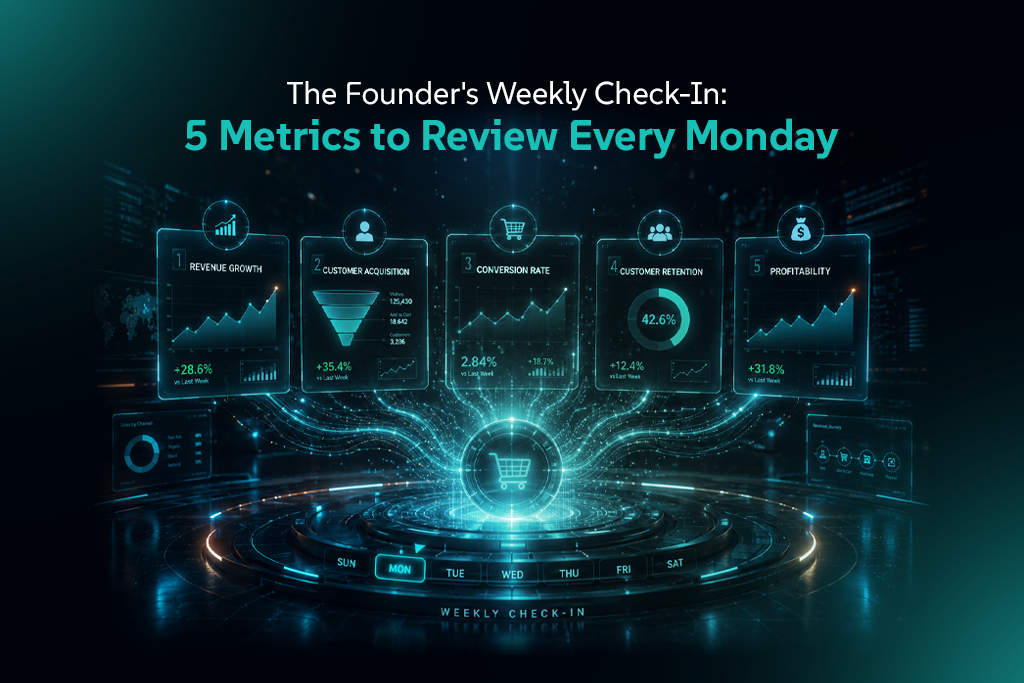
Instead, the weekly check-in should focus on five metric groups that show the health of the business:
Together, these metrics give founders a clear view of growth, efficiency, customer behaviour, and financial health.
Revenue is usually the first number founders check, but weekly revenue alone does not tell the full story.
A brand can grow revenue because of stronger demand, better conversion, higher AOV, repeat customers, or more aggressive discounts. Each situation means something different.
That is why founders should review revenue quality, not just revenue volume.
During the Monday check-in, look at weekly revenue, orders, AOV, product mix, and gross margin. If revenue increased but AOV dropped, customers may be buying lower-value products. If revenue increased but gross margin fell, growth may be coming from discounts. If revenue dropped but AOV increased, fewer customers may be buying, but those who buy are spending more.
Shopify’s reporting tools allow merchants to review store activity, sales, customers, web performance, and transaction data. For ecommerce founders, this makes Shopify a useful starting point for weekly sales performance, but it should not be the only source of truth.
Ask whether revenue grew because the business became healthier or because the brand pushed harder through offers, ads, or discounts.
A founder should not only ask, “Did we sell more?” The better question is, “Did we sell better?”
Revenue quality helps answer that.
Customer acquisition efficiency shows whether the brand is acquiring customers at a cost that makes sense.
The key metrics here are CAC, blended CAC, ROAS, CPC, CTR, conversion rate, and customer payback period.
ROAS is useful, especially for Meta Ads and Google Ads performance. Google Ads also provides Target ROAS bidding, which is designed to help advertisers optimise for conversion value based on a return on ad spend target. But platform ROAS should not be reviewed alone.
A campaign may show strong ROAS inside one ad platform, while the overall business still has rising blended CAC. That happens when acquisition costs increase across channels or when attribution makes one platform look better than the full business picture.
This is why ecommerce founders should review blended CAC every Monday. Blended CAC shows what the business is actually paying to acquire customers across channels, not just what one platform reports.
If CAC rises for one week, it may be manageable. If CAC rises for multiple weeks while LTV, repeat purchase rate, and gross margin stay weak, the business may be scaling inefficiently.
For a deeper view of acquisition cost and customer value, this blog on CAC vs LTV for D2C brand profitability explains why customer acquisition cost must be reviewed with lifetime value.
The key question is not only, “Is ROAS good?”
The better founder-level question is, “Are we acquiring customers at a cost the business can recover profitably?”
That is the difference between campaign reporting and business decision-making.
Conversion rate is among the top weekly ecommerce metrics since it links traffic quality with website efficiency.
While a brand may increase its advertising budget to bring more people to their shop, lower conversion rates will mean that all additional traffic will not be profitable for the business.
A weekly conversion rate analysis should consider website conversion rate, cart abandonment, check out process, product pages efficiency, payment issues, and traffic source quality.
Using GA4 ecommerce metrics can provide valuable insights about customer behaviour in the shopping process. This includes the analysis of product interactions, adding products to the cart, and purchases.
If the traffic level is stable while the conversion rate lowers, there might be a problem with the website.
It can be related to pricing, poor content, lack of trustworthy factors, confusing offers, bad customer experience, problems with check-out, and products’ absence.
If conversion rate stays the same, but revenue decreases, there may be an issue regarding the level of traffic, average order value, product mix, or returning clients.
A founder should ask, “Did we lose customers before checkout?”
Conversion rate helps identify whether the brand has a demand problem, a website problem, or a traffic quality problem.
A D2C brand cannot rely only on first-time purchases forever.
Customer retention, repeat purchase rate, LTV, churn rate, and NPS help founders understand whether customers are staying connected to the brand after the first order.
This is especially important for categories such as beauty, wellness, fashion, food, supplements, personal care, home products, and subscription-based ecommerce. If customers buy once and never return, paid acquisition becomes harder to sustain.
LTV shows how much value customers generate over time. Repeat purchase rate shows how often customers come back. Churn rate shows how many customers stop buying or cancel subscriptions. NPS helps founders understand customer satisfaction and loyalty.
For subscription-led brands, MRR may also be useful. It helps track predictable recurring revenue, especially when the brand operates with memberships, replenishment, subscription boxes, or loyalty plans.
A founder should review customer value and retention every Monday because these metrics show whether growth is becoming easier or harder over time.
If customer retention is improving, the brand may be building stronger customer relationships. If retention is weak, the team may need to improve product experience, post-purchase journeys, WhatsApp marketing, email automation, loyalty programmes, or winback campaigns.
The founder-level question is, “Are customers giving us more value after the first purchase?”
If the answer is no, the business may be too dependent on paid acquisition.
Revenue can look good while the business becomes less healthy.
That is why the Monday check-in should include profitability and operational risk. Founders should review gross margin, contribution margin, burn rate, cash flow, runway, inventory risk, and SKU performance.
Gross margin shows whether products are profitable after the cost of goods. Contribution margin gives a clearer view after variable costs such as discounts, shipping, fulfilment, and marketing. Burn rate and cash flow show how much money the business is using and whether growth is financially sustainable.
For funded startups or investor-backed ecommerce brands, this also connects to investor reporting. Founders may use a Notion dashboard, finance sheets, Ramp, Brex, or accounting tools to track spend, runway, and financial visibility. These tools can help, but the decision still depends on how the metrics are interpreted.
Inventory risk is also important. A top-selling SKU may be driving revenue, but if stock is running low, scaling ads can create fulfillment problems. On the other hand, slow-moving inventory can trap cash and reduce flexibility.
The key question is, “Are we growing in a way the business can afford?”
A founder should not only review what is sold. They should review what growth is costing.
Imagine a D2C brand opens its Monday dashboard and sees the following:
|
Metric |
Weekly Change |
|
Revenue |
Up 9% |
|
ROAS |
Down 12% |
|
Blended CAC |
Up 15% |
|
Conversion Rate |
Down from 2.8% to 2.3% |
|
Repeat Purchase Rate |
Flat |
|
Gross Margin |
Down 6% |
|
Top SKU Stock |
Low inventory risk |
At first glance, revenue is up. But the business may not be healthier.
ROAS is down, CAC is up, conversion rate is weaker, gross margin has dropped, and a top SKU is at risk. This suggests that revenue may have grown because of higher spend or discounting, not because the business became more efficient.
A founder reviewing these weekly ecommerce metrics would not only celebrate higher sales. They would ask what drove the revenue increase, whether acquisition is becoming too expensive, whether conversion friction is increasing, and whether inventory can support another week of demand.
This is how a Monday business review turns data into decisions.
Founders and marketers often look at different versions of performance.
A marketer may focus on campaign ROAS, CTR, CPC, CPA, and creative performance. These are important, but they do not always explain business health.
A founder needs a wider view. The founder must connect marketing performance with revenue, margin, retention, cash flow, inventory, and customer value.
|
Marketing Metrics |
Founder-Level Business Metrics |
|
ROAS |
Blended CAC |
|
CPC |
Customer payback period |
|
CTR |
Revenue quality |
|
CPA |
Gross margin |
|
Campaign conversion |
Store conversion rate |
|
Ad spend |
Burn rate and cash flow |
|
Retargeting performance |
Repeat purchase rate and LTV |
This does not mean marketing metrics are less important. It means they should be reviewed inside a wider business context.
A weekly KPI review should help the founder understand what the business should do next, not just what each channel reported.
The weekly check-in becomes more useful when metrics are connected.
For example, CAC should be reviewed with LTV. ROAS should be reviewed with gross margin. Conversion rate should be reviewed with traffic quality and cart abandonment. Revenue should be reviewed with AOV, orders, product mix, and inventory.
This is the role of ecommerce decision intelligence.
Instead of making founders manually connect every dashboard, decision intelligence helps turn ecommerce analytics into decision-ready insights. It highlights what changed, why it matters, and what may need attention first.
For a deeper explanation of this approach, this blog on ecommerce decision intelligence explains how connected insights help ecommerce teams move beyond scattered reporting.
If your team is already feeling overloaded by reports, this guide on how to stop drowning in data and start making decisions explains how founders can reduce dashboard fatigue and focus on clearer business decisions.
The NetSights AI Scaleboard is designed for ecommerce founders and growth teams who want to go beyond dashboards and enable business intelligence.
Rather than looking at Shopify, Meta Ads, Google Ads, GA4, CRM, retention tools, financial reports, and custom dashboards separately, founders can use NetSights to connect performance signals.
This enables founders to look at weekly ecommerce metrics like revenue, CAC, ROAS, LTV, conversion rates, customer retention, inventory risks, and profitability with more context.
iSight AI revenue intelligence assists teams in determining revenue trends, growth risks, and performance signals. It helps founders determine the reason behind changes in weekly revenue whether it relates to acquisition, conversion, retention, or products.
Netification KPI alerts assist teams in acting quickly to changes in key business metrics. For example, an alert system can help founders reduce time to respond to changes in CAC, ROAS, conversion rates, and inventory risks.
Netty WhatsApp AI Copilot makes weekly business metrics easier to access through conversation. Instead of switching between dashboards, founders can ask business questions and get clearer context from their ecommerce data.
For a founder’s weekly check-in, this matters because the goal is not just to see numbers. The goal is to know what needs action.
Ready to make your Monday review easier?
Start your free trial with NetSights and turn weekly ecommerce metrics into clearer growth decisions.
A founder sees revenue up but gross margin down. Instead of celebrating topline growth, they review discounting, product mix, and contribution margin. This helps the team decide whether growth is actually profitable.
A growth team sees ROAS decline and CAC increase. Instead of cutting spend immediately, they review conversion rate, landing page performance, traffic quality, and AOV. This helps them understand whether the issue is media efficiency or website conversion.
A retention team sees flat repeat purchase rate and low NPS. Instead of sending another discount campaign, they review product feedback, post-purchase journeys, customer segments, and winback opportunities.
A founder preparing investor updates reviews weekly revenue, gross margin, burn rate, cash flow, CAC, LTV, churn rate, and customer retention. This creates a clearer picture of business health than revenue alone.
A founder’s weekly check-in should not be a long reporting ritual. It should be a practical decision-making habit.
The right weekly ecommerce metrics help founders understand whether the business is growing well, acquiring customers efficiently, converting traffic, retaining customers, and staying financially healthy.
Revenue, CAC, ROAS, LTV, conversion rate, customer retention, gross margin, burn rate, cash flow, and inventory risk all matter. But they matter most when they are reviewed together.
That is what turns a weekly business metrics review into a smarter business system.
NetSights helps ecommerce founders move beyond scattered dashboards and manual reporting. With its AI Scaleboard, iSight, Netification, Netty, intelligence cards, KPI alerts, and decision-ready insights, founders can make their Monday review clearer, faster, and more useful.
If you want to stop guessing what your weekly numbers mean, start your free trial with NetSights and turn your weekly ecommerce metrics into better business decisions.
A: Founders should review revenue quality, customer acquisition efficiency, conversion rate, customer value and retention, and profitability with inventory risk. These five areas give a clearer picture of ecommerce business health.
A: A Monday business review helps founders understand what happened last week and what needs attention this week. It creates a structured way to review ecommerce performance without getting lost in daily dashboard noise.
A: Important weekly ecommerce metrics include revenue, orders, AOV, CAC, ROAS, LTV, conversion rate, repeat purchase rate, customer retention, gross margin, blended CAC, contribution margin, inventory risk, and cash flow.
A: Daily reporting helps teams monitor short-term changes. A weekly KPI review helps founders understand business direction, identify trends, and decide what action should be taken.
A: Both matter, but CAC gives a more founder-level view when reviewed with LTV, margin, and customer payback period. ROAS is useful for campaign performance, while CAC helps assess acquisition efficiency across the business.
A: Founders can reduce dashboard fatigue by focusing on a small set of decision-ready metrics, connecting related signals, and using ecommerce decision intelligence instead of checking every platform separately.
We write about growth, retention, and the numbers that actually predict what happens next for D2C brands. Have a topic you'd like us to cover? Get in touch .
Your ecommerce store already contains the answers. Learn how AI ecommerce analytics helps founders ask business questions, understand what changed and why, and move from scattered data to clearer decisions.
Your ecommerce store already contains the answers. Learn how AI ecommerce analytics helps founders ask business questions, understand what changed and why, and move from scattered data to clearer decisions.

Your ecommerce store already contains the answers. Learn how AI ecommerce analytics helps founders ask business questions, understand what changed and why, and move from scattered data to clearer decisions.